Archive for September, 2012

cater to

September 17, 2012

From “A Changing Harlem Celebrates the Queen of Soul Food” by Kia Gregory, in the NYT on 7/21/12:

Joan Avila, a retired nurse who has lived in Harlem for 40 years and rents a room nearby, said she had been to Sylvia’s a few times in the past. “Tourists cater to it,” she said. “If you don’t know how to cook, you don’t know the difference.”

For me, the restaurant could cater to tourists, but not vice versa. Cater to here seems to mean something like ‘be attracted to’ — so we’re looking at a reversal in the roles associated with the subject and oblique object in argument structure. I’m not sure how widespread this new argument structure is, or how long it’s been around (this use of cater doesn’t seem to have been picked up in dictionaries).

(more…)

Urban areas

September 16, 2012

My posting on micropolitans, or micropolitan areas, touched on the more familiar technical term metropolitan area; both are defined by the U.S. Office of Management and Budget. Then I reflected on ordinary-language use for reference to urban areas. There are several alternatives, including semi-technical alternatives to X metropolitan area (in particular, Greater X). And sometimes they pile up.

(more…)

Cartoon diagramming

September 16, 2012

From Craig Campbell to Barbara Need on Facebook, this Mother Goose and Grimm of 4/22/02:

Sentence diagramming (in particular, a Reed-Kellogg diagram) in the comics.

(more…)

Avian Olympics

September 16, 2012

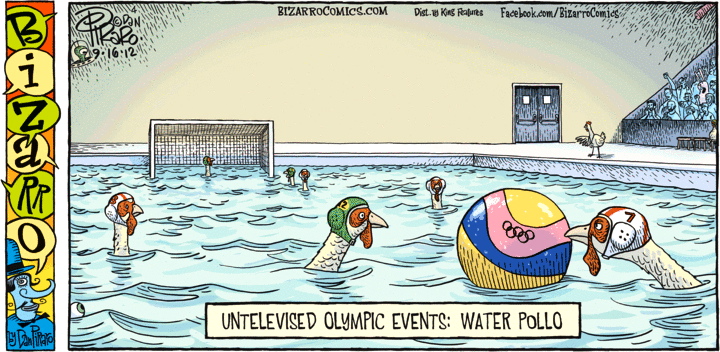
Today’s Bizarro, with a bilingual pun:

It works better orthographically — English L in POLO, Spanish LL in POLLO ‘chicken’ — while in pronunciation the words are somewhat more distant, with the English alveolar liquid [l] corresponding to the Spanish palatal glide [j] (for most speakers, though there is dialectal vaiation).

Name that healthcare marketplace

September 15, 2012

On the front page of today’s NYT: “California Tries to Guide the Way on Health Law” by Abby Goodnough, which begins:

SACRAMENTO — The meeting came to order, the five members of the California Health Benefit Exchange seated onstage with dozens of consumer advocates and others looking on. On the agenda: what to name the online marketplace where millions of residents will be able to shop for medical coverage under President Obama’s health care law.

An adviser presented the options, meant to be memorable, appealing and clear. What about CaliHealth? Or Healthifornia?

Or Avocado?

“I am kind of drawn to Avocado,” declared Kim Belshé, a member of the exchange’s board of directors, which is hustling to make dozens of decisions as the clock ticks toward deadlines set by the law.

The board is hoping that a catchy new name will help spread the word about the exchange, which few people are aware of. A naming decision should be out next month.

We’ll see.


Dream works

September 15, 2012

In a recent posting, I wrote about a vivid long-running dream I’d had,

a murder mystery (never solved) involving art shows in the San Francisco Bay Area, my neighbors in Cambridge MA 50 years ago, the Cape Cod National Seashore, and … Batavia NY. I’ve been having a lot of these dreams in recent weeks, mostly involving blog postings I “work on” in my sleep — on topics that turn out to be entirely illusory, though I can’t help checking the details out when I wake up.

Most of these dream postings are about the analysis of linguistic data, but they are mostly so complex that I can’t retrieve the point when I wake up. But there are some I made notes on, or rehearsed upon awakening.

(more…)

Moroni

September 15, 2012

In the August 16th New York Review of Books, a piece “The Moment of Moroni” by Sanford Schwarz, focusing on the 16th-century artist Giovanni Battista Moroni. Which of course reminded me of the Angel Moroni in the Book of Mormon, and the slur moron. They aren’t related.

(more…)

More Canadian raising

September 15, 2012

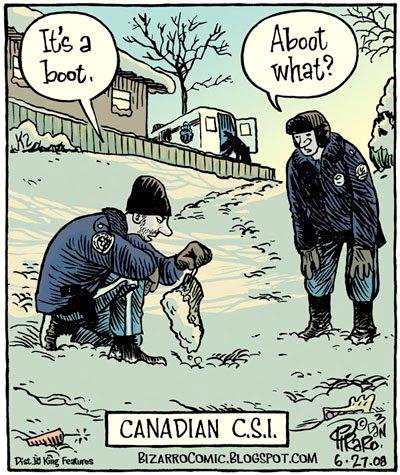
Passed on by Bert Vaux on Facebook, this Bizarro from 2008:

For a similar cartoon reflection on Canadian raising, see the Rhymes With Orange strip in my “Laundromat dialectology” posting. Bert went on to complain about the common American perception that Canadian raising results in something like aboot (rather than aboat):

For the life of me I can’t figure out how Americans came up with the idea that Canadians say [u:] for [aw]. Scots I could see (coo, etc.), but not Canadians.

The stereotype might in fact have been carried over from American perceptions of Scots English.


T-shirts

September 15, 2012

From Elizabeth Daingerfield Zwicky, a present this morning of a mammoth t-shirt (from Threadless):

The name of the shirt: Mammoths were Hippies. Great headband, man.

(more…)

Insult crimes

September 14, 2012

At the top of the news this week are the demonstrations and assaults in Libya, Cairo, and Yemen over an anti-Muslim film. There are several threads to this story, but one of them has to do with the making of the film as a perceived insult crime. From my Pussy Riot posting:

Pussy Riot’s offense was an “insult crime”, disrespecting some public figure, religion, or political entity. They managed to pull off a trifecta (in the eyes of the authorities), disrespecting Vladimir Putin, Christianity (in the form of the Russian Orthodox Church), and the Russian state. And as a result  inciting others to follow them in their disrespect. So of course they had to be harshly punished. [This punishment might now be ameliorated. Stay tuned.]

In this case, the punishment was meted out through the Russian legal system. In the Innocence of Muslims case, as in the Danish cartoons events of a few years ago, punishment comes from angry mobs. And in the earlier controversy over Salman Rushdie’s The Satanic Verses, the initial judgment came from a religious authority (in the form of a fatwa from Ayatollah Ruhollah Khomeini, the Supreme Leader of Iran), followed by mob violence and assassinations.

In each situation, the offense was against religion: disrespecting, insulting, a religion.

(more…)