Well, yeah, a spoiler. But the title should make you wonder how Stephan Pastis manages to weave together the whole setup / payoff formula pun in today’s (9/13) Pearls Before Swine strip. Here it comes:
Archive for the ‘Humor’ Category
Labor Day 2026 #1
September 5, 2026It’s Labor Day weekend in my country — unofficially serving also as the end of summer — and we are supposed to be celebrating ordinary working people (OWP). Eventually, I’ll grind into the tangled mass of sociocultural attitudes and practices clustered around the concept of OWP in America, but today I’m starting with the small and personal.
Struggling Actor
August 20, 2026Having just done two little postings on brief subjects this morning, I’m now going to wade into a few somewhat meatier subjects that have the potential to explode into larger matters of some weight.
The first of these came to me in tv commercials for the Liberty Mutual insurance company, featuring a Struggling Actor character — all of which delighted me and made me laugh out loud. One of my favorites, “Biberty Bungle” (the one with the bubbles), you can view here.
It’s a mistake to rile a gunslinging faggot
August 15, 2026— an arresting dictum from Sundance Kidd, in my short story “The interview” (from my XBlog on 3/15/11 — edited from several 1996 drafts); the piece serves as a kind of vertiginous magic-realist summary of my Sundance and Butch saga (Sundance denies that his book is magic realism, but this isn’t that book, although it is in part a story about that book), alluding to many details of the two men’s lives that you will just have to fill in from what Sundance says.
This isn’t exposition, Mr. Bond; this is a 150-foot waterfall.
Tom of Finland — Touko Valio Laaksonen — famously got off enthusiastically on his own homoerotic drawings, and good for him. In turn, I still find parts of this piece achingly funny and am pleased no end at having written them.
Occasionally, Sundance tosses out something that looks like genuine insight. Well, he may be fictional, but he’s no fool.
Then, yippee, I get a cameo appearance, as a Stanford professor named Alex — Alex Adams being my principal pseudonym and Alex Adams a complex alternative identity.
The 2011 version, with only minor editing…
How’s your old wazoo?
April 24, 2026(some vulgar slang, but (I think) tolerable by kids and the sexually modest)
Today’s (4/24) morning name, the final line of a quatrain I learned as boy lore about 1950:
How’s your ma and how’s your pa
And how’s your sister Sue?
And while we’re on the subject,
How’s your old wazoo?
(#1) The family-wazoo rhyme; I didn’t know the quantity adverbial up the wazoo at the time, so I mistakenly took wazoo to be a variant of street slang dick / cock ‘penis’
Focusing on form rather than content
April 15, 2026In today’s (Wayno / Piraro) Bizarro, a bank teller focuses on how quaint it is that a bank robber has written his demand on paper (the way they did it in old movies), while disregarding the pressing threat of the robber’s gun:
(1) A quibbling triumph of details of form over the real threat of content (if you’re puzzled by the odd symbols in the cartoon — Wayno says there are 4 in this strip — see this Page)
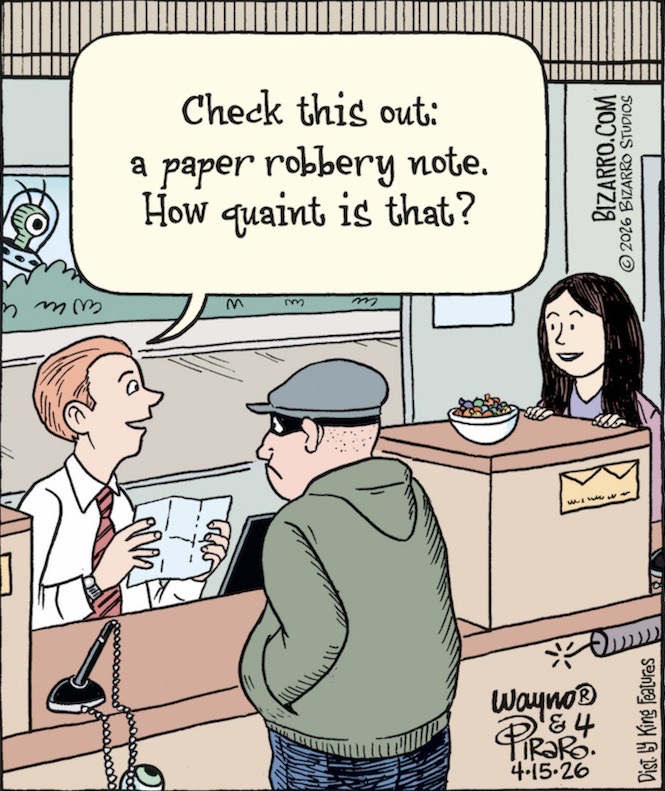
Faced with dreadful, uncontrollable situations, people sometimes take to fretting about some minor issue that is more easily remedied.
The routine tasks of a vengeful God
March 28, 2026From the latest New Yorker issue, of 3/30/26, this cartoon by Daniel Kanhai:
The energetic angelic figure of Moses, with his rather dubious angelic assistant (his brother Aaron? his successor Joshua? just an angel off some random cloud, pressed involuntarily into the frog toss?), lobs jumbo frogs down onto the Egyptians, meting out punishment to them for their Pharaoh’s offenses against the Lord and the Lord’s chosen people, the Israelites
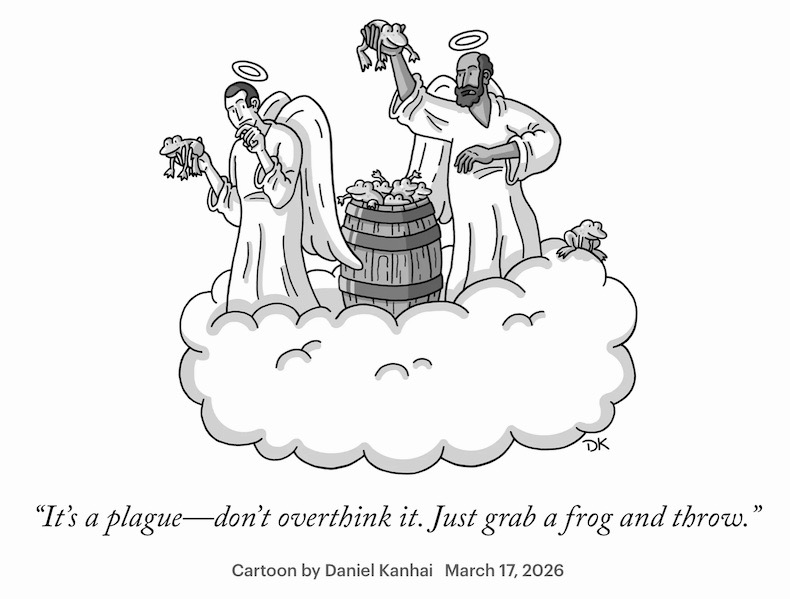
It’s the Biblical second Plague of Egypt — not the disastrous swarming frogs of the book of Exodus, overwhelming entire cities, doomed to die in great stinking heaps; but instead adorable, perky frogs from children’s books and the cartoons (surely they are a pretty green). Moses gets them by the barrel.
In any case, the incongruity of the appalling — literally Godawful — frogs from Exodus and the cute frogs in the New Yorker made me laugh out loud.
The travails of etymology
March 7, 2026Thoughts inspired by a comment by Robert Coren on my 3/6 posting “Checking out”, in which I responded darkly to the information from a grocery-delivery service that you can:
Add items until your shopper checks out
by understanding the intransitive phrasal verb check out in it not as the intended sense
To complete the procedure required in order to register one’s departure from a location or venue, esp. a hotel, at the end of a stay or visit. Also more generally: to leave, to depart. [OED‘s 1b for check out]
but as OED‘s 4a ‘to die’. RC offered a speculation on the etymology of the mortal sense of a different intransitive phrasal verb with out, peg out:
4a reminds me of a phrase that I encountered in Dorothy Sayers’ The Nine Tailors, where “peg out” is used as a colloquialism for “die”; I assume that (1) it comes from the process of being victorious in a cribbage game (which makes it a rather odd metaphor, actually), and (2) it was standard usage among some portion of the British population in the early 20th century.
Lizard warning
February 23, 2026Yes, yes, I am bombarded with blizzard warnings, for the terrifying storm now bringing NYC and the surrounding areas to a standstill. But, bafflingly, though I am fully aware that the warnings are about a blizzard, I keep hearing them as announcing a lizard warning — as if I must now beware of a rain of cold-stunned iguanas falling from the trees or an advancing army of marauding Komodo dragons.
Sadly, since we are now in the zone of terrifying creatures, I have to tell you that Gojira / Godzilla is a reptilian (or dinosaurian) monster, or kaiju, not a squamate one (all lizards are reptiles, but not all reptiles are lizards). You should indeed be alarmed by the news that Godzilla is on the rampage in your neighborhood — that means it’s slated for utter devastation — but such a bulletin is not, technically, a lizard warning. It would be a grievous usage error to race through the streets screaming the lizards are coming! the lizards are coming!