Archive for the ‘Greek’ Category
November 20, 2025
Another chapter in foraging for food by restaurant delivery. I had a desire for some gyros, an old favorite in the wide world of demotic cuisines, in this case Greek: from Merriam-Webster online (considerably amended):
noun gyro (plural gyros): /jíro/ [North American] a sandwich especially of lamb and beef [roasted on a spit and sliced], tomato, onion, and yogurt sauce [tzatziki] on pita bread [AZ: the name comes originally from Greek, but has been thoroughly Anglicized, so that the phonology and morphology of the Greek name are no longer relevant to the American name]
(more…)
Posted in Chinese, Greek, Korean, Language and food, My life, Palo Alto, Rhyme | Leave a Comment »
November 15, 2024
Very briefly noted.
Passed on back on 11/9 by Michael Palmer on Facebook, this fine reworking of the map of Austria as an ostrich:

MP came across it on the Language Nerds Facebook site, but I don’t know who created the image in the first place
In English, Austria (a Latinization of the German name Österreich ‘eastern realm’) and ostrich (from a compound of the Latin avi- stem meaning ‘bird’ and the Greek struth– stem meaning ‘ostrich, big sparrow’) have only medial /str/ as clearly shared material, so are very distant puns, if they count as puns at all. Much the same is true of Spanish Austria and avestruz. Things are even more distant in Italian (Austria and struzzo) and of course German (Österreich and Strauß).
But in French, as I pointed out on Facebook, by the accidents of phonological change, Latinized Austria > Autriche and the avi– + struth– compound > autruche, yielding a truly fine pun: Autriche is an autruche!
So Austria not only looks like an ostrich, in French it sounds like one too. This makes me happy.
Posted in Art, Compounds, French, German, Greek, Language and animals, Language change, Latin, Placenames, Puns, Spanish | 3 Comments »
August 28, 2024
Well, actually, concept time. First come the useful concepts, then come the terms for them. My comments are prompted by Martin Haspelmath on Facebook today, on the useful terms (due to Alexandre François) colexification and dislexification for the expression, in some language, of distinct concepts in a single lexical form or distinct lexical forms, respectively; with MH citing this 2024 article from the journal Asia Pacific Translation and Intercultural Studies: “Colexification of “thunder” and “dragon” in Sino-Tibetan languages” by Hongdi Ding and Sicong Ding. From the abstract:
[372] languages were classified into colexifying and dislexifying languages, depending on whether the two concepts are associated with shared lexical forms. The findings reveal that 47 languages in the sample exhibit thunder-dragon colexification; most of them are Bodic and Na-Qiangic languages, with a few Sinitic, Mongolic, and Turkic languages. This areal pattern results from both inheritance and language contact.
So, patterns of colexification spread areally, through both inheritance and language contact, just like other linguistic features.
Note that colexification must have arisen in at least one language at some time, but this article isn’t about the mechanisms that might have given rise to colexification of ‘thunder’ and ‘dragon’ or to simple examples of colexification in English: ‘grain stalks’ (in the mass N straw) and ‘drinking tube’ (in the count N straw); ‘riverside land’ (in the count N bank, as in both banks of the Seine) and ‘financial institution’ (in the count N bank, as in savings banks).
But now the terminology.
(more…)
Posted in Categorization and Labeling, Derivation, Greek, Latin, Negation, Opposition, Semantics, Terminology | Leave a Comment »
November 21, 2023
A brief, somewhat goofy spin-off from my 11/18 posting “The visiopun”, about plurals of the English noun octopus, which entertained mostly octopi (borrowing the Latin plural, but giving it an English spelling-pronunciation /áktǝpàj/) and octopuses (with the default plural suffix for English nouns), but also entertaining octopodes (borrowed from Classical Greek, so learnèd and obscure). The posting inspired a Facebook exchange today, starting with:
— Gadi Niram: I love the [four-syllable] plural octopodes, but it’s really not suited to most communication.
To which I replied:
— AZ > GN (amplifying on GN’s reservations): It has the primary accent on the second syllable: òctópodes, like àntípodes. … At first I was hoping for óctopòdes or òctopódes, cleaving more closely to the accent pattern of óctopùs. But reality is weirder than that.
(more…)
Posted in Accent, Borrowing, Greek, Historical linguistics, Inflection | 1 Comment »
September 26, 2023
We start with wine, a drink whose enthusiasts, knowledgable fans, aficionados, connoisseurs, and the like are legion, so not surprisingly we have a name for them, with alternative spellings: oenophiles / enophiles. Beer is equally appreciated and enjoyed by many, but there are relatively few beer connoisseurs. But, even if there are few of them, they presumably have a name — maybe an obscure one, but a name nevertheless. What’s the solution to this proportional equation?
wine : oenophile :: beer : X
It turns out that there are (at least) two solutions for X, one Latin-based (like vinophile for wine, which is so rare that it doesn’t make it even into the OED), the other Greek-based like oenophile (Greek to accord with the Greek second element –phile). You’re unlikely to have come across either of them, but the second, Greek-based one, is especially delicious for me, because it’s a Z -word (like Zwicky), and because it came to me through a Facebook friend, Martyn Cornell.
(more…)
Posted in Compounds, Greek, Language and food, Spelling | 3 Comments »
March 12, 2022
From Andras Kornai on Facebook today:
AK: As they say on Sesame Street: brought to you by the letter Z!

(#1) A tank (Andras says it’s a Pantsir missile system) with the glyph Z on it — not a letter in the Cyrillic alphabet (in which both Ukrainian and Russian are written) and now symbolizing the Russian iron fist of death
Livia Polanyi [pursuing the Sesame Street theme]: Zombie zombie zombie starts with Z
AZ > LP: The letter Z long ago became part of my identity, a symbol of who I was. Now it’s become the equivalent of a swastika, and I feel that I have personally been assaulted, dirtied, and shamed. (I manage to surmount Z is for Zombie as just a piece of cultural silliness. But the Z on the tanks is, literally, dead serious.)
(more…)
Posted in Greek, Historical linguistics, Language and politics, Linguists, My life, Names, Russian, Spelling, Switzerland and Swiss things, Ukrainian, Zwickys | 7 Comments »
January 7, 2021
In the latest (December 2020) issue of the journal Language (vol. 96, no. 4), Brian Joseph’s “What is time (and why should linguists care about it)?”, an article that originated as his presidential address at the Linguistic Society of America (LSA) annual meeting in New Orleans on 4 January 2020. The article (abstract below) combines broad humanistic scholarship with fine-grained philological and dialectological research on the Greek language.
Meanwhile, the article is thick with thanks to all sorts of people, a characteristic that is not just personal niceness — though in some cases it is certainly that — but reflects a view about the nature of intellectual community.
(more…)
Posted in Academic life, Greek, Linguists, Time | 2 Comments »
July 23, 2020
Yesterday’s Wayno/Piraro Bizarro, a Psychiatrist strip (Wayno’s title: “Out of Frame”):

(#1) (If you’re puzzled by the odd symbols in the cartoon — Dan Piraro says there are 6 in this strip — see this Page.)
And now we’re in the world of phobias, extreme or irrational fears of or aversions to particular things. People are exceptionally fond of finding or inventing unusual phobias — and, correspondingly, of finding or inventing unusual philias (attachments, especially sexually fetishistic attachments, to particular things).
Fear of furniture, as it turns out, is real but rare. There is even a celebrity afflicted with it.
(more…)
Posted in Actors, Comic conventions, Greek, Linguistics in the comics, Technical and ordinary language | 1 Comment »
July 10, 2018
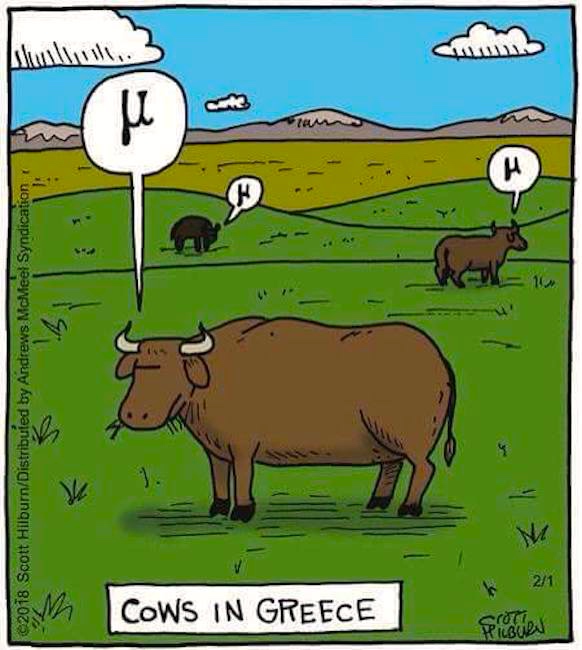
μ μ
(but the bull was real butch about it, and anyway that’s the Greek Way)
Meanwhile, the Greek letter mu is wide open for cow cartoons, like this recent one (from February 1st) by Scott Hilburn, passed on to me by Facebook friends:
 (#1)
(#1)
(more…)
Posted in Art, Gender and sexuality, Greek, Language of sex, Languages, Linguistics in the comics, Onomatopoeia, Writing systems | Leave a Comment »