It’s happening again. The staff where I live now have mostly taken to addressing me as Mr. Arnold — because to lots of Americans (of whatever origins), Mr. Zwicky seems to be simply unpronounceable, a hurdle too high. This produces a twinge of sociolinguistic distress in me, because of the regrettable history of the American address form Mr. FN [that is, FirstName], as in Blues for Mr. Charlie.
Archive for the ‘Address terms’ Category
Blues for Mr. Arnold
August 11, 2026Griffy grapples with Muffler Man on the masculinity mat
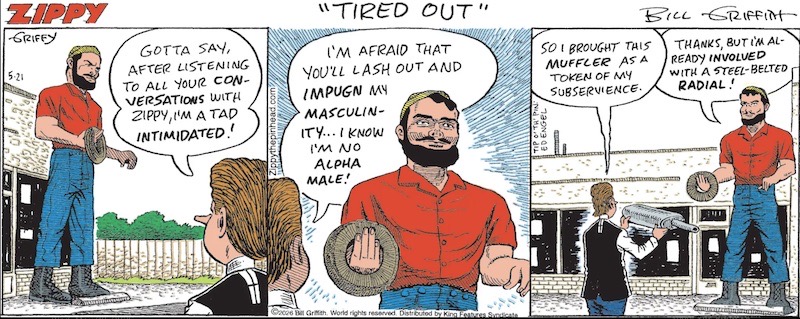
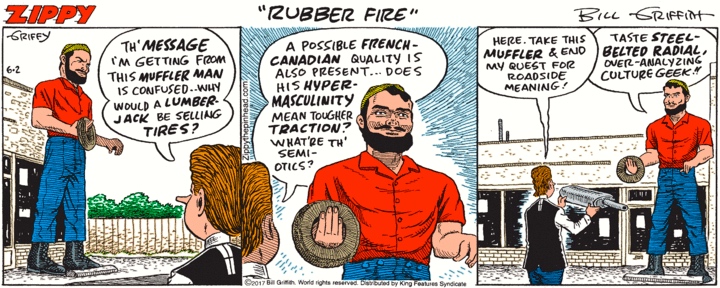
May 22, 2026Yesterday, in my posting “Sir, I bring you a token of my subservience”, a Zippy strip in which Griffy addresses a Muffler Man, offering the fiberglass giant a phallic offering to his superior masculinity. It turns out that this strip is a reworking of the text from an earlier strip on a similar theme. And there we have the two-strip set-up for today’s discussion:
(#1) [The 5/21/26] strip “Tired Out”, with, oh dear, the alpha male theme made explicit; it is, in any case, all about (hyper)masculinity vs. inferior masculinity
(#2) The 6/2/17 strip “Rubber Fire”, showing (hyper)masculine contempt for analytic academics (I am, of course, the very model of the modern analytic academic, so eat my shorts, brute boy)
Comma, comma, comma chameleon
August 3, 2025Yesterday on Facebook, Michael Israel re-posted an item from The Oxford Comma site (showing the cover of an old issue of Tails pet magazine), with the (in this context) foolish advice “Use the Oxford comma, folks”:

A coat of arms
February 19, 2025Unus pro omnibus
Omnes pro uno
This display came by me on my Facebook feed this morning; as a grandson of Switzerland I found it offensive (and, by the way, inaccurate):
(#1) From the Holy Roman Empire Association, the coats of arms of “European Kingdoms, Duchies and Principalities in 1519”

Switzerland is a confederation, with no ruler — not king nor duke nor prince — and has been (with occasional hiccups) since its founding in 1291. Like the Friends / Quakers, it is (in principle) radically egalitarian, as am I personally (though I concede that every person, and every human institution, is imperfect, flawed; but that’s a core principle of radical egalitarianism).
Santa sport
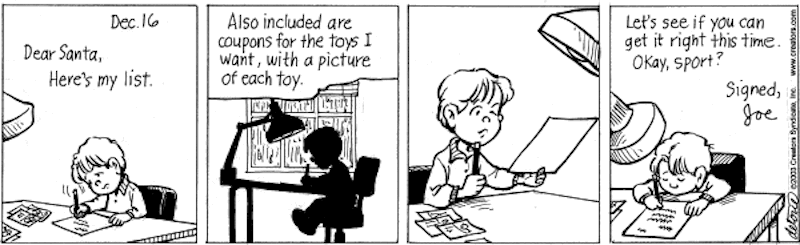
February 6, 2024An old One Big Happy strip that recently came up in my comics feed:
Joe writes to Santa with a very specific gift list, with an accusatory flourish at the end (presupposing that in earlier years Santa had failed to honor Joe’s requests and telling Santa that now it’s time for the old guy to get it right) in which he addresses Santa as sport
This is one of those occasions where I pose questions that I’m in no position to answer, because I don’t have the resources to pursue them. I am an address terms guy — see the Page on this blog with links to my postings on the topic — but sport isn’t a term I use myself, so I have no self-report data on it; and though dictionaries have some useful information on sport, they aren’t able to describe the complexities of usage of address terms like it; and, finally, sport is not one of the high-frequency address terms (like guy) that have gotten the attention of variationist sociolinguists, so we have no systematic data on the way it’s used.
Even so, my first response to Joe’s use was that it was odd. Somewhat antique, but more significantly, impertinent — treating Santa as if he were an equal, or in fact a subordinate. My impression is that Santa, in a somewhat old-fashioned way, might amiably address a little boy as sport, but little kids don’t talk to adults (especially powerful adults) that way. Such an impertinence would, however, fit right in with Joe’s challenge to Santa to get with the program of supplying Joe with the toys he’s asking for (well, demanding). Cheeky monkey.
They do not act that way
March 6, 2023From my comics backlog, a One Big Happy strip that turns on the distinction (in the philosophy of language) between descriptive statements (about what is) and normative statements (about what should be) and shows Ruthie and Joe’s mother exploiting normative statements for her own parental ends — using one to convey injunction or prohibition: saying that this should be the case implicating that you should — or must — act to make it so.
Oh yes, there’s also the third-person reference to her addressees, framing an injunction on them specifically as a kind of normative universal — a manipulation of address terms that the kids simply fail to comprehend (in the last two panels of the strip)

Joe and Ruthie are in fact tearing through the grocery story like wild animals. Ellen Lombard, their mother, asserts that her children do not act like that, meaning this statement normatively. Conveying, in fact, that not only should her children not act like that, but that they must stop acting like that.
Messages in the ABCs
October 22, 2022The One Big Happy in my comics feed today (released to newspapers on 9/4) shows Ruthie finding messages in the ABCs — the letters of the alphabet in their conventional order in modern English (A B C D E F G …):
friendly greeting H I … descending to prohibitive N O
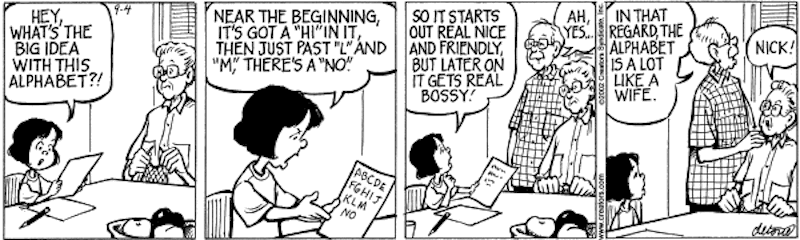
But wait! Go on a bit further and we get to T U, spelling a pronoun of friendly address in French (and sort of, in Spanish, too). Oh, you changeable ABCs, with your many moods!
Mortal power
September 9, 2022The 8/11/22 Rhymes With Orange, exploiting an ambiguity in the noun killer as the modifier N1 in N1 + N2 compounds, in this case in killer abs (literal ‘abs that are killers, abs that kill’ vs. figurative ‘abs that are killer / remarkable’):
(#1) In the worlds of advertisements featuring beautiful people, the health and fitness literature, and soft porn, figurative killer abs are commonplace; abs that kill, however, have (so far as I know) never once appeared on a police blotter

Wider topic: the figurative modifiers of mortal power — premodifying killer (killer abs, a killer app), postmodifying of death (the cruise of death, referring to a penetrating sexual facial expression).
Male body parts and sexual connections between men plus a ton of linguistic expressions in their social contexts, what more could I ask for?