Archive for the ‘Syntax’ Category

Mess, oops or yes

April 26, 2026

(about sexual acts, especially between men, and also about excrement as an accompaniment to sexual acts, all described in vulgar street language, so this posting is massively unsuitable for kids or the sexually modest)

Two messy situations. Anal intercourse sometimes involves the mess of excrement — feces, inadverent (oops!) or intentional (yes!) — and American gay usage has supplied vocabulary for both situations (now extended to women, as well as men, as receptive partners in anal intercourse).

This is as far as I will go using distanced, technical language; from now on, I’ll use the current street language — heavy in F-bombs and S-bombs, among other things — of my sources. This isn’t just a stylistic decision; again and again, it turns out that the distanced language is imprecise and fuzzy, while the street language comes with specific and detailed reference — just as you would expect, because the distanced language is designed to avoid embarrassing reality, while the street language needs to be clear on details that affect how we conduct our everyday lives.

(more…)

On the trail of polypersonalism

April 24, 2026

A report on an exchange between me and my UNC-Chapel Hill colleague Bruno Estigarribia about polypersonalism (explanation to follow). As it unfolded in e-mail between us, presented here with BE’s permission.

This is one in a series of reports on linguists musing about stuff and groping with ideas — showing people something of what we do professionally (before actual publication, if that eventually comes) and something of our passion for and commitment to this work.

(more…)

Over-sensitive ambiguity alarms

April 17, 2026

As I regularly point out on this blog: if you look for it, ambiguity is everywhere; almost any expression can be understood in multiple ways, especially if you’re willing to entertain preposterous or unlikely ideas. So if you had a device that detects every possible ambiguity, it would be ringing forever and driving everyone crazy.

People typically fail to notice most of the possibilities, and then disregard the unlikely ones they do entertain (there’s evidence that most people hearing the word straw entertain, for a fleeting moment, both the interpretations ‘dried stalk of grain’ and ‘hollow tube for sucking a drink’ — even in The straw was mixed with hay and The straw was fabricated from plastic). So most ambiguity lies beneath the level of consciousness.

But some people have become accustomed to listening to and looking for details of language use — it’s one of the things they do — and so are inclined to have over-sensitive ambiguity alarms. Their ambiguity alarms are as a kind of occupational hazard. I am such a person, by profession. I have had to learn to suppress commentary on much of what I notice, because the details aren’t important for most people, though occasionally I’ll cite something that entertains me.

My friend Tim Evanson is also such a person, and since he’s a prodigious writer on Facebook, we get to see his ambiguity alarm in action. On 4/13, he citex a headline from Crain’s Cleveland Business:

CFO [is] named for Akron’s Trailhead Foundation (call this CCB)

And then quipped:

So, I have an etiquette question: Do we refer to her as “Ms. Trailhead”? Or as “Ms. Akron Trailhead”?

(more…)

A fortuitous cold soup

March 26, 2026

Doing a regular grocery order yesterday,* the Safeway page for their excellent house-brand tomato bisque happened to show, among other things I’d ordered previously, small cans of chopped clams (which I used to use for pasta with white clam sauce, when I still actually cooked), and it occurred to me that I could combine the soup and the clams, with some sriracha sauce added for a bit of heat, mix it up, heat it in the microwave, and get myself some nice tomato-clam soup. (I don’t cook, but I microwave up a treat.)  [*If you kvetch about this example as a glaring dangling modifier, I will throw discourse-organizational stones at you, and try to educate you in the ways of non-default SPARs (subjectless predicational adjuncts requiring a referent for the subject — non-default when they don’t obey the Subject Rule, that is, when they don’t pick up this referent from the subject of the main clause; see the Page on this blog about my dangler postings here).]

I gave the spoon a lick to check the spiciness level. And found that it tasted wonderful, just as it was. It didn’t actually need heating. So I had it half of it for lunch, as a nice cold soup, and put the rest in the refrigerator, to produce a truly wonderful chilled soup for my lunch today. It might be nice with a bit of dill, maybe a dollop of sour cream, but I don’t have those in stock, so I was content with what I had.

And I got a nice, botanically oriented, walk around the block with Isaac, answered mail reconnecting with my old friend the philosopher Bill Lycan (see my 3/12 posting “The Vishnu of philosophy”), and then (for dinner) scored some bibimbap from a Korean restaurant, just because I was seized with a desire for it. An excellent day.


Name sharing

March 11, 2026

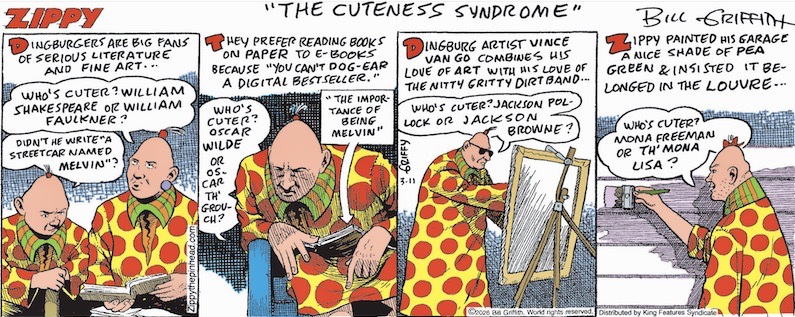
The Zippy strip for today, 3/11, all about sharing a personal name (with some intrusions of the name Melvin):


The large generalization is that mentioning two people together implicates some special relationship, even more so if they share a name (personal name or family name)

In the first panel we start with two authors, from widely separated times, in different genres (plays vs. fiction), and with hugely different styles — but both with the personal name William.

The personal-name sharing goes on with wildly different characters, oddly yoked to one another: Oscar Wilde the writer and Oscar the Grouch the Muppet; Jackson Pollock the painter and Jackson Browne the rock musician (whose career started with the Nitty Gritty Dirt Band); Mona Freeman the actress (and painter) and the Mona Lisa (the subject of Leonardo da Vinci’s famous painting).

(more…)

Notes on Fijian

March 10, 2026

My main helper these days has lived and worked in the US for many years, but he’s a native of Fiji. I call him Isaac in my postings, but his actual personal name is the Fijian version of the name, Aisake, and the syntax of his native language Fijian turns out to have lots of characteristics that are a surprise to, say, speakers of English. So I offer you some notes on the language, building on the material in the Wikipedia article on the language.

(more…)

A monster sale at Bath and Body World

October 26, 2025

In today’s Rhymes With Orange strip, a sale at Bath and Body World:


A sale of body parts from and/or for monsters — not what comes to mind when you come across the N + N compound monster sale, which is a dauntingly large sale, one that’s (metaphorically) a monster

Now the details.

(more…)

An armed gunman

September 29, 2025

From John McIntyre on Facebook today:

— JM: Today’s Pleonasm Award goes to outlets that referred to Thomas Jacob Sanford, who attacked the Mormon church in Michigan, as an armed gunman.

(more…)

I also am of the ursine persuasion

September 18, 2025

Encountered in going through stuff on Facebook: the episode “Fozzie encounters a bit of a language barrier” from “Rocky Mountain Holiday”, a 1983 Muppet special; in the episode, Fozzie Bear describes himself to Gonzo (a character of ambiguous species) following on reports of a bear in their vicinity:

Have you not noticed that I also am of the ursine persuasion … I’m a bear too and I speak fluent bearish

A huge ferocious bear appears, the main characters flee to Kermit the Frog, and Fozzie explains:

Gonzo! Gonzo! Just a slight dialect problem … she speaks Grizzly and I only speak Paddington

You can watch the episode on YouTube here.

(Nice ellipsis of the BEAR in grizzly bear (the name of a type of bear) and Paddington Bear (the proper name, on the pattern of FN + LN, roughly like Stanford Linguist) of a fictional bear, discovered in London’s Paddington Station), as if they were structurally parallel.

The principal characters:


Kermit, Fozzie, and Gonzo

(more…)

The craft of writing

August 29, 2025

The backdrop: yesterday’s posting “Days of grief and anger”. Lise Menn’s comment on it:

— LM: Wonderful writing; may the message reach some new ears.

And my response:

— AZ >LM: Thank you; I hope so. As for the writing, that took hours, of revisions ranging from the minute to the global, with a lot of weeping, but stoked by rage that had to be crafted to present itself as an passionate outpouring of spontaneous feeling, complete with an urgent comma splice. So it pleases me to have it my craft recognized and appreciated; I’ve been working on it for almost 75 years now, but here it’s crucial that I not come off like a splenetic geezer.

Yes, I was a kid 75 years ago, and I was already honing my craft as a professional writer and editor, going on to edit my high school newspaper (and write a humor column for it), finally getting paid for my writing at the age of 17, when I began four years of work at the Reading (PA) Eagle newspaper (one of the jobs that got me through Princeton). All those years later I’m writing, every day of the year, essays — academic entertainments, as I think of them — for this blog.

I am a facile writer — first drafts are a lot of fun — and I have plenty of material to work with, but most of the work of writing is revising, rewriting, reframing, polishing, and editing. It can take stunning amounts of time.

So now I bring you two writing stories, the first about Geoff Pullum and me, writing a one-page abstract on Auxiliary Reduction in English for a 1997 Linguistic Society of America conference paper, an abstract offered to the program committee at the time; the second about E. B. White, writing a single paragraph for William Shawn (the New Yorker editor from 1952 through 1987) on the 1969 moon landing. Pullum & Zwicky had 25 versions labeled as drafts, with of course an enormous amount of churn during each of those revisions (and still at least one typo survived in the published version); White’s piece had 6 versions labeled as drafts, with, again, lots of churn during each revision (but at least the magazine’s staff ensured that the published version was flawless).

(more…)