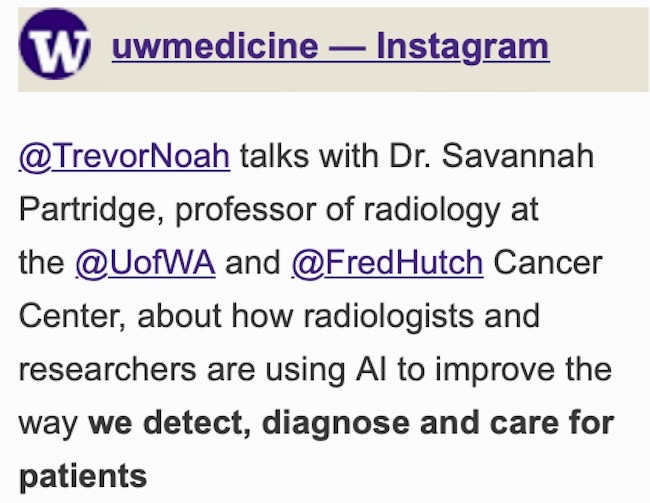
From the annals of astounding coordination, this head-scratcher reported to me yesterday by Ellen Kaisse.
— EK: See bold-face below. I had to read it twice to see why I was having trouble parsing it.
My response:
— AZ: Oh, this is wonderful, and you can see how it happened. DETECT takes an object denoting a medical condition; DIAGNOSE can take such an object or one denoting a patient (to diagnose a patient is to identify their affliction); CARE FOR takes an object denoting a patient. So, thanks to DIAGNOSE fitting into two different argument structures, the first two conjuncts are fine together, and the last two conjuncts are fine together, but the construction shifts in the middle, so all three conjuncts won’t work together. Things sort of wander off in the middle.
I interrupt this exposition to back up my claims about the ambiguity of the lexical item DIAGNOSE with the entry from NOAD:
verb diagnose: [with object] [a] identify the nature of (an illness or other problem) by examination of the symptoms: doctors diagnosed a rare and fatal liver disease. [b] (usually be diagnosed) identify the nature of the medical condition of (someone): she was finally diagnosed as having epilepsy | 20,000 men are diagnosed with skin cancer every year.
Now, back to yesterday’s e-mail, with EK’s reaction to my analysis of the situation:
— EK: I had a vague sense that detect had set off in the disease direction and care for in the patient direction but I missed the pivot function of diagnose. Bravo.
First, praise from Professor Kaisse is praise indeed. Second, thanks to her for framing my analysis in terms of a pivot element, whose ambiguity permits a mid-course switch from one kind of object to another.
January 25, 2024 at 2:36 pm |
If not a pivot, perhaps it’s a garden-path usage of a sense cited in an American Heritage definition:
3. To learn something hidden and often improper about: detected the manager in a lie.
[i.e., using methods of disease detection on patients; screening for illnesses]