Archive for the ‘Parsing’ Category

Aged anchovy salt

December 27, 2024

🎁 Boxing Day 🎁 — also St. Stephen, with his feets uneven — coming a day late, because life has been very difficult for me, and postings have piled up so high I’m not sure I can ever get to them, so I’ve picked something I know I can get done, so that this dark, rainy, and excruciatingly painful low-air-pressure day will not be a total loss

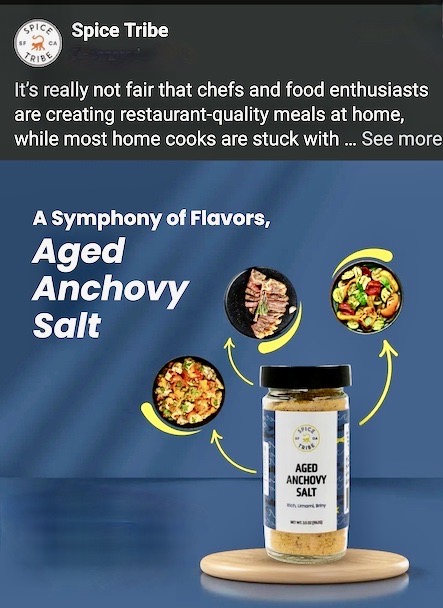
I bring you an e-mail message from Victor Steinbok on 12/25, about this ad for Spice Tribe (website here), a San Francisco-based on-line spice store dedicated to mindful cooking:


(#1) VS wrote: Facebook has offered another example of what I used to refer to as parenthetical ambiguity. Is it [aged anchovy] [salt] or [aged] [anchovy salt]. From a culinary perspective, the latter makes no sense (aging salt doesn’t change it). But that doesn’t mean there’s no built-in ambiguity.

(more…)

great pumpkin pie

November 28, 2024

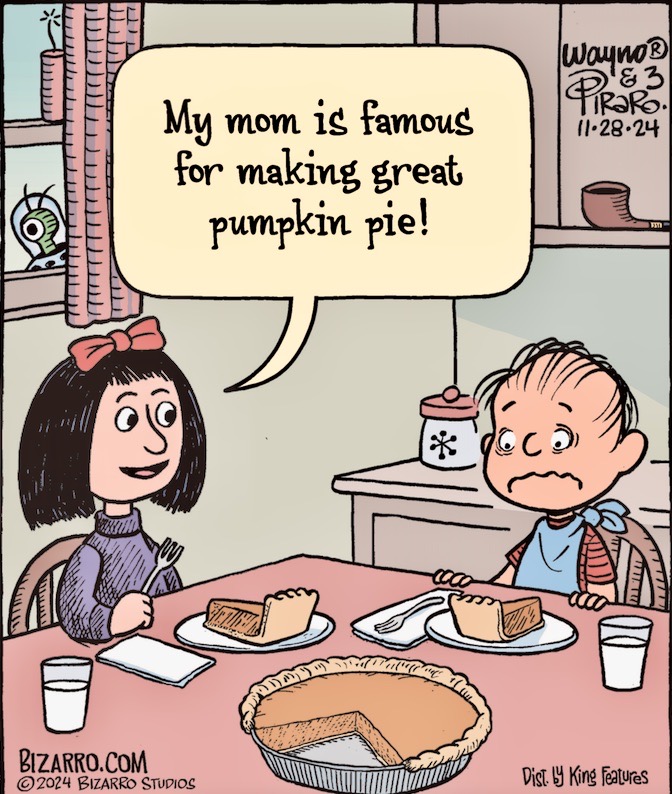
The Wayno Bizarro for today, 11/28, is an exercise in cartoon understanding:


(#1) Wayno’s title: “Horrifyingly Tasty”; I would have suggested the more bloodthirsty “Eat Your Gods” (if you’re puzzled by the odd symbols in the cartoon — Wayno says there are 3 in this strip — see this Page)

But it’s all totally baffling unless you recognize the references to Charles Schulz’s comic strip Peanuts; you really have to know about Linus and the Great Pumpkin. (Meanwhile, your appreciation of the strip will be enriched if you know that today is US Thanksgiving, a harvest festival for which the traditional foods include pumpkin pie for dessert.)

And while we’re talking festivals, the cartoon is a festival of ambiguities in English, structural and lexical.

(more…)

Canadian steak seasoning

August 19, 2024

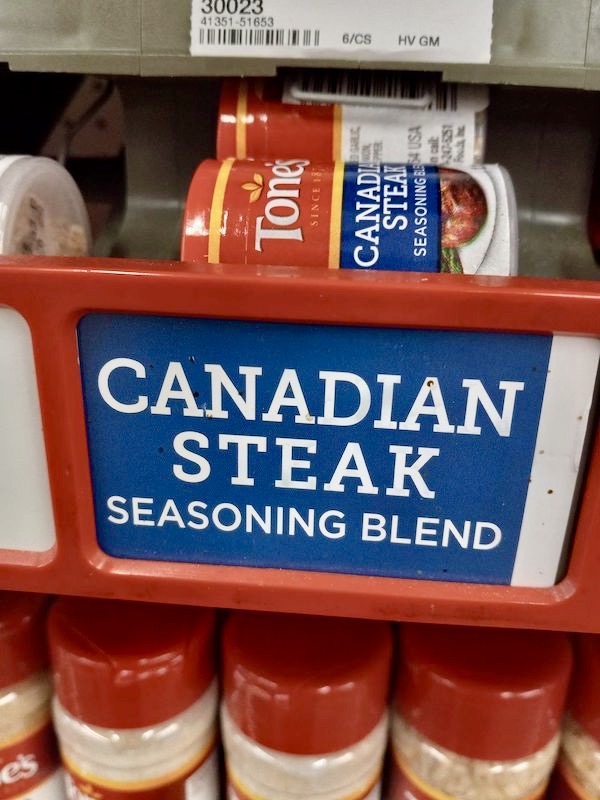
On Facebook recently, Alessandro Michelangelo Jaker remarked on a product label he found at the Hy-Vee supermarket in Watertown SD:


(#1) [AJ:] Canadian friends 🇨🇦: please explain this. What is a Canadian steak 🇨🇦🥩 supposed to taste like?

FB posters seem to have disregarded AJ’s little joke, which turns on parsing CANADIAN STEAK SEASONING as

[CANADIAN STEAK] SEASONING ‘seasoning for Canadian steak’

— a parsing strongly suggested by the font sizes on the label — rather than

CANADIAN [STEAK SEASONING] ‘type of seasoning for steak, associated with Canada’

— which is what the company is actually selling, and which posters went on to describe (as I will myself, in a little while, since this sort of meat rub will not be familiar to many of my readers). I note that this reading of CANADIAN STEAK SEASONING is probably a mischievous willful misparsing on AJ’s part, since he’s accustomed to doing fieldwork in Canada and would likely be familiar with the product. And, since AJ is a friend of mine, I know and appreciate his wry sense of humor.

(more…)

Briefly noted: the lure of Low Attachment

July 21, 2024

Caption on a photo on the front page of today’s New York Times:

A Somber Procession
First responders at the funeral of a father of two killed in the attack on NN

(where NN stands for the name of 45, TFG, the Orange Menace, Helmet Grabpussy; the attack was an attempted assassination). In principle, the PSP (past participial) phrase at the end of the caption — killed in the attack on NN — could be parsed with the preceding material in (at least) four different ways, as a predicative or in one of three ways as a modifier (which I’ll label VHA (very high attachment), HA (high attachment), and LA (low attachment). I doubt that either of the first two parsings would occur to any normal reader (though a mechanical parser would entertain them), but the last two are more imaginable.

To look ahead: ceteris paribus, LA is the favored parsing, but plausibility in context is a powerful effect and often favors HA. I was lured into understanding the caption with LA and had a lot of trouble shaking that parsing, despite its incongruity with the facts of the situation as I knew them and the real-world unlikelihood of this understanding.

(more…)

The unfortunate pivot

January 25, 2024

From the annals of astounding coordination, this head-scratcher reported to me yesterday by Ellen Kaisse.

— EK: See bold-face below. I had to read it twice to see why I was having trouble parsing it.

(more…)

VIO

September 26, 2023

Received in e-mail this morning, from Dave Sayers on the Variationist mailing list:

We are delighted to announce the next in the 2023-24 series of online guest seminars here in the English section at the University of Jyväskylä, Finland — open to all!

On Tues 10 Oct at 11:00 East European Summer Time Mie Hiramoto (National University of Singapore) and Wes Robertson (Macquarie University, Australia) will give a talk titled ‘Framing masculinity and cultural norms: A case study of male VIO hair removal in Japan’.

That’s it. I was baffled by VIO hair removal; it has two possible parsings, and some large number of possible interpretations. And I was baffled by what looked like an unfamiliar initialism, VIO. Masculinity and cultural norms being one of my areas of interest within the G&S (gender and sexuality) field, I wasn’t willing to let these puzzles just slide.

Two parsings (and many interpretations).

 [ VIO [ hair removal ] ‘hair removal related to VIO’, where VIO is one of: a social group, the removers of hair (cf. born-again hair removal, transsexual hair removal, Ainu hair removal, Japanese hair removal ‘hair removal by Japanese (people)’), a method of hair removal (cf. laser hair removal), a philosophy of hair removal (cf. Buddhist hair removal), a place where hair removal is practiced (cf. Japanese hair removal ‘hair removal in Japan’), or any number of other interpretations

[ [ VIO hair ] removal] ‘removal of VIO hair’, where VIO hair is hair related to VIO, VIO admitting of a wide variety of interpretations: an area of the body (cf. armpit hair, pubic hair), a racioethnic group (cf. Black hair, Jewish hair), an evaluative characterization (cf. ugly hair, unwanted hair), a physical characterization (cf. kinky hair), a color (cf. gray hair), and much more

The (apparent) initialism VIO. Acronym dictionaries list a great many unpackings for VIO, but none even remotely hair-relevant. Searching on “VIO hair removal”, I eventually discovered that VIO is Japanese terminology for the bikini zone, with the initials standing for

V line (the pubes and genitals), I line (the perineum), O line (the anus)

So: the three Latin letters are to be understood as iconic signs, as (highly abstract) pictures of the three bodyparts, not as an acronym, not as the initials in an abbreviation. I don’t think that such an interpretation would ever have occurred to me.

No doubt it never occurred to Hiramoto and Robertson, steeped as they are in Japanese sexual culture, that the letter-sequence VIO would be utterly opaque to outsiders, but it is; I had no clue as to what their paper is about, except that hair removal and males are involved, and that the removal takes place in Japan.

Missing lexical items. A recurrent theme on this blog is that languages regularly lack ordinary-language, widely used lexical items for referential categories of things that are in fact relevant in the sociocultural context the language is embedded in.

So it is for English and the body region that extends from the waistline under the crotch to the anus: the pubes, genitals, perineum, and anus, taken together. This is a region of modesty, and it’s socioculturally highly salient in English-speaking communities generally, but English has no lexical item covering just that territory.

The composite phrase private parts would have been a good choice, but it’s already taken, as a euphemism for the central portion of the region of modesty, the genitals. In this case, it’s hard to see how we could get by with a narrow sense of the phrase (the current usage) alongside a broad sense (for the region of modesty). So we’ll bump along with things as they are, as we do in lots of other cases; people cope. Maybe someone can start a fashion for VIO in English.

Cover your VIO, dude! Were you born in a barn? (And while you’re at it, close the front door!)
Today’s attachment ambiguity

July 9, 2023

A tv ad just came by for the (self-injectable) type 2 diabetes medication Mountjaro, warning:

Mountjaro is not for people with type 1 diabetes or children — call this X

Now, there’s a perfectly sensible understanding of X, call it sense A, in which Mountjaro is not for children, and A is the one intended in the ad. And then there’s a rather odd alternative understanding of it, call it sense B, in which Mountjaro is not for people with children. Being the somewhat perverse person that I am, the peculiar B is the understanding I first saw, and laughed at loud at.

This is very familiar territory on this blog, under the heading of High Attachment (HA) in parsing (as in sense A) versus Low Attachment (LA, as in sense B). I will explain.

(more…)

Crash blossoming: Doctor Who as abortionist

November 5, 2022

A headline sighting reported on Facebook yesterday

— Wendy Thrash:
(#1)

— AZ > WT: A lovely garden-path example (as they are known in the trade) — made worse by the line break in your posting (Doctor Who / Performed Abortion …)

Newspaper headlines, with their compressed, trimmed-down format, make a rich ground for garden pathing; garden-path headlines are then some of the most remarkable specimens of the type — so remarkable that they’ve gotten their own label: crash blossoms (after an exemplary species).

I will explain.

(more…)

Knuckle macaroni

August 17, 2022

Yesterday’s Wayno / Piraro Bizarro, at the grocery store:


(#1) Wayno’s title: Joint Replacement (If you’re puzzled by the odd symbols in the cartoon — Dan Piraro says there are 5 in this strip — see this Page.)

So: let’s start with elbow macaroni and go on from there.

(more…)

Spanish fetish all over the guy

March 10, 2020

(Extraordinarily steamy ad, Mr. Fetish Spain in nothing but a pageant banner, and raunchy mansexual talk, so dubious for kids and the sexually modest.)

Today’s Daily Jocks ad re-uses an earlier flagrantly NSFW image in an offer of “Spanish fetish brand Locker Gear” underwear. Well, besides the hot guys in the ad, there’s the parsing of the nominal expression Spanish fetish brand (as a modifier of the brand name Locker Gear).

And the text of the ad, with another significant bit boldfaced:

The DailyJocks Backroom hand picks the best fetish-wear brands from around the world & brings them directly to your inbox. [directly to your inbox was probably carefully chosen, but let that pass]

Check out our hottest new addition, Spanish fetish brand Locker Gear. Featuring a rugged, classic look on all of their products.

From jockstraps with an open pouch to chest harnesses or unlock your addiction with the zipper pouch jockstrap.

Then these two expressions triggered a chain of associations that led ultimately to the romantic comedy movie All Over the Guy.

(more…)