Archive for the ‘Social class’ Category

The food train rolls on

October 26, 2025

Yesterday’s leg of the train trip, on this blog in my posting “Tex-Mex cheese enchiladas”:

[On] cheese enchiladas with Tex-Mex chili gravy, as celebrated by Nelson Minar in “Tex Mex Gravy” on his weblog Some Bits yesterday. A stunning sociocultural contrast to my food posting on this blog yesterday, “Vienne en Isère 3: La Marjolaine”, about Fernand Point’s dacquoise cake La Marjolaine, both elegant and extravagant.

Then in this comment on that posting, NM sets us off on the next leg (which you can think of as Vienne en Isère 4 (there will be a Vienne en Isère 5):

You are right that Tex-Mex enchiladas are a world away from your dacquoises. I can’t think of anything in Tex-Mex cuisine to match those. But Helen Corbitt might have had something. She was Texas’ answer to Julia Child and wrote a lot of fine food books that were popular in my mother’s generation. I am sure one of her cookbooks has a pleasant cake, perhaps alternating layers of angelfood cake and Cool Whip with some tinned fruit to gussy it up. Not quite French patisserie but pretty fancy for Dallas.

(more…)

Cellarettes and cabinet drinks

October 9, 2025

Adventures in furniture inspired by a Benjamin Dreyer posting on Facebook yesterday:

Goshamighty, I completely forgot to mention, when I posted my Old Acquaintance piece a few hours ago, that in commencing this morning to read John Van Druten’s 1942 The Damask Cheek (co-written with one Lloyd Morris), I learned a new word! It’s cellarette: “a movable cabinet or container, often made of wood, designed to store and secure alcoholic beverages.”

If there’s a more perfect word to turn up in a play set in “The library of MRS. RANDALL’s house in the East Sixties, New York. December 1909,” [the  setting of The Damask Cheek] I can’t think of it.

BD locates the sociocultural milieu of the item (and then its name as well) as privileged urban upper class — traditional, elegant, and elite — and we will see that his classdar is first-rate.

I then broke in with the news that I have one of these things, a very nice one, of Danish design, made of teak, on wheels, with a durable bar top, in two parts that slide open to reveal the storage spaces within (there will be photos). I am neither elegant nor elite — I have several good points, but they are not these — but this clever and handsome object suits me (and it was mine and Jacques’s, and before that mine and Ann’s, so it comes with with waves of sweet memory; I will soon pass it on to my grand-child Opal).

But first, the cellaret / cellarette. The object and the name.

(more…)

Skyparty

August 21, 2025

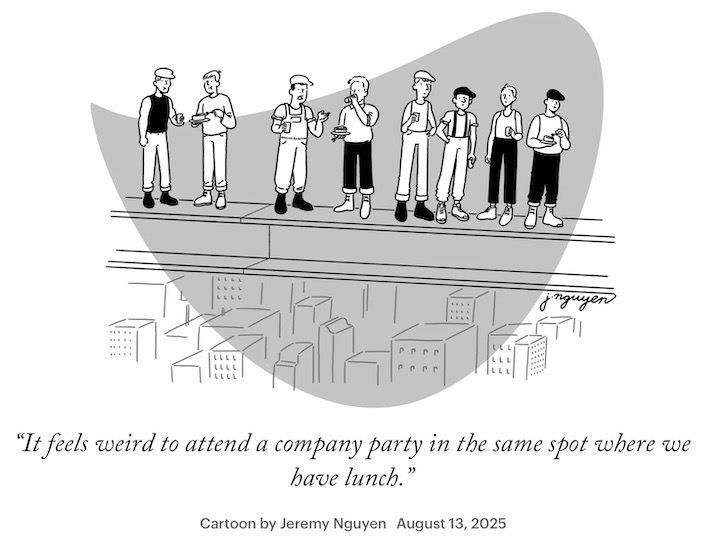
In the latest (8/25/25) New Yorker, a Jeremy Nguyen cartoon in which some construction workers party in the sky:


(#1) A play on the well-known “Lunch atop a Skyscraper” photo originally taken in New York in 1932 (which I have labeled Skylunch 1; it was followed by a series of Skylunch variants)

Nguyen has 8 men, grouped 2, 2, 2, 1, 1; they are working-class guys in casual dress (caps rather than hard hats, no harnesses), standing (rather than sitting) around with simple party fare (rather than lunch boxes) in their hands. What guy #3 finds remarkable is not that they are standing on a girder suspended far above the city streets, but that they’re getting their little party in what is for them their lunch spot. This is elephantlessness: missing the elephant — in this case, the floating girder — in the situation.

(more…)

The factory whistle and the retirement pocket watch

August 16, 2025

A note on two  items of American working life which are, in fact, connected to one another. A little follow-up to my 8/14 posting “The watch and the microscope”, where I wrote:

the watch is … from my grandfather Melchior Arnold Zwicky’s (1879-1965) retirement from the Textile Machine Works in Wyomissing PA

(more…)

Advantages

August 4, 2025

A brief follow-up to my 7/31 posting “Of money, class, and prejudice”, where I told a story about an acquaintance, Johnny, from early in my life, who was blessed with privilege, family money, and social connections, and turned out to be, unsuspectedly, a reflexive anti-Semite, revealing himself while he was dissing me and my family (“they might as well be Jews”). My friend Bill (from summer camp in childhood, then from Princeton, and then from the summer of 1961, when I stayed in his family’s house) served as a kind of counterbalance in this tale, as someone blessed with privilege, family money, and social connections who has been a good friend to me and also has devoted a big slice of his life working doggedly against poverty, urban decline, and racial injustice, just because he thinks these things need fixing and he can do something to help).

At this point there’s a posting to be written on the nature of friendship, involving as it does a recognition, on both sides, of significant disparities between the two of you, which each of you then respect by working around them with as little comment as possible (adjustments often made without conscious reflection), in exchange for enjoying the good qualities the other person brings to the relationship.

In e-mail Bill and I have been looking at these disparities, at how we dealt with them long ago and how we come at them now. Back then, he was somewhat uncomfortable with his position of privilege, family money, and social connection, but is now untroubled by these things, understanding that, as I said to him:

in large part, these are things that just come to you, and the question is what you’ll do with them

and that he had in fact put these advantages to good use throughout his life. Indeed, one of our first exchanges had to be cut short because he was off to demonstrate in the local Good Trouble National Day of Action (honoring John Lewis) — at the age of 85 (Bill is 6 months older than I am, and obviously vigorous in a way I am not).

And then I riffed some on advantages:

privilege, family money, and social connections, along with other advantages on this (seriously incomplete) list (some of them guy-specific):

(more…)
John Koch (and Gustave Caillebotte and John Singer Sargent)

May 18, 2024

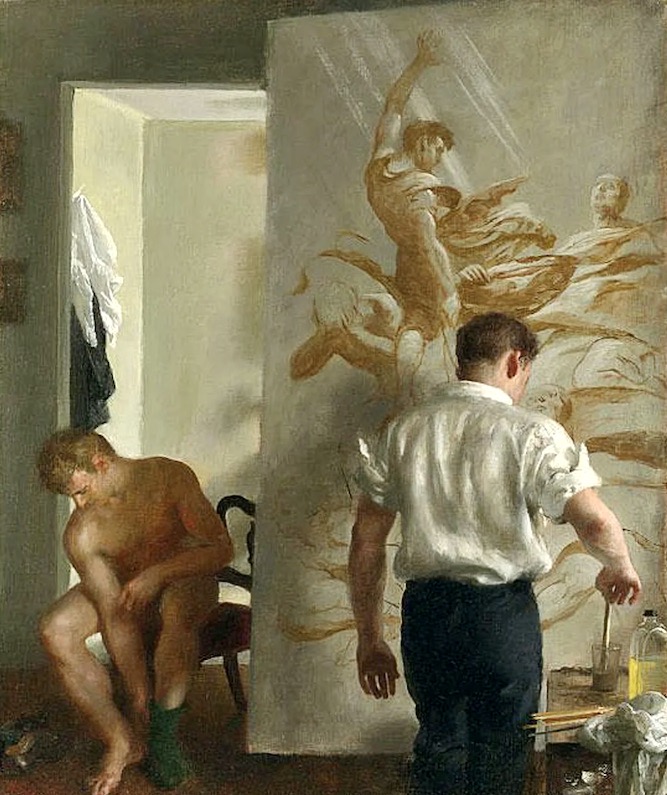
Earlier today, Pinterest offered me this arresting painting by American artist John Koch:


(#1) Koch’s After the Sitting: the artist and his male model

Koch (1909 – 1978) was famous as a painter of New York society, but also produced studies of the male body, including male nudes (also female nudes, but that’s not my focus here), and many of working-class men. This made him an American 20th-century counterpart to the French 19th-century painter Gustave Caillebotte (1848 – 1894), another society painter who did startling male nudes and depictions of working-class men. And to some degree comparable to the American society painter John Singer Sargent (1856 – 1925), who also produced many male nudes and sketches of working-class men.

(more…)

The overture to Mozart’s Marriage of Figaro

February 19, 2024

First came the moral monster Don Giovanni being dragged down to hell for murder and a career of sexual imposition, with a restorative operatic appendix in which the people of Seville sing to his downfall. Then a delightful Mozartean orchestral interlude, apparently the brisk scherzo movement of a symphony (dominated by woodwinds and brass). And then we’re back in Seville, where Figaro is measuring the space for the bridal bed he and Susanna will soon share, while she’s trying on her wedding headpiece; hovering over the couple is the specter of Figaro’s literally rapacious employer Count Almaviva. Yes, it’s a comic opera about sex and power, and it’s a masterpiece.

That’s what brought me to consciousness and a new day at 2:15 am — my life has been deranged in so many ways that I no longer know how to report on it, except for the MQoS announcement that I’m not dead yet — and, yes, I did recognize that the orchestral interlude was in fact the overture to Mozart’s Le Nozze di Figaro [‘The Marriage of Figaro‘], capturing the spirit of the work without using any of its music, getting us into the proper mood for the opera without disclosing any of its thematic material. Not even a whiff of Figaro’s aria “Se vuol ballare (signor contino)”, which is the essence of the opera plot distilled into a dance tune. (If this were a Broadway musical, “Se vuol ballare” would be the main theme of the overture. With Figaro’s aria to that amorous butterfly Cherubino, “Non più andrai (farfallone amoroso)”, as a contrasting second theme.)

Expanding now on three things: the overture as a free-standing orchestral composition; “Se vuol ballare” as Figaro‘s theme song; and a note on Figaro as an ensemble opera. Plus an appendix flagging an intricate topic in g&s (gender & sexuality) studies that’s central in the plots of both Don Giovanni and Figaro.

(more…)

Annals of home upkeep: again, the plumber

July 20, 2023

Two chapters in this story. One from 7/13, the other from yesterday, 7/19.

(more…)

In the menswear ROJ

May 15, 2022

As in yesterday’s posting “Romper buddies”, about an ad for Romperjacks: not RAJ the land of Uttar Pradesh, Madhya Pradesh, and Andhra Pradesh, but ROJ the land of rompers, overalls, and jumpsuits. With a photo gallery. To whet your interest, two Romperjacks items:


(#1) The floridly beautiful Jungle Print romper


(#2) The elegant White Chateaux romper

(more…)

But what does his chest hair MEAN?

August 22, 2021

On 8/19, a posting about the novelty song “Harry’s Jockstrap” from 50+ years ago — a jock that’s pale blue, suggesting that Harry is a fairy:

Harry’s jockstrap, Harry’s jockstrap
It’s pale blue, it’s pale blue
They say that he’s a fairy. But Harry is so hairy
So are you, so are you

… [The verse] suggests that Harry’s hairiness shows that he couldn’t be queer, presumably because, the singer believes, significant body hair is a sign of masculinity, and that’s incompatible with homosexuality. The whole thing is silly beyond belief; the world is rich in hairy fairies … Though I do understand that hairiness as a litmus for straightness is a widely held folk belief, a consequence of the powerful folk theory that homosexuality is literally sexual inversion, so that gay men are, by definition, feminine, in fact a species of female.

So far, some folk associations; there will be more:

— 1 a man’s wearing pale blue clothing (or, more generally, pastel clothing), especially underwear, especially a jockstrap, INDICATES homosexuality

— 2 heavy body hair on a man, especially on the chest, INDICATES high masculinity, which in turn INDICATES heterosexuality

(more…)