Archive for the ‘Words’ Category

Three words to marvel at

November 1, 2023

🐇 🐇 🐇 trois lapins to inaugurate November, the final month of autumn or spring (depending on which hemisphere you’re in), and celebrate the Day of the Dead. A day on which we’ll enjoy three English words that have entertained posters on Facebook (from now on, FB) recently: calceology ‘the study of footwear’; telamon ‘male figure used as an architectural pillar’; and hallux ‘the first and largest toe (on a human foot)’.

At this point, you might admit that these terms are English words but, quite rightly, object that it would be bizarre to talk about expressions that almost no speakers of English know or use as words of English. Certainly, if I asked you whether English has a word for the study of footwear, you’re almost surely going to say no, because part of our everyday understanding of word of English is that such an expression has some currency, and hardly any speakers of English know or use the expression calceology.

On discovering the technical term calceology, then, you might be willing to say that the term is an English word, or maybe even a word in English, but still balk at saying it’s a word of English. It should by now be clear that we’re dealing with distinct concepts here, and grappling, awkwardly, with putting labels on them. At least one fresh label is called for. I’ll hold off on choosing a label to cover the territory that includes words of English until after I’ve looked at three other characteristics of CTH — calceology, telamon, and hallux — separate from their lacking currency.
(more…)

Briefly noted: sconge

February 19, 2020

(Penis-talk. Use your judgment.)

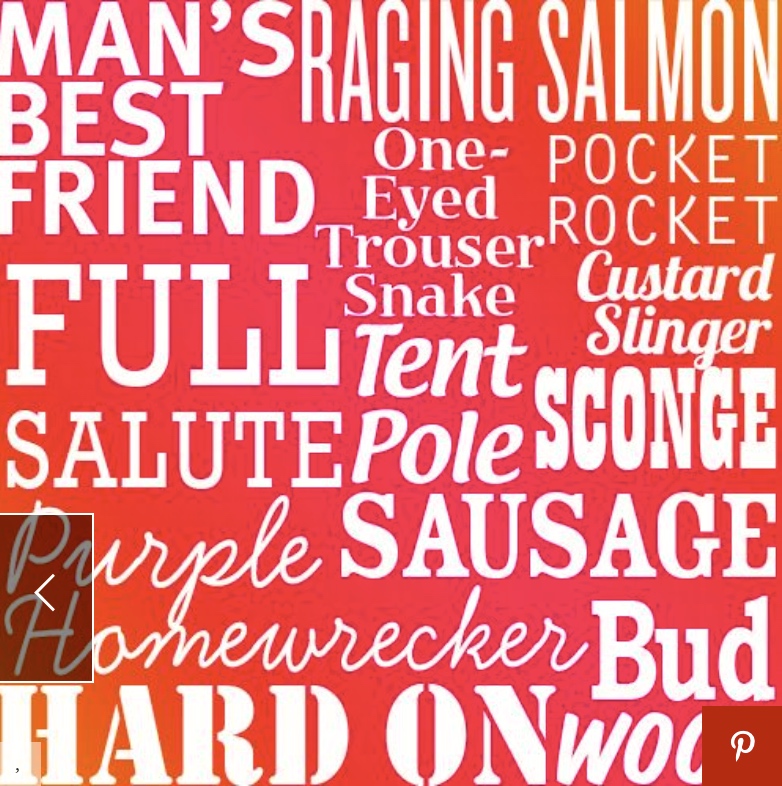
In yesterday’s posting “Saluting the presidents”, image #4 showed a montage of synonyms for erection (hard-on, boner, etc.), with (the) full salute among them:

(#1)

Robert Coren commented:

Re #4: Raging Salmon elicited a slightly puzzled chuckle, but Sconge? Sheer puzzlement.

Had he pursued the matter on his own, he would have discovered what I suspected immediately on encountering sconge: that it was a sheer invention, a show-off neologism concocted from phonologically satisfying parts (while most of the others are show-off neologisms incorporating colorful metaphors).

But in this case, it seems that sconge has been invented specifically for a half-erect / semi-erect / half-hard penis, so that you might argue that it would be an actually useful single word, at least if you were someone (like me) who talked about penises a lot.

(more…)

acyrologia

February 22, 2018

Recently from friends on Facebook:

From one friend: “this looks as though it could be described as an eggcornucopia”. Well, no, not without understanding eggcorn as meaning ‘word error’, which would be a bad move.

(more…)

News from the Mormon territories

January 7, 2018

Two pieces of news, from wildly disparate parts of my life, but both with Mormon connections.

First, a gay porn sale from the Lucas studios, from their MormonBoyz.com specialty site: tons of deeply transgressive LDS mansex, framed as daddy-son sex to boot; also with lots of images of men kissing, which I happen to find very satisfying.

Second, the news from Salt Lake City, where the 92nd annual meeting of the Linguistic Society of America is drawing to a close today — an event that brings with it meetings of sister societies, among them the American Dialect Society, sponsor of an annual Word of the Year competition, a kind of public lexicographic circus with voting from the floor. The overall WOTY winner this year, announced on the 5th: fake news, in two different senses. Details on this and the other winners below.

(more…)

hinky?

September 16, 2016

Caught in passing on a tv show, a character talking about cop-talk:

Hinky? That’s not even a word!

Like every other cry of “That’s not a word!”, this one is bullshit.

Start with the very short story, from NOAD2:

US informal (of a person) dishonest or suspect: he knew the guy was hinky. (of an object) unreliable: my brakes are a little hinky. ORIGIN 1950s: of obscure origin

(more…)

In brief: phonological words

November 19, 2015

Heard — or, rather, misheard —  in a tv commercial for Oral-B electric toothbrushes (which can be viewed here):

(1) I’m never going back to Emanuel Brush.

when what the actor was saying was:

(2) I’m never going back to a manual brush.

Now, since I have [ǝ] (rather than [ɪ]) in the first syllable of the name Emanuel and the indefinite article a [ǝ] usually forms a phonological word with the word that follows it, (1) and (2) are in fact normally homophonous for me.

Yes, I don’t know anyone named Emanuel Brush, so I don’t know how the name came to me, in a toothbrush ad, no less.

Three morning names

September 7, 2015

(Some sexual topics to come.)

They’ve been piling up while other things happen. But here’s the recent crop: Futhark, eructation, sex sling. Definitely a mixed bag.

(more…)

Giving two hoots

September 1, 2015

A follow-up to my “What a hoot!” posting, which was about a set of senses of hooter that turn out almost surely to be related. One of these is mammary hooters (as in the restaurant’s name), and there’s some question about its history (though it’s clear that it predates the restaurant); there are sources that attribute the item to Steve Martin on Saturday Night Live, but for reasons I’ll expand on here, I was very wary of the idea.

That’s the first hoot.

Then, as so often happens when I post about specific uses of particular lexical items, people wrote me about other uses, which are really beside the point of my posting, or about other items that are merely similar to the target item (usually phonologically). Now it can be entertaining to follow up such associations, but that’s at the risk of losing the point. Occasionally I’ve followed these associations, though I try to mark associative chaining off from the main line of the posting, as when I branched from a posting on Ficus plants to a collection of loosely fig-related other things: the fig leaf of modesty, Fig Newtons, figgy pudding, giving a fig for, the fig sign,

So: soon to loosely hoot-related things. That’s the second hoot.

(more…)

restituted

May 17, 2015

In the NYT yesterday, in the piece “Matisse From Gurlitt Collection Is Returned to Jewish Art Dealer’s Heirs’ by Melissa Eddy:

Germany has invested €13 million in provenance research and restituted 12,000 objects over the past decade, many of them books. But families and even small museums have been stymied by uncertainty over where to go for information related to looted works, as well as some insensitivity as to what is at stake.

It’s the verb form restituted. A transitive verb restitute is entirely comprehensible in the context (especially given the noun restitution), but I didn’t think I’d ever experienced it before. Not in NOAD2. But a couple of on-line dictionaries (Merriam-Webster, Collins) have brief entries for the word, and OED3 (March 2010) has a nice entry for it.

(more…)

snit

April 6, 2015

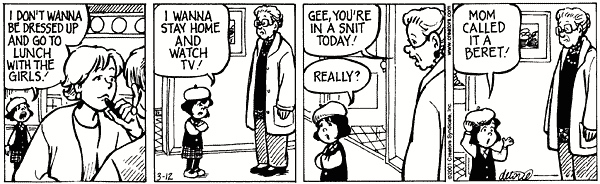
This morning’s One Big Happy:

Once again, Ruthie copes with vocabulary she doesn’t know — in this case, the word snit in in a snit, where she has to figure out which of the many senses of the preposition in is at play here.

(more…)