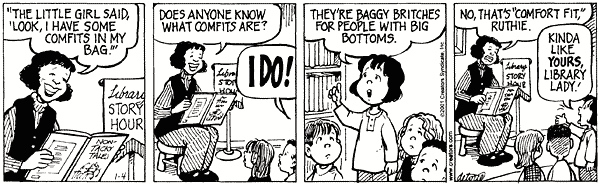
In today’s One Big Happy, Ruthie once again understands a rare and unusual expression (the word comfit) in terms more familiar to her:
 (#1)
(#1)
I very much doubt that I knew the word comfit when I was 6.
In today’s One Big Happy, Ruthie once again understands a rare and unusual expression (the word comfit) in terms more familiar to her:
(#1)
I very much doubt that I knew the word comfit when I was 6.
Two Stanford linguistics stories in the Sunday (January 18th) New York Times: Tyler Schnoebelen at the American Dialect Society meetings, Will Leben on product naming.
Today’s One Big Happy:

gargoyle / gargle
The cartoonist, Rick Detorie, goes to some lengths to put Ruthie in situations where she’s confronted with vocabulary that will be unfamiliar to her. Recall Ruthie in an art museum (#2 in this posting), where she gets to cope with odalisque.
From Sim Aberson, a Miami Herald story from the 12th, “Martelly asks Haitians to ‘Give the country a chance'” by Jacqueline Charles:
Port-au-Prince. President Michel Martelly used his nation’s most solemn anniversary to issue an appeal for calm and unity, asking Haitians to remember the victims of the country’s devastating earthquake five years ago Monday by putting Haiti first.
… Martelly reminded Haitians that it wasn’t just the earthquake, which has no name in Creole and has become known as goudougoudou, that killed the victims, but the lack of development in the country that led to the poorly constructed homes, businesses and government buildings that came crashing down during the 35 seconds.
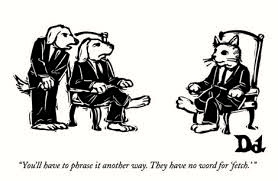
What could Martelly have meant by saying that that the earthquake has no name in Creole (but has become known as goudougoudou)? Is this the “no word for X in L” meme (no word for earthquake in Haitian Creole)? Or a claim that there is no proper name for this particular earthquake? Either way, it looks to me like Martelly has it wrong.
I’ve written occasionally about my linguistics dreams; typically, I have an unshakeable dream (it keeps coming back during the night) about some point of linguistic analysis that seems very urgent because it’s such a breakthrough; or a dream about some name that haunts me; or a dream about a term that cries out for analysis. On waking, the point of linguistic analysis turns out to make no sense at all; the name is of a real person, but no one of significance to me; and the term is of interest, but it’s not news to me. Yesterday, it was the last, and the term was the very formal philoprogenitive (‘having many offspring’ or ‘showing love for one’s offspring’ — NOAD2).
I rushed to my computer to search for the word — and found there a posting by me on this blog: “Our philoprogenitive congressmen” of 4/7/12. Many sighs.
Our forgetful scholars.
In a discussion on ADS-L recently, the wonderful technical term ithyphallic came up (so to speak), and I realized that this was another case (of many) where English doesn’t have a word for something, in any useful sense of to have a word for.
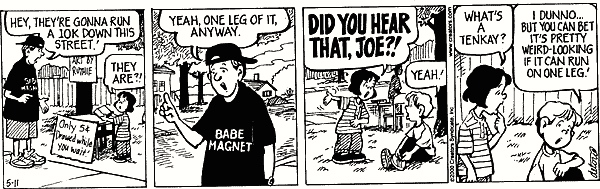
In today’s One Big Happy, Ruthie and Joe are back on the track of trying to make sense of things they haven’t heard before:
 (#1)
(#1)
Lots of knowledge needed here — about the words of English and about sociocultural conventions:
From an accumulation of material over the years, this Calvin and Hobbes (from 9/14/92):

The strip is “about” Calvin’s lacking a tail, which Hobbes (as a tiger) naturally sees as a defect (while Calvin thinks he’s perfect as he is; it might not be too much to read Calvin’s position as related to male anxiety about penis size).
The point of linguistic interest is Calvin’s sophisticated vocabulary, often remarked on; bear in mind that Calvin is a six-year-old boy, yet he slings things like “the evolutionary perfection of earthly DNA”, “the culmination of creation”, and “aesthetic enhancement” (nicely combined with butt here).
On ADS-L on the 2nd, Geoff Nunberg started a discussion about political language coded for race. The background is dog whistle politics.