Archive for the ‘Geography’ Category

Hexagonal French

November 7, 2024

In an on-line notice of a journal article, a language name that I don’t recall having come across before, but one I understood after a moment’s thought: Hexagonal French, the French spoken in the hexagon of France — that is, Metropolitan French, or more plainly, the French of France, France French, French French (occasionally referred to as European French or Continental French, but those terms would take in Belgian French and Swiss French, which are outside the hexagon). Meaning, of course, the standard, Paris-based, varieties of this language; there are plenty of provincial varieties in the country, plus other Romance languages related to French, and, even further afield, non-Romance languages within the hexagon, like the Celtic language Breton in Brittany.

From Wikipedia:

French of France is the predominant variety of the French language in France, Andorra and Monaco, in its formal and informal registers. It has, for a long time, been associated with Standard French. It is now seen as a variety of French alongside Acadian French [in the Maritimes], Belgian French, Quebec French, Swiss French, etc.

Lots to unpack here, starting with the hexagon. Which will lead immediately to names of regions, including those that constitute the land masses of political entities. including countries like France.

(more…)

Central Europe

September 21, 2024

The term for a region of Europe that’s neither north (Scandinavian) nor south (Mediterranean), but, most significantly, neither west (France, the Low Countries, the British Isles) nor east (Russia plus at least some portion of its sphere of influence, especially in the old Russian Empire). In between lies territory historically under a shifting patchwork of rule, notably including: the Habsburg Empire  and the Austro-Hungarian Empire that succeeded it; the Polish-Lithuanian Commonwealth; Bavaria; Prussia; and eventually a unified Germany.

After World War II the German nation was starkly divided into two: West Germany, allied with France and the UK (and the US); and East Germany, allied with the Soviet Union. Germany was central in Europe only in the sense that that’s where the dividing line between west and east fell.

Somewhere along the line, the region-term Central Europe came to be applied to Germany (plus more) as the hinge between regions called Western Europe and Eastern Europe (as well as between Northern Europe and Southern Europe); I don’t know the history of the term (so I hope someone has already studied it). But if you just look at a map of modern Europe and look only at national boundaries, there’s a huge territory between Germany and Russia, with a swath just to the east of Germany that looks like something that you could reasonably call Central Europe (and brings to mind the Habsburg Empire); without going south and east into the Balkan peninsula:

(A) Poland, Czech Republic, Slovakia, Austria, Hungary, Slovenia

Then there’s a more eastern strip that would (with western Russia) count as Eastern Europe; without going north into the Baltic states, at least:

(B) Belarus, Ukraine, Moldova, Bulgaria

Meanwhile, at the other side of Germany, there’s Switzerland, with strong cultural and linguistic ties to both Germany and France (plus, to confound things further, shared boundaries with Austria and Italy).

I took up some of the nomenclature back in 2018, as an interested party (I am only two generations away from German-speaking Switzerland — canton Glarus in the northeast, to be specific). And then on 9/15, along came another interested party, Hana Filip (born in the Czech Republic — in Moravia in the east, to be specific). Both of us reacting to specific nomenclatural proposals.

(more…)

Arctic education

September 21, 2024

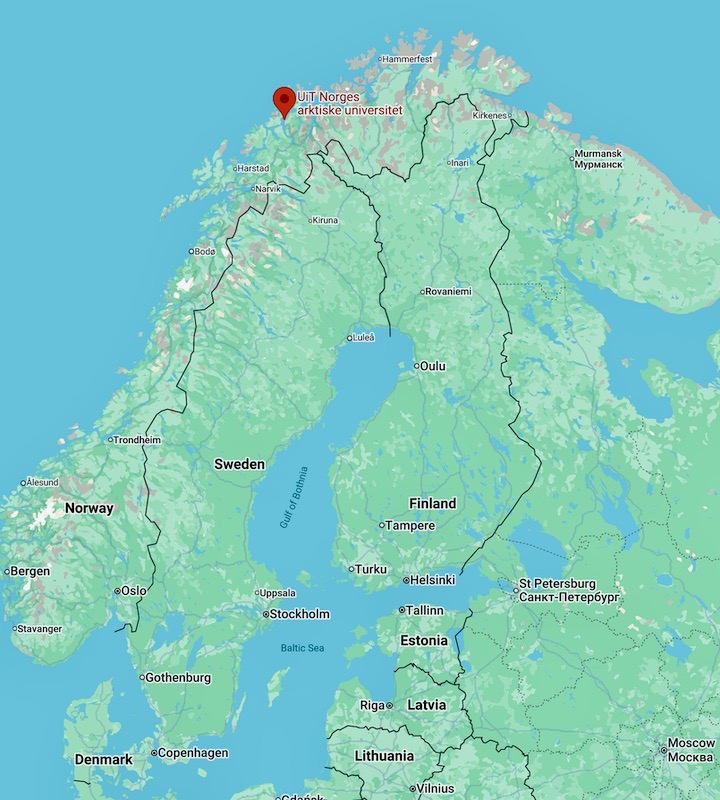
I was delighted to discover yesterday that there is an Arctic University of Norway (UiT), with 11 study sites / campuses across northern Norway and administrative offices in Tromsø. As someone whose friendship network embraces the University of Alaska at Fairbanks (plus my collaborator Jerry Sadock, who is a scholar of, among other things, Greenlandic Eskimo), I’m pleased to see teaching and research flourishing in the far north.

Now consider this map of the continental Scandinavian countries (Norway, Denmark, Sweden, Finland) and nearby lands — and marvel at just how far north Tromsø (marked on the map) is:


I have friends, students, and colleagues who have grown up in, studied in, or taught in most of the Scandinavian cities named on this map, but the farthest north of these cities is Oulu in Finland (Don Steiny loved his time there), which is way south of Tromsø (and Murmansk in Russia); meanwhile, on the Linguistic Typology mailing list, Dave Sayers often writes about the pleasures of his home university, Jyväskylä, in Finland, which is away from the madding crowds, but far south even of Oulu, in the Finnish central lake district, north of Tampere on this map

(more…)

Love wins in the Queen City

August 18, 2023

From Aric Olnes on Facebook yesterday:


(#1) [AO:] “Love Wins” mural [by artist Matthew Dayler] in Cincinnati, Ohio … Flamingos 🦩, Drag Queens 💃🏿 and winged Leather Pigs 🐖, oh my!

For me, it’s the two guys on the left; I’m a fool for men kissing (in fact, this blog has a Page devoted to my postings about men kissing).

(more…)

Holiday specials 2021

January 17, 2022

In the Economist‘s holiday double issue (December 18th – 31st 2021), “an exuberance of articles about Middle Eastern railways, India’s touring cinemas, quadratic voting and much more”. A set of 18 special reports: long feature stories on cultural, political, and economic topics — some familiar subjects of interest (schemes for tallying votes, vegetarianism, cryptocurrencies, the history of restaurants), others more out of the way. It had never occurred to me to wonder about the history and cultural significance of corrugated iron, or what happened to the rural villages of Singapore (well, obviously, they were razed and replaced by skyscrapers, but how was that done?), or how Bollywood movies became so wildly popular all over India.

So: from these 18 I’ve picked 8 that especially fascinated me. These are my personal choices, clearly slanted towards sociocultural topics — note that my personal history includes fellowships at the Center for Advanced Study in the Behavioral Sciences and the Stanford Humanities Center — and others would make other picks (how could I possibly disregard “Why Vladimir Putin’s Russia cannot tolerate a free Ukraine”?).

(more…)

A double desert cartoon

November 13, 2021

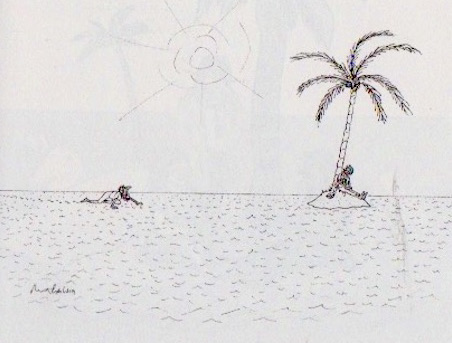
It arrived this week, just published: Send Help! A Collection of Marooned Cartoons, edited by Jon Adams and Ellis Rosen: a compendium of Desert Island (DI) cartoons that has given me much pleasure. More on the book and its contents to come below, but here I note cartoons that combine the DI cartoon meme with another cartoon meme: in the book, DI + Psychiatrist and DI + Grim Reaper. And then, stunningly, Desert Island + Desert Crawl.

A Desert Crawl cartoon has a man (or, more generally, people) crawling, parched and hallucinatory, across a seemingly endless desert — without escape, something the DC meme shares with DI. (The most recent DC cartoon on this blog is by David Sipress in my 11/10/21 posting “Four cartoons on familiar themes”.) The wonderful DC + DI combo in Send Help! is by Mort Gerberg. A terrible scan of it, but the best I could do:


(#1) The original is a bit bigger than this, and even wispier, almost ethereal, like an indistinct vision; as a result, it takes a bit of time for you to realize the deep absurdity of the scene

(more…)

gentoo

July 28, 2020

My morning name for 7/26: the name of a species of penguin:


(#1) From NOAD: noun gentoo (also gentoo penguin): a tall penguin with a white triangular patch above the eye, breeding on subantarctic islands. Pygoscelis papua, family Spheniscidae.

But the name, the name: where does it come from? It sounds a bit like gentile, but then seat-of-the-pants etymologizing is almost always way off the mark, however entertaining the stories might be. But this one might possiby be so, although that’s far from a sure thing; NOAD‘s note:

ORIGIN mid 19th century: perhaps from Anglo-Indian Gentoo ‘a Hindu’, from Portuguese gentio ‘gentile’.

The connection between Portuguese gentio ‘gentile’ (< Latin gentilis ‘of a family or nation, of the same clan’) and Anglo-Indian Gentoo ‘a Hindu’ is firm, however remarkable it might seem to you. What is still unclear is how to get from Hindus to penguins, so other sources for gentoo have been proposed, but, apparently, none with solid evidence.

(more…)

A morning in the home counties

November 29, 2018

That morning was November 11th, when the morning name was home counties.

A first stab, from Wikipedia:


(#1) The former administrative counties (1889—1965) surrounding London (names of those bordering London in boldface): 1. Buckinghamshire 2. Hertfordshire 3. Essex 4. Berkshire 5. Middlesex (now entirely absorbed within London) 6. Surrey 7. Kent 8. Sussex.

The home counties are the counties of England that surround London (although several of them do not border it). The counties generally included in the list are Berkshire, Buckinghamshire, Essex, Hertfordshire, Kent, Surrey, and Sussex. Other counties more distant from London — such as Bedfordshire, Cambridgeshire, Hampshire and Oxfordshire — are also sometimes regarded as home counties due to their proximity to London and their connection to the London regional economy.

(more…)

Pride Time #5: on Barceloneta beach

March 30, 2018

(From June 2017. Underwear men, Catalonia, gay life, Barcelona beaches, art and architecture, and, eventually, food. First, underwear with my captions.)

The saints of Catalunya
Pretty in purple and pink

(#1)

Sant Jordi the savory in heat
Stretched out on rocks
Homage to Barceloneta
Between sail and fish

(#2)

Sant Joan the sweet
Celebrant of gay pride
Summer solstice confection
Of fruit and nuts

It’s all about Barcelona, the beach, and swim briefs.

(more…)

Who views what

December 3, 2017

About the readership of this blog, examined through the very imperfect lens of WordPress statistics. Back in May 2016 AZBlog had accumulated 5 million spam comments (since late December 2008), and WP said I was getting about 1000 views a day. Then reported spam comments dropped to about 100,000 a year and reported views to 750-800 a day, leading me to wonder if I was doing something wrong, but friends convinced me that WP’s monitoring was simply screwed up.

And then, about two months ago, the views per day went back up to 1000-1200, reliably, so I stopped fretting. (Spam comments stayed down at the ca. 100,000/yr level, which I view as a blessing.)

More interesting is which postings get the most hits, and from which countries. Some of this is easily explicable — there’s a big market for sex — but some is bizarre; Elizabeth Daingerfield Zwicky tells me it’s probably bots ruling the netverse, and not much to do with me specifically.

(more…)