Archive for the ‘Modification’ Category

Over-sensitive ambiguity alarms

April 17, 2026

As I regularly point out on this blog: if you look for it, ambiguity is everywhere; almost any expression can be understood in multiple ways, especially if you’re willing to entertain preposterous or unlikely ideas. So if you had a device that detects every possible ambiguity, it would be ringing forever and driving everyone crazy.

People typically fail to notice most of the possibilities, and then disregard the unlikely ones they do entertain (there’s evidence that most people hearing the word straw entertain, for a fleeting moment, both the interpretations ‘dried stalk of grain’ and ‘hollow tube for sucking a drink’ — even in The straw was mixed with hay and The straw was fabricated from plastic). So most ambiguity lies beneath the level of consciousness.

But some people have become accustomed to listening to and looking for details of language use — it’s one of the things they do — and so are inclined to have over-sensitive ambiguity alarms. Their ambiguity alarms are as a kind of occupational hazard. I am such a person, by profession. I have had to learn to suppress commentary on much of what I notice, because the details aren’t important for most people, though occasionally I’ll cite something that entertains me.

My friend Tim Evanson is also such a person, and since he’s a prodigious writer on Facebook, we get to see his ambiguity alarm in action. On 4/13, he citex a headline from Crain’s Cleveland Business:

CFO [is] named for Akron’s Trailhead Foundation (call this CCB)

And then quipped:

So, I have an etiquette question: Do we refer to her as “Ms. Trailhead”? Or as “Ms. Akron Trailhead”?
(more…)

A fortuitous cold soup

March 26, 2026

Doing a regular grocery order yesterday,* the Safeway page for their excellent house-brand tomato bisque happened to show, among other things I’d ordered previously, small cans of chopped clams (which I used to use for pasta with white clam sauce, when I still actually cooked), and it occurred to me that I could combine the soup and the clams, with some sriracha sauce added for a bit of heat, mix it up, heat it in the microwave, and get myself some nice tomato-clam soup. (I don’t cook, but I microwave up a treat.)  [*If you kvetch about this example as a glaring dangling modifier, I will throw discourse-organizational stones at you, and try to educate you in the ways of non-default SPARs (subjectless predicational adjuncts requiring a referent for the subject — non-default when they don’t obey the Subject Rule, that is, when they don’t pick up this referent from the subject of the main clause; see the Page on this blog about my dangler postings here).]

I gave the spoon a lick to check the spiciness level. And found that it tasted wonderful, just as it was. It didn’t actually need heating. So I had it half of it for lunch, as a nice cold soup, and put the rest in the refrigerator, to produce a truly wonderful chilled soup for my lunch today. It might be nice with a bit of dill, maybe a dollop of sour cream, but I don’t have those in stock, so I was content with what I had.

And I got a nice, botanically oriented, walk around the block with Isaac, answered mail reconnecting with my old friend the philosopher Bill Lycan (see my 3/12 posting “The Vishnu of philosophy”), and then (for dinner) scored some bibimbap from a Korean restaurant, just because I was seized with a desire for it. An excellent day.


An armed gunman

September 29, 2025

From John McIntyre on Facebook today:

— JM: Today’s Pleonasm Award goes to outlets that referred to Thomas Jacob Sanford, who attacked the Mormon church in Michigan, as an armed gunman.

(more…)

boneless bananas

December 18, 2024

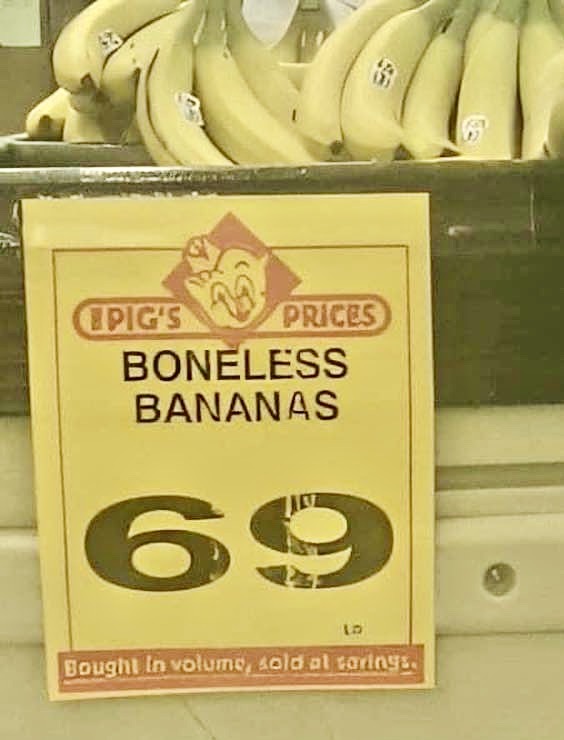
The boneless bananas came to me on Facebook on 12/15 through Ruth Lawrence, who passed on this photo from the Give Me A Sign site on FB:


(#1) [RL’s comment:] I feel so reassured now

(more…)

“I have a ##”

October 20, 2024

So my caregiver León Hernández Alvarez said to me last Tuesday; ## represents a word I totally failed to recognize, at the most elemental level; I didn’t recognize any of the sounds in the word, though I thought it was probably of the form CV. L then came closer to me and said it again, more slowly: “I have a n#”. Ah, an initial n — a Spanish n (distinct from an English n), but clearly something in the [n] zone, and followed by a vowel.  On the third repetition, I was able to identify the vowel: u — a Spanish u (distinct from an English u), but clearly something in the [u] zone. Apparently, L was telling me that he had a [nu].

I recognized the word phonetically, but still totally failed to recognize the lexical item he was talking about. Surely he didn’t have a GNU. Is there such a thing as a NOO? Ah, finally it dawned on me: L was telling me he had a NEW. Hmm, a new what? And then, finally, the realization that he was telling me that he had a piece of news, that he had reconstructed a singular NEW ‘report of a recent event’ from the word NEWS ‘report of recent events’.  This is clever, but alas mistaken.

(more…)

Canadian steak seasoning

August 19, 2024

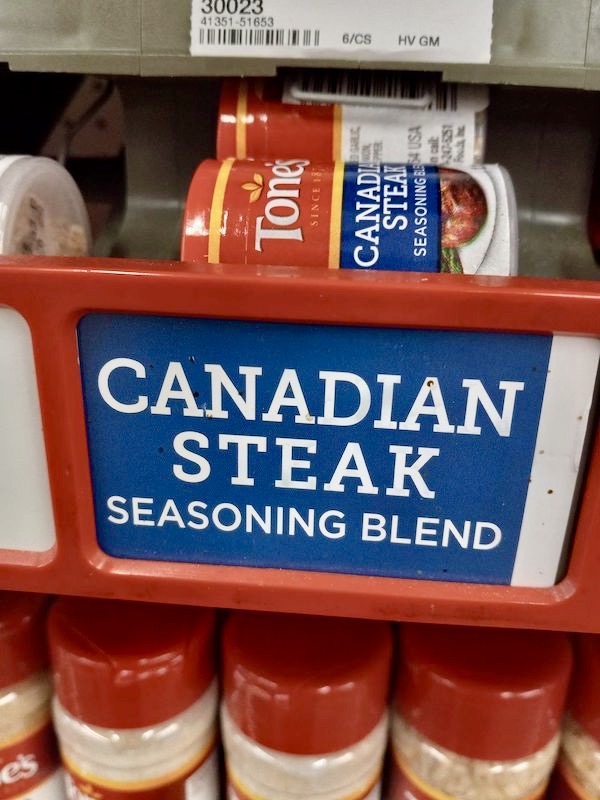
On Facebook recently, Alessandro Michelangelo Jaker remarked on a product label he found at the Hy-Vee supermarket in Watertown SD:


(#1) [AJ:] Canadian friends 🇨🇦: please explain this. What is a Canadian steak 🇨🇦🥩 supposed to taste like?

FB posters seem to have disregarded AJ’s little joke, which turns on parsing CANADIAN STEAK SEASONING as

[CANADIAN STEAK] SEASONING ‘seasoning for Canadian steak’

— a parsing strongly suggested by the font sizes on the label — rather than

CANADIAN [STEAK SEASONING] ‘type of seasoning for steak, associated with Canada’

— which is what the company is actually selling, and which posters went on to describe (as I will myself, in a little while, since this sort of meat rub will not be familiar to many of my readers). I note that this reading of CANADIAN STEAK SEASONING is probably a mischievous willful misparsing on AJ’s part, since he’s accustomed to doing fieldwork in Canada and would likely be familiar with the product. And, since AJ is a friend of mine, I know and appreciate his wry sense of humor.

(more…)

Briefly noted: the lure of Low Attachment

July 21, 2024

Caption on a photo on the front page of today’s New York Times:

A Somber Procession
First responders at the funeral of a father of two killed in the attack on NN

(where NN stands for the name of 45, TFG, the Orange Menace, Helmet Grabpussy; the attack was an attempted assassination). In principle, the PSP (past participial) phrase at the end of the caption — killed in the attack on NN — could be parsed with the preceding material in (at least) four different ways, as a predicative or in one of three ways as a modifier (which I’ll label VHA (very high attachment), HA (high attachment), and LA (low attachment). I doubt that either of the first two parsings would occur to any normal reader (though a mechanical parser would entertain them), but the last two are more imaginable.

To look ahead: ceteris paribus, LA is the favored parsing, but plausibility in context is a powerful effect and often favors HA. I was lured into understanding the caption with LA and had a lot of trouble shaking that parsing, despite its incongruity with the facts of the situation as I knew them and the real-world unlikelihood of this understanding.

(more…)

Moose attachment

June 27, 2024

A follow-up to my 6/25 posting “Dogs on wheels”, about the ambiguity between low attachment (LA) and high attachment (HA) of modifiers, as exemplified in a memic joke about a dog chasing people on a bicycle (in the LA reading, people on a bicycle are chased by the dog; in the HA reading, the dog chasing people is on a bicycle):


(#1) One version of the dogs-on-wheels joke

In that posting, I complained:

I was … sure that I’d seen a version of [the “dog chasing people on a bicycle” meme] and had posted about it; but then I couldn’t find it on any of my blogs or in the “to blog”  files on my computer or in the “to blog” images on my desktop or in my stored albums of images. Much annoyed growling.

I surmised that I had indeed saved it for later posting, but then deleted the image and my notes on it in one of the necessary periodic purges of my “to blog” material.

Then, yesterday, I noticed an oddly named image on my desktop display of images (which, even pared down, is still sizable): MooseAttachment.jpg. This turned out to be a different memic joke exploiting a LA / HA ambiguity:

(more…)

Dogs on wheels

June 25, 2024

Well, it’s about attachment ambiguity, in a family of memes about dogs chasing people on two-wheeled vehicles (mostly bicycles). Along the way, I’ll use this opportunity to expose some of the complexities of my blogging life.

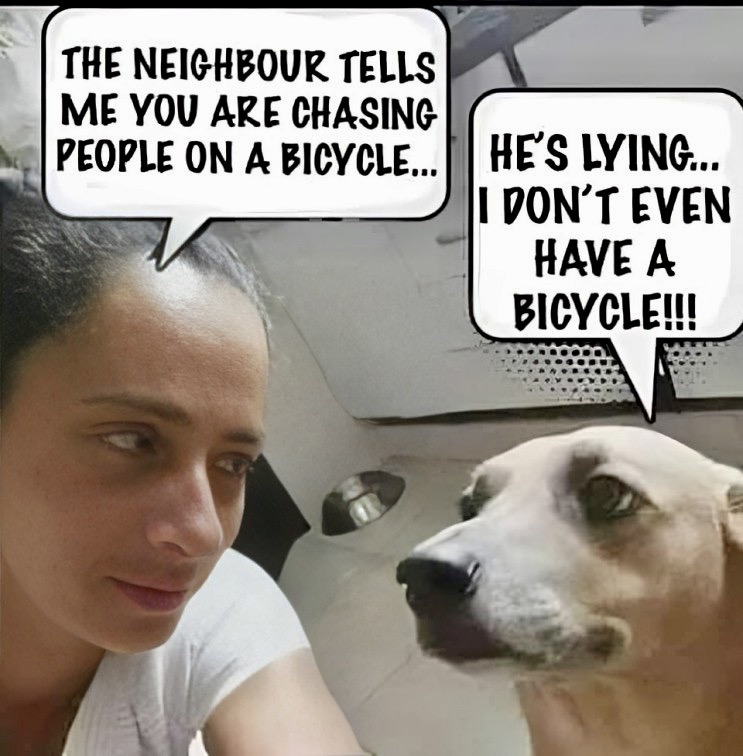
The story begins on 6/23, with a message from Ellen Kaisse — a regular on this blog — offering me this memic wheel-dog joke that turns on an ambiguity between low and high attachment of the modifying PP on a bicycle:


(#1) Did the neighbo(u)r report that some people on a bicycle were being chased by the dog, or that the dog was on a bicycle in pursuit of some people? The human in the photo cartoon supposes the former, the dog the latter

In the human’s report, the PP is intended as a modifier of the head N people within the direct object NP of the verb chasing (low attachment (LA), which you could also think of as narrow attachment); but the dog’s response makes it clear that it understands the PP as modifying the VP are chasing people (high attachment (HA), which you could also think of as wide attachment). (There is a Page on this blog about my postings on modifier attachment, including lots of cases of potential LA vs. HA ambiguity; there’s some overall preference for LA, but how things are understood in actual usage depends very much on the plausibility in context of the two understanding.)

The text in #1 has the BrE spelling neighbour, but there are otherwise identical versions out there with the AmE spelling neighbor, plus otherwise identical versions in which the cycle in the text is a motorcycle rather than a bicycle. And then there are further variations, lots of them, on both image and text (a couple of them reproduced below).

In any case, EK cautiously added the note, “You’ve probably seen this before” — her caution the product of previous occasions on which she sent me some cool example and I told her that I’d posted an analysis of it in 2008 or 2015 or whenever. This time, I was in fact sure that I’d seen a version of #1 and had posted about it; but then I couldn’t find it on any of my blogs or in the “to blog”  files on my computer or in the “to blog” images on my desktop or in my stored albums of images. Much annoyed growling.

(more…)

Queens Pride

May 31, 2024

To mark the eve of Pride Month, this digital composition passed on by Steven Levine on Facebook today:


Queen Elizabeth II of the United Kingdom, in the 7 ROY G. BIV, or Newtonian rainbow, colors, rather than the 6 Pride Flag colors — so the composition was probably not intended to celebrate the wonderful LGBTQ+ness of June; but let’s just disregard that

Now, the composition supplies a number of tokens of the Queen Elizabeth II type, so I had to consider whether my title for this posting would be Queen’s Pride (one QEII type) or Queens’ Pride (many QEII tokens). This is a familiar sort of problem, cropping up annually when Mother’s / Mothers’ Day and Father’s / Fathers’ Day come around, and I’ve chosen the same solution for my title that I chose for those two commercial holidays: axe the damn apostrophe. It’s Queens Pride.

(more…)