Archive for the ‘Psychology of language’ Category

In reverse

August 19, 2026

Committed in speech, by me, on 7/27/26:

help get through me the day [1]

This is an error in the ordering of the parts, localized in the underlined portion.

[1] is the production. What was the target? What did I intend to say? There are two possibilities:

help get me through the day [2] (with reversal of the underlined adjacent words)

help me get through the day [3] (with reversal of the underlined adjacent constituents)

(side note: [1] is in fact a possible construction, though it’s very awkward, and has the wrong structure: it has through me as a constituent, which neither of the targets does)

Now the question is how any of this fits into what we (think we) know about reversal errors in syntax. There are important generalizations about the kinds of reversals we see again and again, generalizations that can then be used to suggest hypotheses about the processes of speech production; the overarching observation here is that we’re forever planning ahead, metaphorically assembling, in stages, chunks of stuff that will eventually get manifested in speech. Glitches in production are then indirect evidence about what’s going on behind the curtain. Some of them are extraordinarily common, others less so, and down the line, but we don’t see just random word jumbling.

The end of the story is that I have stumbled onto a vein of relatively uncommon reversal types (some of which Vicki Fromkin had already recorded), so it’s worth pointing out that they too are principled; I will characterize them roughly, as reversals of adjacent elements — as in [2] and [3], yielding [1].

(more…)

The Threat Illusion

May 26, 2022

More from the annals of selective attention and confirmation bias, now in the journal Psychological Science.

The umbrella phenomenon is the Frequency Illusion: if your attention is drawn to some phenomenon, it’s likely to appear to you to be very frequent, all around you. Then in the special case of the Out-Group Illusion, in which your attention is drawn to a phenomenon associated with a group you don’t belong to (which then appears to you to be characteristic of that group and especially frequent there). Now in the even more special case of what I’ll call the Threat Illusion, in which your attention is keenly drawn to a phenomenon associated with an out-group you perceive as being threatening to you (which then appears to be not only characteristic of that group but extraordinarily frequent there).

A Frequency Illusion cartoon (under the more colorful label of Baader-Meinhof Phenomenon, a name based on one example of the effect, the sudden omnipresence of the Baader-Meinhof Gang’s name):

(more…)

35 years of the CHSP

March 18, 2022

Announcements now out with the program for the 35th Annual Conference on Human Sentence Processing — that is, the 35th meeting of the Annual Conference on Human Sentence Processing — at UCSC, the University of California at Santa Cruz, on 24-26 March.


The CHSP 2022 logo, with its mascot Chuspie; Chuspie appears to be a sea otter (clutching a statistical distribution), unrelated to the UCSC mascot Sammy the banana slug

Two nomenclatural matters: the designation of the conference’s subject as human sentence processing; and the change in this year’s title, the 34 preceding meetings having been the Annual CUNY Conference on Human Sentence Processing. The purely historical reference to CUNY (specifically, to the Graduate Center of the City University of New York, where the conference was founded in 1988, by Janet Dean Fodor) now having been elided.

(more…)

Revisiting 27: Lilo, Stitch, Bouba, and Kiki

March 25, 2019

Mike Pope on Facebook, following up on my posting of the 25th “Lilo & Stitch”, with a question about the naming of the characters in the movie:


(#1) Stitch and Lilo

MP: Do you think the animators consciously followed a kiki/bouba paradigm?

AZ:  Almost surely not consciously; they just chose names that “sounded right” to them.

In general, writers’ name choices for fictitious characters are inscrutable in detail; even if the writers have an explicit account of where the names came from, unconscious preferences for certain kinds of names can usually be seen to be at play.

One of these preferences is the bouba/kiki effect, which has to do with the visual appearance of the referents (see the images above). Also involved are effects having to do with the gender of the referents (Stitch is male, Lilo female). No doubt there are more.

(more…)

A small moment of lexicographic fame

March 20, 2019

Announced yesterday on Language Log, in a piece by Ben Zimmer entitled: “Frequency illusion” in the OED. It begins:

The latest batch of updates to the online edition of the Oxford English Dictionary includes a term that originated right here on Language Log, in a 2005 post by Arnold Zwicky. The term is frequency illusion, first attested in Arnold’s classic post, “Just Between Dr. Language and I.” Here is the OED treatment, an addition to the main entry for frequency:

frequency illusion n. a quirk of perception whereby a phenomenon to which one is newly alert suddenly seems ubiquitous.

(more…)

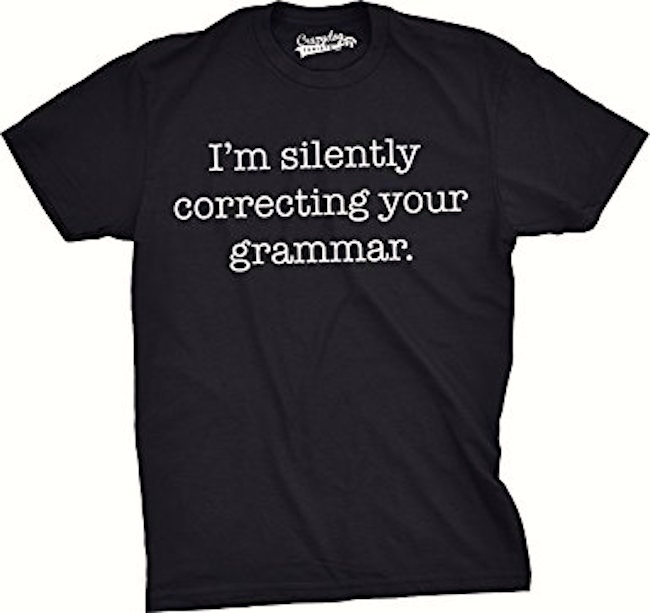
I’m silently labeling you an asshole

October 5, 2017

Accidentally encountered on the net yesterday: this t-shirt triumph of supercilious peeving:

(#1)

It’s also available on signs, mugs, plaques, and goodness knows what else. Dare I hope for underwear?

(more…)

Associative thinking

May 27, 2017

Today’s (5/27-28/17) Daily Post (SF mid-peninsula) front-page headline:

Caltrain to cut 1,000 trees*

And what my mind took me to immediately was

Four thousand holes in Blackburn, Lancashire

Associative thinking strikes!

(more…)

Words. words, words

May 7, 2017

From a King Features Comics Kingdom posting on the 3rd, “Ask a Cartoonist: Words to Live By” (by tea), three cartoons on words in comics: a Dustin on adolescent sniggering over potential double entendres and two Zippys about repeating words for sheer pleasure.

(more…)

Morning spunk: same word, different word

May 27, 2016

In a sense, a re-play of an earlier posting, “spunk” of 3/16/11, which was about spunk ‘spirit, mettle, courage, pluck’ vs. spunk ‘semen, seminal fluid’. Now spunk appeared as a morning name for me a few days ago, along with the ‘pluck’ context of the interview between Mary Richards (played by Mary Tyler Moore) and Lou Grant (played by Ed Asner) in the first episode of the Mary Tyler Moore Show: Grant: “You’ve got spunk … I hate spunk.”

That led me to NOAD2, where I found a single noun entry with three subentries:

1 informal courage and determination.
2 tinder; touchwood.
3 Brit. vulgar slang semen.

(Note: seminal spunk might be more common in BrE than AmE, but it is scarcely unknown in AmE, as a search will readily confirm.)

Speaking informally, this dictionary presents these three as a single word with three different uses (all of which ae available in my speech), while I would have thought these were three different words which just happened to be identical in spelling and pronunciation. What could possibly unite them?

(more…)

Coffeenyms and reservation names

October 7, 2014

From Andras Kornai, a link on my Facebook timeline, tagged as “for Mr. Alexander Adams”: a Schwa Fire piece, “The Name on the Cup: Brewing the Perfect Coffeenym” by Greg Uyeno. About choosing a name for ordering in a coffee shop with lots of background noise. A related task is choosing a name for making reservations over the phone (I have a small amount of local fame in some circles for using Alexander Adams as a reservation name.)

Then there’s Uyeno’s playful coinage coffeenym.

(more…)