A Leigh Rubin Rubes cartoon, via Facebook:
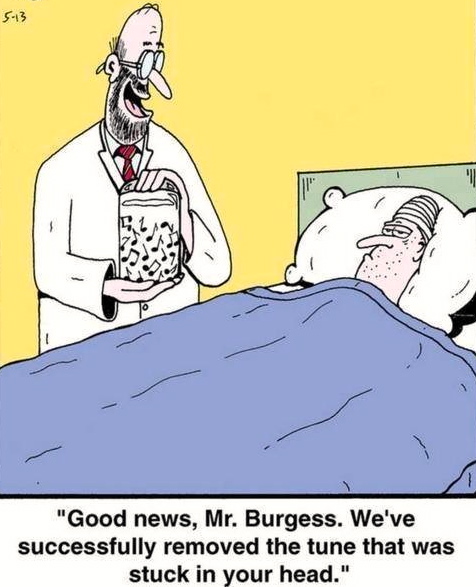
Brain surgery to remove the notes of the offending tune, now kept in a jar, like captured fireflies.
A Leigh Rubin Rubes cartoon, via Facebook:
Brain surgery to remove the notes of the offending tune, now kept in a jar, like captured fireflies.
From Chris Waigl on Facebook:
Garden path alert. After reading this for the first three times, I was left with an extraneous “appear to have been a loan”. Got it the fourth time.
Both McDonnells, who now face years in prison, were acquitted of lesser charges of making false statements on loan applications, while Ms. McDonnell was convicted on a charge she alone faced, of obstructing a grand jury investigation by trying to make a gift of $20,000 worth of designer dresses and shoes appear to have been a loan. (link to NYT)
At first (second and third), Chris understood that Ms. McDonnell was convicted of trying to make a $20,000 gift of dresses and shoes (to some person or organization). She thought the sentence was finished – but then it went on!
A classic garden path sentence, to use the term of art (in linguistics and the psychology of language) that has been around since 1970 and has often been used on Language Log and this blog.
In the April 18th issue of Psychological Science, an article by Elizabeth R. Schotter, Randy Tran, and Keith Rayner (all of UC San Diego), entitled “Don’t Believe What You Read (Only Once): Comprehension Is Supported by Regressions During Reading”.
(I came across this first on the Association for Psychological Science site (behind a wall), but there’s an account of the research available for non-members here.)
In last Sunday’s NYT Sunday Review, a piece under this title by Ana Gantman and Jay van Bavel (NYU Psychology). The lead-in:
Take a close look at your breakfast. Is that Jesus staring out at you from your toast?
Such apparitions can be as lucrative as they are seemingly miraculous. In 2004, a Florida woman named Diane Duyser sold a decade-old grilled cheese sandwich that bore a striking resemblance to the Virgin Mary. She got $28,000 for it on eBay.
The psychological phenomenon of seeing something significant in an ambiguous stimulus is called pareidolia. Virgin Mary grilled cheese sandwiches and other pareidolia remind us that almost any object is open to multiple interpretations. Less understood, however, is what drives some interpretations over others.
Three cartoons this morning: A Dilbert on writing conventions, a Pearls Before Swine with yet another word avalanche (a repeated theme in this strip), and a Zits on reading and listening:
From the Telegraph on 3/24/13, a story by science correspondent Richard Gray headed:
Get that tune out of your head – scientists find how to get rid of earworms
Scientists claim to have found a way to help anyone plagued by earworms – those annoying tunes that lodge themselves inside our heads and repeat on an endless loop.
(Postings beget other postings.)
People have been writing me to say that at first they misread abutilon in my posting on this plant as ablution. In Google+, Robert Coren called this an “anagrammatic” misreading; this isn’t literally so — people aren’t going to misread glean as angel, for instance — but it’s right in spirit. Three things are crucial: the status of abutilon as a very rare word, one that many people don’t know at all and others see very infrequently; the relationship between the spellings ABUTILON and ABLUTION; and the frequency of TION as word element in English.
An arresting summary in This Week in Psychological Science, of “Learning, Memory, and Synesthesia” by Nathan Witthoft and Jonathan Winawer (in Psychological Science for January 10, 2013, (24)1):
Individuals with color-grapheme synesthesia experience color when viewing written letters or numerals. Although some studies examining whether there is a learning component to synesthesia have returned negative results, these studies have examined very small numbers of individuals. Witthoft and Winawer revisit this question with the benefit of a larger sample. Eleven individuals with color-grapheme synesthesia completed a color-letter matching task in which they indicated the shade of the color they associated with each letter of the alphabet. The researchers found that participants’ color-letter associations closely matched those found in Fisher Price magnetic letters sets — which all but one of the participants had owned as a child. The authors suggest that these findings demonstrate a need to include learning and memory components into explanations of synesthesia.
The Fisher Price alphabet:

The full article (available only to subscribers) is very clear that these results don’t mean that some number of synesthetes have simply learned the letter-color associations from refrigerator magnets. For one thing, a huge number of children have been exposed to the Fisher Price alphabet, but the number of synesthetes is small. Witthoft and Winawer suggest that a small number of children are inclined to synesthesia, and that for them, exposure to colored letters and numbers can provide models for their associations.
Yesterday, writing a postcard (by hand), I intended to quote an old (and not particularly good) dirty joke with the line “How far is the Old Log Inn?” in it, but started writing
How far is the Old Logg
when I saw the error, crossed out Logg and went on with Log Inn.
The error? I’d anticipated the double N in Inn, transferring it to the G of Log; “doubled letter” was part of the plan.
On Facebook, Ry Schwark reports the following exchange:
Jenny: I miss Bukkake.
Me: (Stunned Silence)
Jenny: Yeah, I mean, the Japanese dance.
Me: You mean Butoh?
Jenny: Yeah, the other Japanese B thing.
This is about as clear an example of a Fay/Cutler malapropism as you could want.