Archive for the ‘Quotation’ Category
May 9, 2026
From Bethany “Bitty” Ramirez on Facebook on 5/8:
I chopped the rhubarb
But I did not chop the strawberry
— (#1) Ramirez
BR often writes (mouth-wateringly) about food and its preparation, but not lined out like this, and not with what looks like a reference to the song “I Shot the Sheriff” (in either of its two most famous recordings). Depending on your knowledge of popular music (which probably depends on your age), this is either an ostentatiously playful allusion — pretty much everybody of a certain age knows the song, so it leaps right out as the model for #1 — or an Easter egg quotation — a kind of hidden bonus for those younger listeners who happen to be familiar with the model. (More on OPAs and EEQs below.)
(more…)
Posted in Allusion, Music, Quotation | Leave a Comment »
August 3, 2025
Yesterday on Facebook, Michael Israel re-posted an item from The Oxford Comma site (showing the cover of an old issue of Tails pet magazine), with the (in this context) foolish advice “Use the Oxford comma, folks”:

(more…)
Posted in Address terms, Books, Conjunctions, Coordination, Faith vs. WF, Movies and tv, Music, Prosody, Punctuation, Quotation, Signage | Leave a Comment »
May 10, 2025
My morning name on 5/6 was a misremembered word — I report to you, regularly, on the fragility of memory, including my own — that evoked an excellent political portmanteau from the autumn of 2016, as the Presidential elections (HC vs. DT) were heating up, these words together taking me to a bit of prescient song-writing by Gilbert & Sullivan in 1882 — involving loud braying, vulgar display, and open contempt for their inferiors — a character sketch of the moral monster of 2016, who has over the ensuing decade transfigured into a foolish but vindictive scorpion, with a deadly sting in its tail and no control over its instincts.
Now come with me back to the morning of 5/6. As I woke, what dinged in my mind was the repeated:
tarentara tarentara
which I recalled with pleasure as a chorus of peers from G&S’s Iolanthe, imitating the sound of brasses, specifically of trumpets, as they marched. I went to the net to recover the rest of the chorus, only to discover that I had misremembered the marching noise; it was actually
tantantara tantantara
And so began the journey that ends with all of us embrangled in the animal tale The Frog and the Scorpion.
(more…)
Posted in Language and poitics, Memory, Mistakes, Morality, Morning names, Music, Nicknames, Portmanteaus, Quotation, Stories | 6 Comments »
August 9, 2024
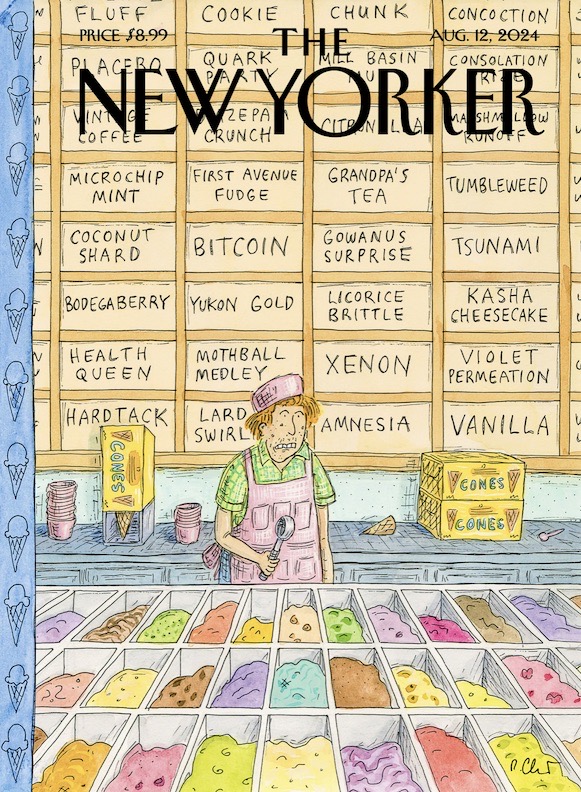
The New Yorker cover for the August 12th, 2024 issue is a great big Roz Chast cartoon. With the accompanying cover story, “Roz Chast’s “Flavor of the Week”: The artist’s enticing (and not so enticing) tweaks to one of summer’s enduring pleasures” by Françoise Muhly on 8/5/24:
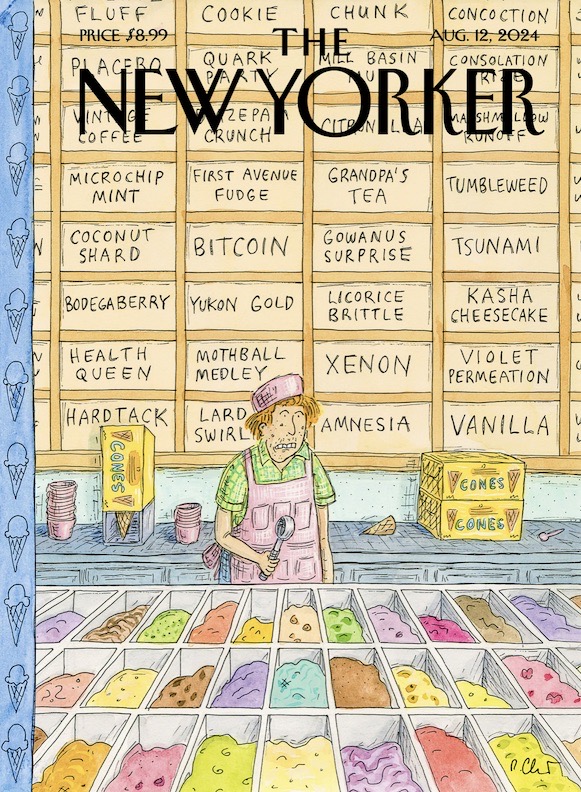
(#1) Along with plain Vanilla, there are strangely modified real flavors, in it for the alliteration (Microchip Mint, First Avenue Fudge); actual food names not especially attractive in an ice cream (Lard Swirl, Hardtack, the potato variety Yukon Gold); and lots of totally non-food allusive names (Placebo, Bitcoin, Tumbleweed, Amnesia, Tsunami, and the noble gas Xenon)
For the cover of the August 12, 2024, issue, the cartoonist Roz Chast — who has delighted readers since 1978 with her opinionated and peculiar takes on life’s indignities — gives ice-cream makers some suggestions for new flavors. “There are a lot of things I like about ice-cream stores aside from the ice cream itself,” Chast said. “I like looking at the different colors and patterns of all the bins. I like comparing cones: wafer flat-bottom or pointy classic? And the names of the flavors: the more preposterous and baroque, the better.”
(There’s a Page on this blog with links to my postings about Roz Chast and her work)
Preposterous and baroque naming schemes run riot in several domains: famously, for colors, especially of paints and of fabrics; and then widely in the word of ice cream flavors, where many frozen-confection firms exult in their naming practices. I’ll comment on just three US companies, with three different approaches: Häagen-Dazs, Baskin-Robbins, and Ben & Jerry’s.
(more…)
Posted in Alliteration, Allusion, Art, Color, Language and food, Naming, Portmanteaus, Puns, Quotation, Rhyme, Taste, Trade names | 3 Comments »
June 3, 2023
Advice for Pride Month this year, when forces of hatred and fear, wielding harassment and intimidation, seem increasingly arrayed against LGBT+-folk, threatening our celebrations, attacking the symbols of our communities, spreading malicious disinformation about us, and acting to curtail our rights — so that we have to confront these forces publicly and fiercely. An image of resplendent, powerful, ferociously sharp-toothed pride for the occasion, covering the spectrum from intense red to vibrant purple:

(#1) From my 6/27/15 posting “Gay Pride”, with my comment: rather more adult males than you’d expect in a pride of lions — but then these are gay lions, so they bond with pleasure
(Already back then, 8 years ago, the image was clearly memic, distributed from hand to hand from an original source no one knew (or cared about); some creator crafted this remarkable image and paired it with the punning title Gay Pride — a gay pride for Gay Pride — but we’re almost surely never going to be able to identify the source. It came to me again yesterday, through another acquaintance who found it on Facebook.)
From #1 a fortuitous find enabling an associative leap to a famously savage leonine diorama. And then in another associative leap, to feasting with panthers, to big cats in general (especially those of the genus Panthera), and to gay men who are beautiful, powerful, and fierce.
(more…)
Posted in Art, Books, Formulaic expressions, Homosexuality, Language and animals, Language and sexuality, Language of sex, Lexical semantics, Metaphor, Movies and tv, Puns, Quotation, Rainbow | Leave a Comment »
May 18, 2019
(OPAs, for short.) The contrast is to inconspicuously playful allusions, what I’ve called Easter egg quotations on this blog. With three OPAs from the 4/20/19 Economist, illustrating three levels of closeness between the content of the OPA and the topic of the article: no substantive relationship between the two (the Nock, Nock case), tangential relationship (the Sunset brouhaha case), and tight relationship (the defecate in the woods case).
The three cases also illustrate three degrees of paronomasia: the Nock, Nock case involves a (phonologically) perfect pun; the Sunset brouhaha case an imperfect pun; and the defecate in the woods case no pun at all, but whole-word substitutions.
I’ll start in the middle, with Sunset brouhaha. But first, some background. Which will incorporate flaming saganaki; be prepared.
(more…)
Posted in Acronyms, Allusion, Ambiguity, Idioms, Implicature, Jokes, Language and animals, Language and food, Language play, Metaphor, Metonymy, Movies and tv, Names, Pragmatics, Puns, Quotation, Sarcasm and irony, Semantics, Speech acts | 3 Comments »
April 30, 2019
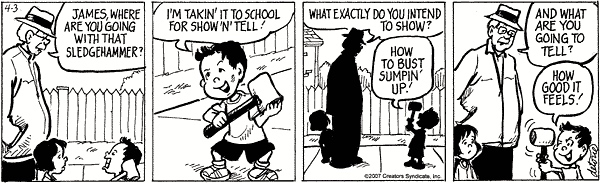
The One Big Happy from 4/3, recently in my comics feed: the tough neighborhood kid James and his sledgehammer:
 (#1)
(#1)
What I hear in the first panel is an echo of a quotation with an ax, not a sledgehammer:
‘Where’s Papa going with that axe?’ said Fern to her mother as they were setting the table for breakfast.
One of the great first lines in English literature, just grips you right off, does E.B. White’s Charlotte’s Web.
(more…)
Posted in Books, Linguistics in the comics, Memory, Metaphor, Movies and tv, My life, Phallicity, Quotation, Signs and symbols, Verbing | 4 Comments »
April 22, 2019
From the 3/30/19 issue of The Economist, in “Reflecting on past sins” about “the clamour to return cultural treasures taken by colonialists” (from Africa), this photo on p. 62 (as captioned here), presumably included to illustrate the cultural, political, and legal issues involved:

(#1) Getting back to where it once belonged.
First, there’s the photo in #1. What does it show? Why this picture — are we supposed to recognize the elements in the picture, or is it just intended as a generic representative of a certain type of situation or event? And what is it doing in a story on the restitution of African art objects removed by colonial powers (mostly in the 19th century)?
Then there’s the Easter egg quotation in the caption, from the Beatles’ song “Get Back”. That’s what caught my eye first (unsurprisingly, given my interests in ludic language in general, and Easter egg quotations in particular), but then I cast a puzzled eye on the photo itself.
(more…)
Posted in Art, Language play, Music, Quotation | 3 Comments »
April 13, 2019
[The body of this posting vanished from WordPress on 4/23/19. Below is a summary of its content, without most of the original bells and whistles; when I finished the 4/13/19 posting, I deleted the files of background material for it, and I no longer have the heart to reconstruct it all. (By some software freak, the comments from the original posting were preserved.)
If you’re looking for my posting about Louis Flint Ceci and Magrittean disavowals, that’s “A Ceci disavowal” at:
https://arnoldzwicky.org/2019/04/24/a-ceci-disavowal/ ]
(more…)
Posted in Art, Books, Formulaic language, Gaming, Language play, Metaphor, Quotation, Snowclones, Technology, Writers | 5 Comments »
May 17, 2017
I’ve been on break from remarking on some of the obsessions of the New York Times — its periodiphilia, its taboo avoidance, and so on — but I’m moved to return to the second of these topics because the Gray Lady has managed to reproduce, in deail, one of its previous encounters with taboo vocabulary, a tussle with poet Philip Larkin’s “This Be the Verse”.

(more…)
Posted in Euphemism, Language in the media, Poetry, Quotation, Taboo language and slurs | 6 Comments »