Archive for the ‘Variation’ Category

Toxic, resilience, Rizzler

May 19, 2026

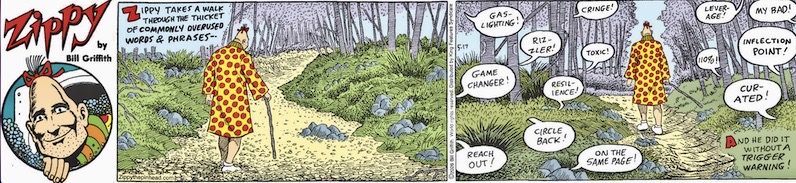
Whoa: toxic, resilience, Rizzler — all cry out to Zippy as he makes his critical way along a forest path, deprecating — despite their (respective) colorfulness, exactness, and freshness — the way these expressions are overused:


In the Zippy strip of 5/17, the forest is alive with the sound of lexical lamentation — with 14 such sounds, to be specific

For each of them, you might feel that you’re legitimately complaining that you’ve been hearing the expression often in recent times, though this impression is obviously going to depend a lot on who you hang out with (Rizzler has a minuscule role in my life. and my bad not much of one; consequently, I find them notable, but not because they seem to be used too much).

Now, people choose — mostly tacitly, not through conscious planning — to use certain expressions for reasons; people choose them because they have some function in the speakers’ and writers’ lives. The usual critique of overuse amounts to the claim that people are making their choices entirely on the basis of stylishness, choosing certain expressions merely because they are fashionable, stylish, with-it, what (they believe to be) the cool people are saying; and that this is reprehensible, because people are making choices just to show off that they’re in whatever counts as the in crowd for them and not on the basis of some more abstract goodness of fit of expressions for conveying particular meanings.

But talking this way just puts things back onto the question of where these styles come from. There’s room there for a certain amount of historical accident, but there are also reasons why certain expressions might get some social traction, through their values or virtues. Specifically, the values of colorfulness, exactness, and freshness. I will ilustrate all three from Zippy’s 14.

(more…)

Vulgar slang is busting out all over

April 28, 2026

(about a family of vulgar slang expressions, so streams of raunchy talk about sex: totally not for kids or the sexually modest)

With apologies to the Rodgers and Hammerstein of Carousel, notes on to bust a nut ‘to ejaculate, orgasm’ and its kin, among them the verbs bust, nut, dick, and ball (plus all those bodypart nouns).

(more…)

phantasia

April 21, 2026

A brief notice.

A recent issue of the New Yorker recommends an earlier piece in the magazine, on an aspect of our mental lives, on  mental imagery (experienced in the phenomenon of phantasia) — with which we can compare mental sounds (experienced in the phenomenon of auralia) — and how it works (or not) in different people:

Annals of Inquiry: “Some People Can’t See Mental Images. The Consequences Are Profound: Research has linked the ability to visualize to a bewildering variety of human traits — how we experience trauma, hold grudges, and, above all, remember our lives”  by Larissa MacFarquhar on 10/27/25 on-line; published in the print edition of the 11/3/25 issue, with the headline “Phantasia” — on aphantasia (lacking these mental perceptions) and hyperphantasia (having extraordinarily vivid mental perceptions), with considerable reporting on the lived experiences of aphantastics and hyperphantastics

(more…)

More questions for anauralics

April 15, 2026

Following up on my 4/13 posting “A host of voices”, on

an enormous amount of variability in the way mental imagery and mental sounds work, in different people and for different purposes

focusing on auralia, on hearing sounds in the mind, and on anauralia, its lack (in a small percentage of people), in various contexts:

in silent reading, in the voice of an internal adviser, in recollected speech or music, in auditory hallucinations, in speech or other sounds in dreams

I had my University of Arizona colleague Heidi Harley as an exemplary anauralic (while recognizing that each person has their own profile of mental-percept abilities); what she can tell us is important, beause it appeared then, and still does, that there’s not much research on mental sound (or mental imagery), in perceptually deficient subjects (anauralics, aphantastics) or even in perceiving (“normal”) subjects (auralics, phantastics), though it looks like there’s an enormous amount of variability.

Now: two further contexts to consider.

(more…)

Things I didn’t know

April 14, 2026

Things I probably should have known, but didn’t, and have just recently discovered: one linguistic (on a pronunciation in BrE), one botanical (on the identity of a plant growing on the street a block from my house).

(more…)

A host of voices

April 13, 2026

Following up on my 4/11 posting “Variability in our mental lives”, about (a)phantasia and (an)auralia, having to do with, respectively, visual and auditory mental experience and their lack: having, or not having, a mind’s eye or a mind’s voice. Almost immediately, it becomes clear that there’s an enormous amount of variability in the way mental imagery and mental sounds work, in different people and for different purposes.

(more…)

Variability in our mental lives

April 11, 2026

Variability in language — from person to person, and for any particular person, from context to context — is all around us. It’s a routine aspect of our mental lives, amazingly complex in its details, but in no way surprising as a phenomenon. Similarly for variability in factual and procedural knowledge: impressively intricate, but familiar.

But now it turns out that more and more of our mental lives is open to variation. As a way into the topic, consider an NPR Radiolab segment from 2024 that came by me on KQED-FM a while back, on the phenomenon of aphantasia.

(more…)

Bottoming, literally and figuratively

March 25, 2026

(well, yes, deeply about sex between men, considered analytically but described in the most direct street language, so entirely inappropriate for kids and the sexually modest)

Today’s topic combines the interests of my two previous postings

on 3/24, “Luke Adams and the power bottoms of the pre-pandemic days”

on 3/25, “The power of the normative gender binary”

and introduces as a side theme one of the overarching ideas of my work in both gender & sexuality studies and linguistics, that of pervasive variety / variability.

— as slogans: There are a great many homosexualities | There are a great many masculinities

Along the way, we’ll engage with four great bottoms from gay porn: Tannor Reed, Johnny Rapid, Kevin Wiles, and Trent Atkins.

(more…)

A moment with my mates Baz and Hazza

March 20, 2026

As a Z-person, I was immediately pulled into Bert Vaux’s query to his “British and Antipodean friends” on Facebook this morning: Bert is collecting examples of -Z(ZA) nicknames (what I’ll call znicknames), like Baz for Barry and Hazza for Harry. The -Z(ZA) (phonetically -z / -zǝ) replaces an intervocalic r following what is, in the varieties in question, an accented short / lax / open vowel: ɪ ɛ æ a ʌ ɔ.  Some more conversions of model names to znicknames from Bert’s collection:

Carrie, Carol → Caz
Darren, Darryl → Daz, Dazza
Jerry, Jeremy → Jez, Jezza
Karen → Kazza
Larry → Laz, Lazza
Mary → Maz, Mazza

(more…)

Anarthrousness in the comic strips

February 16, 2026

The Pearls Before Swine strip by Stephan Pastis, for 1/9/26:


A difference between British English and American English over constructions with the definite article (arthrous) or without it (anarthrous) — putting aside British Bob’s touching belief in the primacy of BrE over AmE

(There is a Page on this blog with links to postings on Language Log and this blog on arthrousness)

Now for some scholarly observations on BrE vs. AmE practices in arthrousness with various prepositional objects, among them hospital and university. Here I take you to Lynne Murphy’s blog “Separated by a Common Language: Observations on British and American English by an American linguist in the US” — in her posting “(the) menopause, (the) flu, (the) hospital” from 4/17/2007:

(more…)