Whoa: toxic, resilience, Rizzler — all cry out to Zippy as he makes his critical way along a forest path, deprecating — despite their (respective) colorfulness, exactness, and freshness — the way these expressions are overused:
In the Zippy strip of 5/17, the forest is alive with the sound of lexical lamentation — with 14 such sounds, to be specific
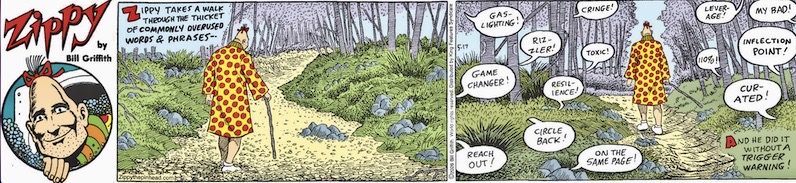
For each of them, you might feel that you’re legitimately complaining that you’ve been hearing the expression often in recent times, though this impression is obviously going to depend a lot on who you hang out with (Rizzler has a minuscule role in my life. and my bad not much of one; consequently, I find them notable, but not because they seem to be used too much).
Now, people choose — mostly tacitly, not through conscious planning — to use certain expressions for reasons; people choose them because they have some function in the speakers’ and writers’ lives. The usual critique of overuse amounts to the claim that people are making their choices entirely on the basis of stylishness, choosing certain expressions merely because they are fashionable, stylish, with-it, what (they believe to be) the cool people are saying; and that this is reprehensible, because people are making choices just to show off that they’re in whatever counts as the in crowd for them and not on the basis of some more abstract goodness of fit of expressions for conveying particular meanings.
But talking this way just puts things back onto the question of where these styles come from. There’s room there for a certain amount of historical accident, but there are also reasons why certain expressions might get some social traction, through their values or virtues. Specifically, the values of colorfulness, exactness, and freshness. I will ilustrate all three from Zippy’s 14.
colorfulness / vividness. Consider the use of toxic ‘poisonous’ (in expressions like toxic masculinity) to convey, hyperbolically, harmful / dangerous. We don’t need another way to say ‘harmful, dangerous’, but the extravagance of toxic evokes the vivid imagery of a grisly death from poisoning. So it’s a good thing to have. (But if we use it a lot, we risk having its vividness erode, and we end up with just another sense of toxic.)
exactness. We have existing vocabulary, but nothing quite conveying the particular meaning we want, so we adopt figurative language conveying the subtlety we’re after. Suppose we want to convey the desirable behavioral capacity:
adaptability / flexibility + toughness / durability
That is, ‘the capacity to recover quickly from difficulties; toughness’ — which is NOAD‘s sense 1 for another of Zippy’s expressions, the noun resilience. A metaphorical extension of NOAD‘s sense 2 ‘the ability of a substance or object to spring back into shape’.
rizz is an internet slang word defined as style, charm, or attractiveness. It is likely short for charisma. [cf. fridge for refrigerator and flu for influenza]
The phrase was popularized by American YouTuber and Twitch streamer Kai Cenat in mid-2021, with it being used among his friend group long before. It subsequently garnered virality on the social media application TikTok
… As a verb, rizz can be used to describe using charisma to attract someone, as to rizz up a person.
… Further development of the word rizz includes Rizzler or Rizz God, meaning [someone who is] highly charismatic, and Unspoken Rizz, meaning a person’s ability to attract a person without speaking
May 20, 2026 at 6:35 am |
And as they say on Easter, “He is rizz”.
(sorry!)
May 20, 2026 at 7:35 am |
😀 I resisted the impulse to go there, but I’m not holding you back. 😀
May 21, 2026 at 6:30 am |
Dredged up from a childhood memory – I don’t remember where I encountered it (supposed to represent a strong Brooklyn accent):
Da spring is sprung,
Da grass is rizz –
I wonder where dem boidies is?
Da little boids is on da wing.
Ain’t dat absoid?
Da little wings is on da boid.
May 21, 2026 at 9:04 am
The poem seems to be anonymous, and comes in various spellings, mostly with “ris” or “riz”, and in British versions that make no attempt to mimic Brooklyn pronunciation, just offering widespread non-standard English.
In my memory the last line has “the little bird” (in some pronunciation), but “the bird” is also possible.
The poem is then an iambic 4 x 4 (4 lines of tetrameter), with a truncated (2- or 3- measure) rhyming punchline appended:
The spring is sprung, the grass is ris —
I wonder where the birdies is.
The little birds is on the wing —
Ain’t that absurd? The little wings
Is on the (little) bird.