Archive for the ‘Opposition’ Category

Dizzy Zippy zigs at Zzyzx

November 9, 2024

… and, instead of taking the Zzyzx exit, catches a ride with a guy in a SYZYGY car to the end of the road, where one-point perspective takes you (so we are both out in the desert in San Bernardino County CA; and also in the artist’s meta-world, where perspective lines converge in a vanishing point, and that is truly the end of the road). All this in yesterday’s Zippy strip, which is rich in Z, Y, ZY / ZI, and ZYG. plus the occasional antic X:


(#1) Three things: Zzyzx Road; one-point perspective; and the word SYZYGY (the ZYG of which took my mind to the word ZYGOTE; while the concept of syzygy took me to A Midsummer Night’s Dream, which is a wedding-feast of syzygy — of counterparts, contrasts, conflicts, and oppositions)

And then there’s zig; from NOAD:

noun zig: a sharp change of direction in a zigzag course: he went round and round in zigs and zags.

(which can then be verbed to yield to zig ‘to take a zig’, as in my title)
(more…)

The cartoon glory that was Rome

September 4, 2024

In this morning’s comics feed, two linguistic jokes from the Roman Empire (in a Rhymes With Orange and a Bizarro); maybe it’s just something in the air, but on the other hand, September 4th, 476, marks the end of the Western Roman Empire as a political entity and consequently (in some people’s view) the beginning of the Middle Ages. So let’s say goodbye to the boy emperor Romulus, aka Augustulus, and antiquity; and hello to the barbarians and, oh yes, medieval times!

Bye-bye, Imperial times
Took Romulus to the border, to see the Empire die

I’ll get to Augustulus in a while.  But first the cartoons.

(more…)

Terminology time

August 28, 2024

Well, actually, concept time. First come the useful concepts, then come the terms for them. My comments are prompted by Martin Haspelmath on Facebook today, on the useful terms (due to Alexandre François) colexification and dislexification for the expression, in some language, of distinct concepts in a single lexical form or distinct lexical forms, respectively; with MH citing this 2024 article from the journal Asia Pacific Translation and Intercultural Studies: “Colexification of “thunder” and “dragon” in Sino-Tibetan languages” by Hongdi Ding and Sicong Ding. From the abstract:

[372] languages were classified into colexifying and dislexifying languages, depending on whether the two concepts are associated with shared lexical forms. The findings reveal that 47 languages in the sample exhibit thunder-dragon colexification; most of them are Bodic and Na-Qiangic languages, with a few Sinitic, Mongolic, and Turkic languages. This areal pattern results from both inheritance and language contact.

So, patterns of colexification spread areally, through both inheritance and language contact, just like other linguistic features.

Note that colexification must have arisen in at least one language at some time, but this article isn’t about the mechanisms that might have given rise to colexification of ‘thunder’ and ‘dragon’ or to simple examples of colexification in English: ‘grain stalks’ (in the mass N straw) and ‘drinking tube’ (in the count N straw); ‘riverside land’ (in the count N bank, as in both banks of the Seine) and ‘financial institution’ (in the count N bank, as in savings banks).

But now the terminology.

(more…)

Double in-laws

August 20, 2023

About Virginia Bobbitt Transue — born 10/12/40 (a month after me) — the wife of a brother (Bill) of my husband-equivalent (Jacques). More succinctly, my husband’s brother’s wife, in effect my sister-in-law-in-law. Or, putting it in more abstract terms, my spouse’s sib’s spouse, my sib-in-law-in-law.

Here we have the equivalence of X’S SPOUSE’S SIB’S SPOUSE to X’S SPOUSE’S SIB (my brother-in-law’s wife treated as my sister-in-law) — an equivalence not recognized by some people, while for other people, it’s routine. It’s the way things work for Virginia and me; I refer to her as my sister-in-law, she refers to me as her brother-in-law.

There are other equivalences. The point of all of them is not merely selecting simple terms: the equivalences express feelings of familial closeness, caring, and even responsibility; they are emotionally potent.

Another double in-law equivalence (distinct from the Arnold-Virginia relationship, though parallel to it): of X’S SIB’S SPOUSE’S SIB to X’S SIB’S SPOUSE, again in effect X’s sib-in-law-in-law. For example, Keene Daingerfield’s wife Elizabeth (Libby) Walcutt Daingerfield’s sister Ann Walcutt Winn’s husband Jack Winn — Keene’s sister-in-law’s husband — treated by Keene as his brother-in-law.

Now, the background to all of this. (Some of this will be a bit repetitious; I’m trying to pull out some really cool abstract distinctions that take a while to appreciate, because what we know about them is pretty much all below the level of our consciousness, and we don’t learn anything about kinship relations in school.)

(more…)

The commonification of Magic Shell

August 10, 2023

A comment from Bill Stewart this morning on my posting from yesterday, “The states of matter: coconut X”, with reference to the third of the  (temperature-sensitive) states of coconut X considered there: not the free-flowing oil nor the spreadable semi-solid fat / cream, but a firm solid:

You remind me that I can take advantage of this unwanted by you hardening to make our own Magic Shell. Not that we need the ice cream anyway, or even the decadent indulgence of Magic Shell, which we’ll impose upon our grandson.

What caught my eye was the treatment of Magic Shell, obviously a proper noun (and a brand name), as a common noun (and a generic name): you can make your own.

But then I had to face up to the hard truth that I was utterly ignorant of what (commercial) Magic Shell or (homemade) magic shell might be. From Bill’s context, some sort of killer dessert, with coconut X as an ingredient.

So, the first order of business was to learn about Magic Shell. Then some recipes for making your own stuff. Then some comments about the generification / genericization of brand names, and the commonification (my term) of proper nouns.

(more…)

Double negatives: the big picture

January 19, 2023

In yesterday’s installment, the two kids of the Lombard family in the comic strip One Big Happy, Ruthie and Joe, advance a devious — and transparently malicious — idea about the pragmatics of conversation. As a slogan,

Two nasties make a nice.

That is, saying two nasty things about someone counts as saying a nice thing about them, yuk yuk. We-e-ell, the kids maintain, with impish speciousness, that that’s just a special case of the general principle that

Two negatives make a positive.

First thing: such a slogan is a highly abbreviated formula in ordinary language of some significant technical principle, the virtue of the slogan being that it is striking and memorable; it’s an aide-memoire. But it’s just a label, and labels are not definitions.

Second thing: the kids’ version exploits a massive ambiguity in the adjectives negative / positive, and a corresponding ambiguity in the verb make. To which I now turn.

(more…)

But what does his chest hair MEAN?

August 22, 2021

On 8/19, a posting about the novelty song “Harry’s Jockstrap” from 50+ years ago — a jock that’s pale blue, suggesting that Harry is a fairy:

Harry’s jockstrap, Harry’s jockstrap
It’s pale blue, it’s pale blue
They say that he’s a fairy. But Harry is so hairy
So are you, so are you

… [The verse] suggests that Harry’s hairiness shows that he couldn’t be queer, presumably because, the singer believes, significant body hair is a sign of masculinity, and that’s incompatible with homosexuality. The whole thing is silly beyond belief; the world is rich in hairy fairies … Though I do understand that hairiness as a litmus for straightness is a widely held folk belief, a consequence of the powerful folk theory that homosexuality is literally sexual inversion, so that gay men are, by definition, feminine, in fact a species of female.

So far, some folk associations; there will be more:

— 1 a man’s wearing pale blue clothing (or, more generally, pastel clothing), especially underwear, especially a jockstrap, INDICATES homosexuality

— 2 heavy body hair on a man, especially on the chest, INDICATES high masculinity, which in turn INDICATES heterosexuality

(more…)

The Raw and the Cooked

May 30, 2021

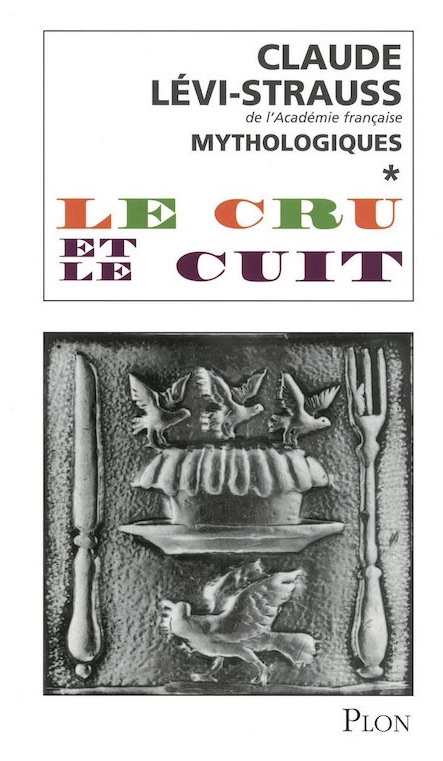
The title of the first book of Claude Lévi-Strauss’s monumental 4-volume work Mythologiques — a title that served as the model for the title of my posting yesterday, “The hairy and the smooth” (referring to male body types) — one of three conceptual oppositions treated in that posting, the other two being raw – refined (referring to crudeness, naturalness, or simplicity vs. artfulness, in the presentation of these bodies in underwear ads) and authentic – synthetic (referring to natural materials, like leather, vs. various imitations, mostly based on plastics, in the garments the models are wearing).


(#1) A cover for a French edition

(more…)

The hairy and the smooth

May 29, 2021

(Much attention to men’s bodies, wearing nothing but what’s billed as fetishwear / kinkwear. Not over the raunch line, but possibly not to some readers’ tastes.)

It starts with some photos of ensembles of bulldog harness plus jockstrap, all in high-macho black, but differing in significant details — of the model’s body, the way his body is displayed in the photos, and the garments he is wearing. With respect to the oppositions

hairy – smooth
raw – refined
authentic – synthetic

(more…)

Film blanc

September 27, 2020

From my posting backlog, this Wayno/Piraro Bizarro from 1/17/20:


(#1) (If you’re puzzled by the odd symbols in the cartoon — Dan Piraro says there are 3 in this strip — see this Page.)

If there’s a film noir, there must be a film blanc, right? If there’s black comedy, there must be white comedy, right? If there’s an X, there must be a ~X, the opposite of X.

(more…)