First came the moral monster Don Giovanni being dragged down to hell for murder and a career of sexual imposition, with a restorative operatic appendix in which the people of Seville sing to his downfall. Then a delightful Mozartean orchestral interlude, apparently the brisk scherzo movement of a symphony (dominated by woodwinds and brass). And then we’re back in Seville, where Figaro is measuring the space for the bridal bed he and Susanna will soon share, while she’s trying on her wedding headpiece; hovering over the couple is the specter of Figaro’s literally rapacious employer Count Almaviva. Yes, it’s a comic opera about sex and power, and it’s a masterpiece.
That’s what brought me to consciousness and a new day at 2:15 am — my life has been deranged in so many ways that I no longer know how to report on it, except for the MQoS announcement that I’m not dead yet — and, yes, I did recognize that the orchestral interlude was in fact the overture to Mozart’s Le Nozze di Figaro [‘The Marriage of Figaro‘], capturing the spirit of the work without using any of its music, getting us into the proper mood for the opera without disclosing any of its thematic material. Not even a whiff of Figaro’s aria “Se vuol ballare (signor contino)”, which is the essence of the opera plot distilled into a dance tune. (If this were a Broadway musical, “Se vuol ballare” would be the main theme of the overture. With Figaro’s aria to that amorous butterfly Cherubino, “Non più andrai (farfallone amoroso)”, as a contrasting second theme.)
Expanding now on three things: the overture as a free-standing orchestral composition; “Se vuol ballare” as Figaro‘s theme song; and a note on Figaro as an ensemble opera. Plus an appendix flagging an intricate topic in g&s (gender & sexuality) studies that’s central in the plots of both Don Giovanni and Figaro.
The Figaro overture. From the LA Phil website, in the program notes on Mozart’s Marriage of Figaro overture by Herbert Glass:
The overture to the opera Le nozze di Figaro, the first of Mozart’s three collaborations with librettist Lorenzo Da Ponte (the other two are Don Giovanni and Così fan tutte), begins with a busy whispering and buzzing that develops quickly into a short-breathed little theme that might just slip by the less than alert listener. Then, bang!, comes a tutti with trumpets and drums, the music subsequently driven by scampering violins, flutes, and oboes in a succession of hectically upbeat figurations, the whole accomplished in four minutes. The piece is self-contained, which is to say that it does not quote themes from the opera proper nor does its ending fade into the opening measures of the opera, both also characteristic of the overtures to Mozart’s Abduction from the Seraglio, Così fan tutte, and The Magic Flute. The Figaro overture does, however, give us a delectable foretaste of the mood of its opera: fleet, witty, often acerbic in its humor.
(I’m particularly fond of delectable foretaste.)
The Figaro theme song, so to speak. From the Wikipedia entry on the aria (yes, it has its own entry):
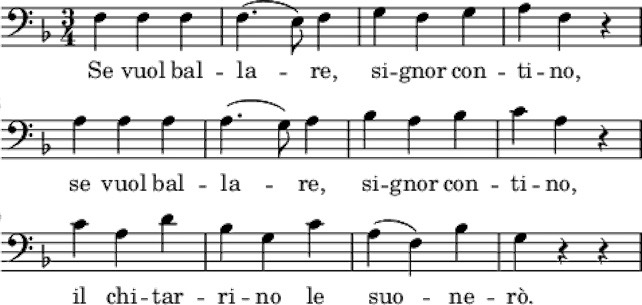
“Se vuol ballare (signor contino)” [‘If you want to dance (my little count)’] an aria for bass from the first act of the opera
… The song is sung by Figaro upon discovering the count’s ploys to exercise his newly reasserted feudal Droit du seigneur, the ius primae noctis to sleep with Figaro’s wife Susanna [AZ: that is, impose himself on her sexually, against her will] before the consummation of their marriage. Figaro sings of how he will unravel the count’s schemes and thwart him [AZ: which he eventually does, largely through the efforts of Susanna and the Countess working together]. Written a mere three years before the French Revolution, it can also be read as a political attack on the power-wielding nobility of the time.
Together, the clever, scheming, sweetly sexy, and deeply good-hearted common folk Figaro and Susanna are the moral as well as the narrative centers of the opera, and “Se vuol ballare” is Figaro’s mocking anthem against the oppressive and morally rotten upper class, his “Aux armes, citoyens“, framed as an immensely catchy dance tune in 3/4 time (the earworm will be with me for days now):
… ‘I’ll play the little guitar for you’ … and eventually: Tutte le macchine roversecerò ‘All of your schemes I’ll turn inside out’
How scandalous.
Figaro as an ensemble opera. The three Mozart / Da Ponte operas are all ensemble affairs. Così fan tutte is a minimalist gem, all done with three interrelated pairs of two characters each. Don Giovanni and Figaro, however, are sprawling affairs, with roughly twice as many named characters as Così, involved in overlapping plot lines in intricate ways (take a glance at the daunting plot summaries in Wikipedia). Don Giovanni has a creepy supernatural subplot (recall the climactic descent into hell). Figaro — a comic opera with plenty to laugh at in it — has an absurd subplot that to a modern audience looks like it was taken out of Gilbert & Sullivan (you can hear Anna Russell cackling, “But he can’t marry her, ’cause she’s his mother!).
Putting aside that silliness, it’s a fabulously composed structure for 11 characters joining to sing together in varying groups, a structure carefully put together by Mozart not to be noticeable to the engaged listener (contrast Mozart with Beethoven, who couldn’t help showing off some of his clever compositional tricks, like an actor — Marlon Brando comes immediately to mind — visibly inhabiting one of his characters; Mozart effaces his cleverness so that you appreciate the effect subliminally). From the Wikipedia article on Figaro:
Charles Rosen, in The Classical Style [notes] the “richness of the ensemble writing”, which carries forward the action in a far more dramatic way than recitatives would. Rosen also suggests that the musical language of the classical style was adapted by Mozart to convey the drama; many sections of the opera resemble sonata form. By movement through a sequence of keys, they build up and resolve musical tension, providing a natural musical reflection of the drama.
… [On] the closing numbers of all four acts: as the drama escalates, Mozart eschews recitativi altogether and opts for increasingly sophisticated writing, bringing his characters on stage, revelling in a complex weave of solo and ensemble singing in multiple combinations, and climaxing in seven- and eight-voice tutti for acts 2 and 4. The finale of act 2, lasting 20 minutes, is one of the longest uninterrupted pieces of music Mozart ever wrote. Eight of the opera’s 11 characters appear on stage in its more than 900 bars of continuous music.
Oh, and then the grand finale (for act 4) brings 10 of the 11 characters onstage to sing together in various combinations while they wrap up the plots. That’s one crowded stage, and the effect is delightful.
Appendix: multiple sexual partners. Don Giovanni, and Count Almaviva too, are often referred to as libertines, but that’s a whitewash for some very ugly sexual behavior, so long as you take libertine just to be a nice way of saying slut (without regard to the sex of the slut or the sex of the slut’s partners) — conveying not only multiple sexual partners and also the opprobrium of immorality, but without any imputation of force, imposition, contempt, malicious deceit, or brainwashing. All of the latter figuring in the behavior of Don Giovanni and Count Almaviva, which I would characterize as proto-rapist, sometimes clearly over the line.
The world of taking multiple sexual partners is enormously complex, with all manner of ways of folding this bit of behavior into the larger fabric of lives and relationships. I could tell stories — some of them mine — for hours, but I have no overarching account of this world, I’m just flagging the problem for today. But I can’t leave the vileness of Don Giovanni and Count Almaviva, which Mozart and Da Ponte certainly deplored, escaping under the banner of libertinism.
February 20, 2024 at 8:09 am |
I may be about to get a bit long-winded here; that’s what you get for writing about my favorite operas.
(1) About the “political” aspect of Figaro: My understanding (without knowing details) is that the Beaumarchais play on which the libretto is based is much more overtly political, with speeches by Figaro decrying the established order, etc. In addition to the normal necessity of trimming the play to make up for the fact that it takes longer to sing words than to say them, I gather that Mozart and da Ponte felt it necessary to avoid anything explicitly political for fear of censorship by the Austrian authorities.
(2) In modern productions, all 11 characters appear in the finale; the reason it wasn’t written that way is that, in Mozart’s day, the roles of Bartolo and Antonio were performed by the same person.
(3) Every December, WQXR (New York City’s classical music station) solicits votes from its audience to determine the 100 or so “favorites” that the station will air over the final 4 or 5 days of the year. Le Nozze di Figaro and Don Giovanni invariably make the cut, and of course they can’t take the time to play them in their entirety, so the provide excerpts, and I am invariably annoyed that they concentrate on famous arias and never include examples of Mozart’s wonderful ensemble writing (well, sometimes they include Là ci darem la mano, but that’s about it).
(4) Yeah, those two guys are nasty pieces of work, but they get some of the best music, something I as a baritone especially appreciate.
February 21, 2024 at 7:47 am |
Oh, and one additional tangential note: The title page of the original score of the opera we know as Don Giovanni gives the primary title as Il dissoluto punito, with the name of the principal character as an alternative title (in smaller print, if I remember correctly). Which kind of gives the game away, in case one didn’t know how it was going to end.