That’s what the fuzzy sign said that was being passed around on Facebook, in appreciation of its unintended ambiguity: it’s supposed to be exhorting us to oppose hate (with noun hate), but it could be telling us to do our hating on our feet (with verb hate); consider some parallels in which the N and V readings are pulled apart:
Stand Up To Hatred [N reading] OR Stand Up To Execrate [V reading, with understood object]
Stand Up To Yelling [N] OR Stand Up To Yell [(intransitive) V]
Stand Up To Urination [N] OR Stand Up To Urinate [ (intransitive) V]
I’ll look at the ambiguity in detail in a little while. But first some words about slogans, like the one on that fuzzy sign.
Sloganmongering. That fuzzy sign with the ambiguous slogan was passed on to me on Facebook on 4/24 by Joelle Stepien Bailard. I wrote to JSB:
— This would be fodder for my unintended ambiguities collection, but since the photo is unsourced and not located reliably in an actual place, it looks like an invention. (These days, most photos on FB are suspect.) I’d hoped to find an original via Google search, but what I got were (what appear to be genuine) signs for: STAND UP TO JEWISH HATE, STAND UP AGAINST HATE, and SAY NO TO HATE, so STAND UP TO HATE isn’t implausible, I just can’t find an actual example of it. So as things stand, it’s not a funny example from real life, but Something That Could Happen — or something that with some effort could be worked into a joke.
JSB countered that Google offers photos of t-shirts and the like with STAND UP TO HATE. Ah, I had searched specifically for signs, but now with clothing we were in business, with clothing from several reliable sources, just one of which I’ll mention here.
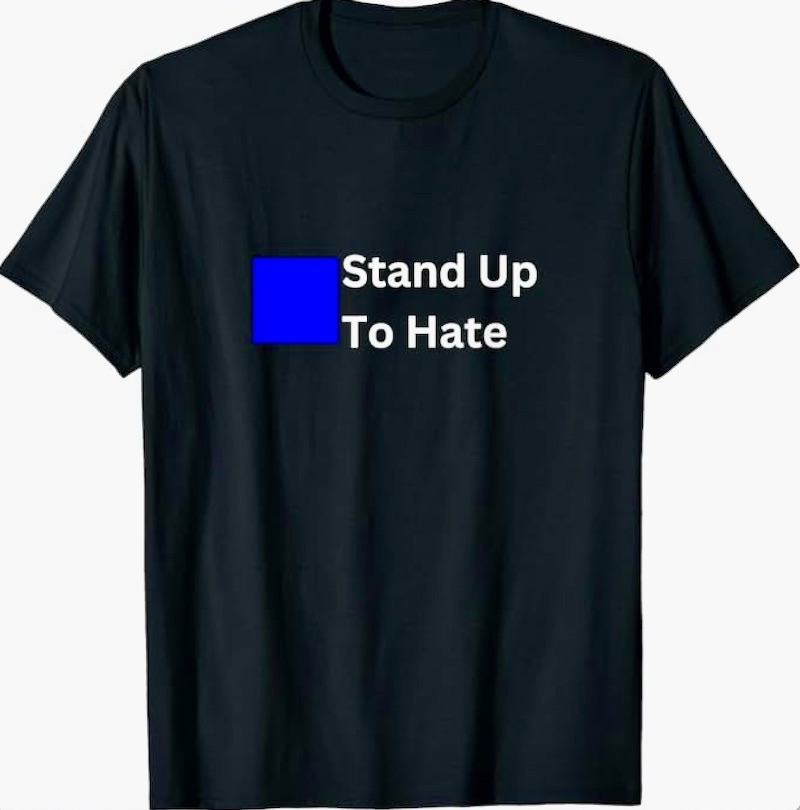
Robert Kraft’s FCAS. The Foundation to Combat Antisemitism sells Stand Up To Hate shirts (available in black and pink, and in shirt styles: t-shirt, sweatshirt, V-neck t-shirt, long sleeve t-shirt, hoodie, and tank top) plus Stand Up To Jewish Hate and Stand Up To All Hate — all with the Blue Square emoji 🟦 opposing antisemitism:
(#1) The FCAS Stand Up To Hate t-shirt in black
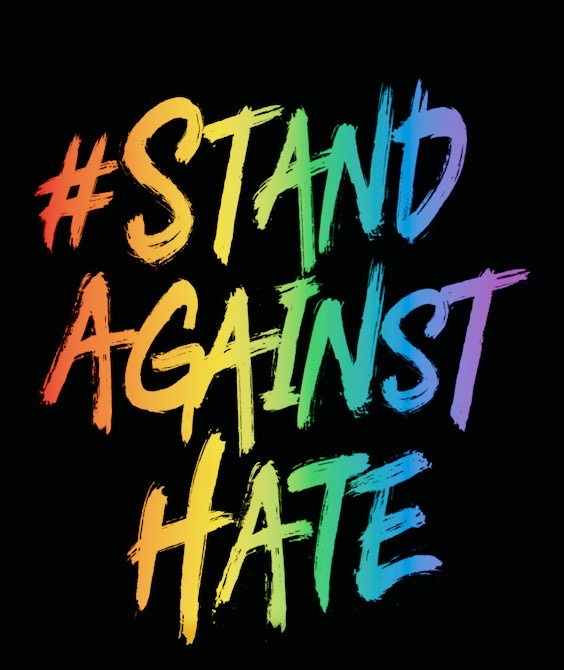
The AHF logo. Meanwhile, yet another ambiguous slogan — Stand Against Hate (and its variant Stand Up Against Hate) has made its way onto clothing (and stickers and the like), via the AIDS Healthcare Foundation. In various letter styles — including pride rainbow, as here:
(#2) Not a N vs. V ambiguity, but entirely a matter of linked ambiguities in the V stand and the P against having to do with the mental (opposing something) vs. the physical (being on or rising to one’s feet, being in contact with or coming into contact with something) — though with the physical reading hard to contextualize with an abstract direct object like hate
The lexical background. From NOAD, as relevant to the ambiguous expression stand up to hate:
verb stand up: 1 rise to one’s feet: the two men stood up and shook hands
phrasal verb stand up to: 1 (stand up to someone or something) make a spirited defense against someone or something: many workers are afraid to stand up to their employers.
The verb stand up can occur with various adverbial modifiers, among them an infinitival VP — infinitival to + a BSE-form VP (like yell or urinate) — expressing purpose.
The phrasal verb stand up to takes NPs as objects of the preposition to, including bare abstract nouns (like yelling or urination).
So stand up to V and stand up to N have very different structures. But there are a huge number of English words W that are ambiguous as between V and abstract N (with a variety of historical sources), among them hate (and love and most of the demotic vocabulary for bodily excretion, like sweat, spit, pee, and crap). So there are also a ton of ambiguous stand up to W examples like #1.
As for stand (up) against hate, there are two linked ambiguities, in the verb stand and in the preposition against; from NOAD:
verb stand: 1 [a] [no object, usually with adverbial of place] have or maintain an upright position, supported by one’s feet: Lionel stood in the doorway | she stood still, heart hammering | to improve your balance, practice standing on one foot. [b] rise to one’s feet: he pushed back his chair and stood. … 3 … [b] adopt a particular attitude toward a matter or issue: students should consider where they stand on this issue.
prep. against: 3 in or into physical contact with (something), so as to be supported by or collide with it: she stood with her back against the door | his lips brushed against her hair. … 1 [a] in opposition to: the fight against crime | he decided against immediate publication | swimming against the tide.
The contrast is between physical state or action and mental state or action. The slogan stand (up) against hate in #2 intends the mental understandings, but the physical ones are also available, if hard to contextualize. In any case, it’s totally different from the ambiguity in #1.
Leave a Reply