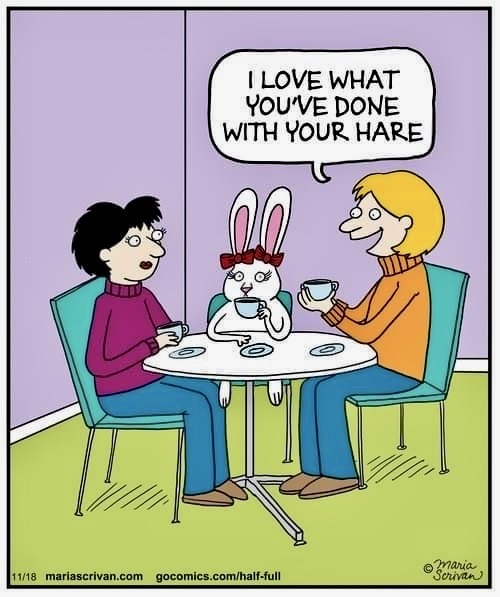
🐇 🐇 🐇 three rabbits to inaugurate the new month, 🃏 🃏 🃏 three jokers for April Fool’s Day, and 🌼 🌼 🌼 three jaunes d’Avril. yellow flowers of April, all this as we turn on a dime from yesterday’s folk-custom bunnies of Easter to today’s monthly rabbits; for this intensely leporine occasion, a Maria Scrivan hare-pun cartoon:
(#1) (phonologically perfect) pun hare on model hair, taking advantage of I love what you’ve done with your hair as an common exemplar of the stock expression (I) love what you’ve done with X; a cartoon posted on Facebook by Probal Dasgupta, who reported, “Even I groaned at this one”
Things to talk about here: my use of turn on a dime just above; Easter + April Fool’s; the yellow flowers of April (which will bring us to Jane Avril — Fr. Avril ‘April’); and the stock expression (I) love what you’ve done with X.
turn on a dime. From NOAD (under the noun dime), a somewhat too-specific definition for the idiom on a dime:
phrase on a dime: North American informal used to refer to a maneuver that can be performed by a moving vehicle or person within a small area or short distance: boats that can turn on a dime.
stop on a dime and turn on a dime are both common instances of the idiom; pivot on a dime and reverse on a dime are both attested, and I’m sure there are more. But on a dime is also used used for actions performed in a short period of time (rather than space), as in the well-attested respond on a dime ‘respond almost immediately’.
The idiom is metaphorical, based on the dime’s being the smallest-sized US coin, so you can use it to refer to tiny amounts of space or time.
Easter + April Fool’s. My 4/1/18 posting “Easter Fool’s” was about 4/1/18’s being simultaneously Easter Sunday and April Fool’s Day. In 2024 they’re consecutive; we’ve turned on a dime from Easter to April Fool’s Day. Both occasions come with rabbits, hence the relevance of Maria Scrivan’s wonderful pun.
The yellow flowers of April. Les jaunes d’Avril. It’s the season for yellow crocuses and yellow daffodils, and eventually yellow tulips. With yellow as the color of early spring, in April. Treated in my 5/1/19 posting “The May flower” — about white muguets as the flower of that month, but with a long look backward at yellow April.
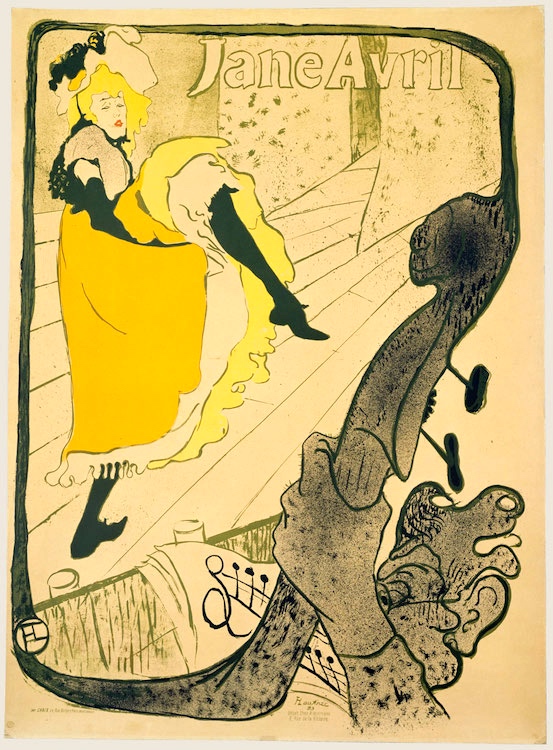
April and the color yellow, as put together by Toulouse-Lautrec’s 1893 poster of the can-can dancer Jeanne Louise Beaudon, whose stage name was Jane Avril:
(#2) Jane Avril, a vision in yellow
(I) love what you’ve done with X. The format for a family of exclamatory compliments, of which I love what you’ve done with your hare in #1 is an instance. The syntax of these expressions is fairly complicated, but their meanings and uses are deducible from their syntax; they are not idioms. They do, however, have something special about them: they come easily to hand; they are, so to speak, at the front of the shelf of expressions for these purposes; they are stock expressions.
I’ll refer to this family as LWYDW, after the words in the format:
the main verb love;
with an interrogative-clause object introduced by indefinite what representing the direct object in that clause;
with the addressee pronoun you as the subject in that clause;
with activity do as the verb in that clause;
and with the preposition with marking an oblique object (referring to material used for some purpose) in that clause.
Now, comments on a few of the parts of LWYDW (with no pretensions to completeness).
The main verb love (or its less extreme variant like) is conventionally used in exclamations of admiration, hence normally has a 1st-person subject there (though of course reports of other people’s admiration can have other subjects):
Love your hat! Love how you walk! Love the furniture arangement! Like that bathing suit!
Omissible subject I. In informal registers in English, a main-clause subject I is generally omissible — in a type of informal “subject-drop”. As in the examples just above, and in:
Hate to tell you this, but your photos are all upside down. Knew right away that we’d be friends.
Exclamatory reinforcement. Exclamations can occur with the reinforcing adverb just ‘really’ (vs. just ‘only, merely’):
Just love your hat! ‘I really admire your hat!, What a wonderful hat!’
and in LWYDW examples like:
Just love what you’ve done with your hair!
Objects of activity do. This verb freely occurs with indefinite objects:
do something / nothing / everything / (negated) anything / (interrogative) what / a little / little / a lot / much
As in:
I can’t do anything with my hair. I can do a lot with my hair. What have you done with your hair? I love what you’ve done with your hair!
Objects of the preposition with in LWYDW. These are
— the / this / your place
— your N, where N is hair, makeup, an item of apparel (belt, shoes), a household furnishing (rug, quilts), a dwelling (house, apartment) or room in one (kitchen, bathrooms), or anything else that can be (re)designed or decorated or otherwise artfully arranged or altered
Then, given the stock expression, you can fool around with the format for other purposes, as I did in my title for this posting:
Love what Scrivan did with the rabbit pun!
xx
April 2, 2024 at 6:09 am |
It’s the season for yellow crocuses and yellow daffodils, and eventually yellow tulips.
Also Forsythia, at least in these parts.