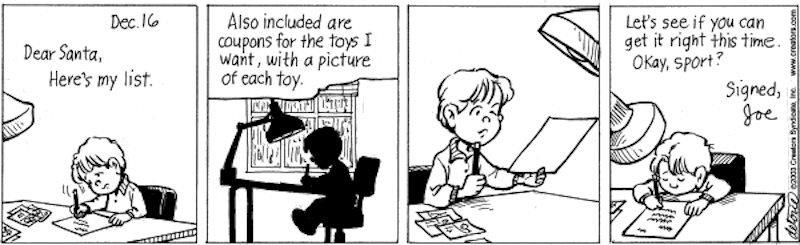
An old One Big Happy strip that recently came up in my comics feed:
Joe writes to Santa with a very specific gift list, with an accusatory flourish at the end (presupposing that in earlier years Santa had failed to honor Joe’s requests and telling Santa that now it’s time for the old guy to get it right) in which he addresses Santa as sport
This is one of those occasions where I pose questions that I’m in no position to answer, because I don’t have the resources to pursue them. I am an address terms guy — see the Page on this blog with links to my postings on the topic — but sport isn’t a term I use myself, so I have no self-report data on it; and though dictionaries have some useful information on sport, they aren’t able to describe the complexities of usage of address terms like it; and, finally, sport is not one of the high-frequency address terms (like guy) that have gotten the attention of variationist sociolinguists, so we have no systematic data on the way it’s used.
Even so, my first response to Joe’s use was that it was odd. Somewhat antique, but more significantly, impertinent — treating Santa as if he were an equal, or in fact a subordinate. My impression is that Santa, in a somewhat old-fashioned way, might amiably address a little boy as sport, but little kids don’t talk to adults (especially powerful adults) that way. Such an impertinence would, however, fit right in with Joe’s challenge to Santa to get with the program of supplying Joe with the toys he’s asking for (well, demanding). Cheeky monkey.
Previously on this blog. From my 11/17/10 posting “Data points: address terms 11/17/10”, on the address terms pal and sport:
These are both address terms used by men to men — a rich lexical field on its own, without getting into the full collection of address terms available in English. Address terms in general are famously complex pragmatically, varying dramatically in their import depending on who’s using them to who in what contexts, and sociolinguistically, with different uses by different social groups, changing over time
… without the context, we can’t tell whether a vocative use of pal conveys male friendship, neutral male reference, or socially distant male reference
… But what strikes people I’ve talked to … is that vocative pal is not something they’d use, nor can they recall occasions where they’ve heard it; it sounds quaint, like something in an old movie (with smart-talking reporters, cops, private eyes, bartenders, and the like). It’s a high-masculinity address term, but somewhat old-fashioned.
… as with pal, male-address sport strikes me as somewhat old-fashioned. Somehow it got written into Ken Mack’s lines in [the gay porn film] Arcade on Route 9 to establish his persona as older (and more experienced) trucker talking to a [teenager], establishing himself as the boy’s “best buddy” who’s going to teach his very willing student about “that dirty sex stuff”.
So: from a powerful older authority to a young man. Hard to imagine the kid in Arcade addressing the trucker as sport, though my impression is that if he did, he’d be positioning himself as the trucker’s equal (rather than his acolyte) and framing their sexual liaison as mutual satisfaction rather than as a learning experience for the kid: goodbye “thank you, Daddy”, hello “great sex, dude”.
Cousin of sport. Revisiting sport put me in mind of the phonologically similar address term scout. Which, however, comes with a very different usage profile from scout, though actual data for the address term seems to be extraordinarily sparse. So I start with notes on referential scout. From NOAD:
5 informal, dated a man or boy: I’ve got nothing against Harrison — he’s a good scout.
Compare subentry 1, for someone who gathers — scouts out — information; and subentry 3, for Boy Scouts (and Girl Scouts too). And note the example, with good scout — an approving use of scout, indeed the typical collocation for scout. The OED on scout is still unrevised and lacks this (positive) generic use. But GDoS covers it:
4 in positive sense, a person, esp. as good scout, an admirable person [the popular image of the Boy Scouts] [1st cite from 1912; lots of good scout examples]
The referent of this scout is typically male. A vocative use would presumably preserve the central characteristics of this scout: judgmental, positive in affect, addressing a male. So probably most likely to be used by a man to another male, of equal or subordinate status; Santa might use it to a boy, but a boy wouldn’t use it to Santa. (In any case, like sport, it’s dated, somewhat antique.)
My sources have exactly one instance of vocative scout: from GDoS:
1998 [Irish novelist] Joseph O’Connor, The Salesman [set in Dublin] Are y’all right there, scout?
Here things grind to a halt. It would take me some weeks to get hold of a copy of the book, and then I’d have to search through it to find the cite in context, without which the quotation is inscrutable: who’s saying what to who? for what reason? and what was the Dublin English of the mid-20th century like?
I have no idea, but my feeling is that scout in the context of the One Big Happy strip above would be even odder, and more impertinent, than sport.
February 6, 2024 at 6:02 pm |
And the similar question, Why is the tomboy narrator called Scout in To Kill a Mockingbird? The website SparkNotes says: “The exact origin of Scout’s nickname is never clearly stated; however, it is heavily implied that her moniker is derived from her curious nature that leads her to observe and ask questions about the world.”
February 6, 2024 at 6:39 pm |
From the discussion of this posting on Facebook (edited a bit):
— Joel Levin: When I think of addressing someone as scout, the first person who comes to my mind is Jean Louise Finch from “To Kill a Mockingbird”.
— AZ > JL: I probably should have forestalled this in the original posting. But this isn’t addressing someone as scout; it’s addressing someone by the name (in this case nickname) Scout.
This is the difference between addressing someone as guy (as in Hey, guy, put down that wrench) and addressing Guy Lombardo as Guy (as in Hey, Guy, lend me your tux). Similarly with buddy: Hey, buddy, how’s it hanging? vs. Buddy to Buddy Hackett (Hey, Buddy, where’d you get that joke?).
February 6, 2024 at 7:05 pm |
More from the Facebook discussion (again, edited some):
— Ben Yagoda: Brings to mind The Great Gatsby, where according to this from the books community on Reddit, Gatsby uses vocative old sport 40 times:
[hulksmashpatriarchy] As I read The Great Gatsby, I kept a record of how many times Gatsby says old sport.
He says it a total of 40 times, although once is in Nick’s imagination. There were very few pages in which Gatsby had dialogue and didn’t say it.
Bonus: Tom says old sport twice while mocking Gatsby.
[MHaaskivi] Bonus: Holden Caulfield (who says his favorite book is Gatsby early on) also calls everyone sport.
https://www.reddit.com/r/books/comments/8rn31f/as_i_read_the_great_gatsby_i_kept_a_record_of_how/
— BY: Tom Buchanan calls him on it:
“That’s a great expression of yours, isn’t it?” said Tom sharply.
“What is?”
“All this ‘old sport’ business. Where’d you pick that up?”
“Now see here, Tom,” said Daisy, turning around from the mirror, “if you’re going to make personal remarks I won’t stay here a minute. Call up and order some ice for the mint julep.”
— AZ >BY: Ah, the summer we all went to Gatsby’s was a hundred years ago, but still I should have remembered this (I had a long, Princeton-induced, Fitzgerald period).
February 7, 2024 at 6:29 am |
More from Facebook discussion (again, somewhat edited), back on scout, in response to my posting this vocative example:
1998 [Irish novelist] Joseph O’Connor, The Salesman [set in Dublin] Are y’all right there, scout?
— George Reilly [writing from Dublin]: I haven’t read this book, but Are y’all right there sounds very working class Dub. I’ve never heard anyone addressed as scout, however, but I’m guessing that it’s meant as a term of endearment.
[suggesting a possible source of further examples:] Roddy Doyle is probably the best-known novelist writing about working class Dublin over the last 30 years. If you look at all the posts on his page that have pictures of pints of Guinness, you’ll find little stories told in dialogue.
— AZ > GR: My guess was that the O’Connor cite was understood like “You ok, buddy / mate?” (expressing affectionate concern).
Then a bonus from George (eliciting a wow from me):
— GR: Joseph is Sinead O’Connor’s brother, btw. Here’s “Blackbird in Dún Laoghaire”, the poem Joseph O’Connor recited at Sinéad O’Connor’s funeral:
https://www.independent.ie/irish-news/blackbird-in-dun-laoghaire-the-poem-joseph-oconnor-recited-at-his-sister-sinead-oconnors-funeral/a884775607.html