Archive for the ‘Semantics’ Category

bob’s extortion / appeasement cartoon

April 21, 2025

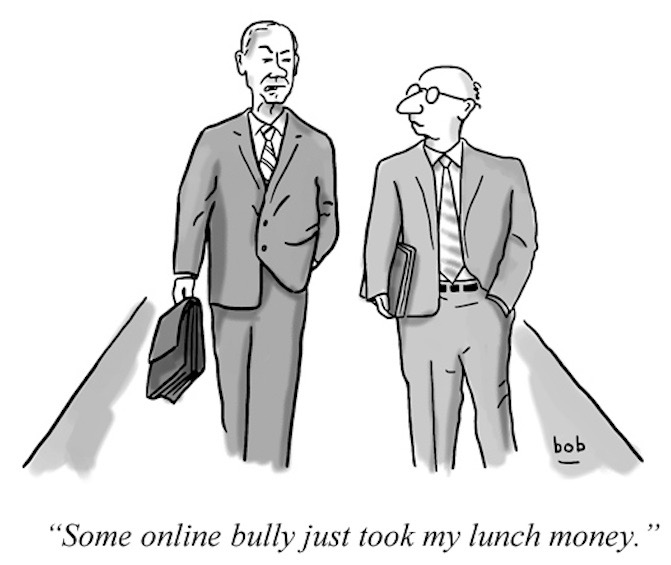
The cartoonist is bob, whose full name is Bob Eckstein, and the one-panel gag cartoon in question is a very recent one (from the May 2025 issue of Funny Times) and a pointedly topical one — and I greatly admire it:


bob’s lunch money cartoon; the cartoon — showing a middle-aged businessman who’s been somehow, absurdly, extorted for his lunch money online (just the idea of such a person having lunch money is funny) — would be entertaining in any circumstance, but in a world in which the US president is attempting  to use online declarations to extort services and actions from various institutions (universities, law firms, media outlets, businesses), it’s painfully relevant
(For information about everything bob, see his official website)

The flip side of extortion is appeasement. So we are to assume that the businessman somehow appeased that bully by giving up his lunch money. Rather than fighting back — though it’s not clear to me what the online equivalent of punching the bully in the nose would be (but maybe Harvard is showing us the way). In any case, he probably believes be has gained, as Neville Chamberlain once thought, peace for his time. If so, he is doomed; today the lunch money, tomorrow the check at République. It never ends, it just gets worse, he’s on the hook, the poor sap.

So, to come: the English verbs extort and appease, with some lining-out of their meanings in detail, plus an excursus on Peace for / in our time.

(I know, I know, you let a linguist in the house, and suddenly you’re getting Little Lectures on Language. Life is perilous. Just be thankful I’m sparing you a gender and sexuality take on bob’s cartoon. There’s always a language point, in whatever, and there’s always a gender and sexuality take too, you just have to know how to look.)
(more…)

One of these things is not like the others

April 14, 2025

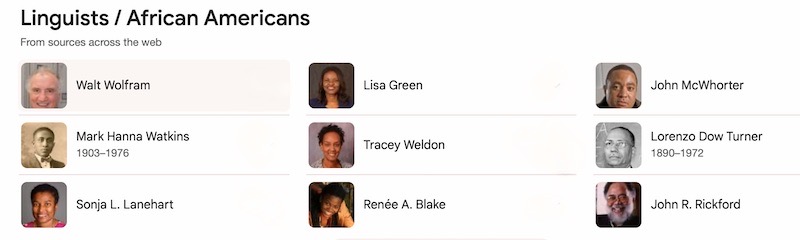
This morning, for complex reasons that shouldn’t concern you here, I did a Google search on “African American linguists”, not reckoning on what might happen with Google’s AI-guided search. This astonishing result, a page with the first 9 of 13 items retrieved:


2 historical figures, 7 living linguists; of those living linguists, 4 are women, 3 are men; of those men, two are African Americans, but the linguist in the position of greatest prominence, at the top left, Walt Wolfram, is not like the other 8 linguists: WW is a strikingly European — specifically German — American

Now, if there were a gold medal for wokeness, WW would surely have retired it for life, but he doesn’t belong in a display of African American linguists.

Thing is, Google hasn’t answered the question that I (implicitly) asked, Who are some linguists who are African American? (which might have pulled up, say, Ken Naylor, who studied the dialectology of what was then called Serbo-Croatian), but instead answered a somewhat similar question it had the answer to, Who are some linguists who have studied African American English? (which should pull up at least Bill Labov, Roger Shuy, and WW, all of whom are white).

Wokeness. From NOAD:

adj. woke: alert to injustice and discrimination in society, especially racism … (1960s: originally in African American usage)

Expanded on in a Wikipedia article:

used since the 1930s or earlier to refer [AZ: especially by African Americans of other African Americans] to awareness of racial prejudice and discrimination, often in the construction stay woke.

… By 2019, the term was being used sarcastically as a pejorative among many on the political right and some centrists to disparage leftist and progressive movements as superficial and insincere performative activism. [AZ: heavy sigh]

Encomia. I was sure that I had posted an encomium to WW and his remarkable career studying the language of, and supporting the communities of, African Americans (and Appalachians and Carolina Tidewater folk too), with all the passion he has devoted to sports (he played basketball, baseball, and football at Olney High School in north Philadelphia many years ago, and seems never to have met a sport he didn’t like). But I can’t find it in my files. Well, you can see the outlines of it from what I just said; he’s been a model of engagement and energy for the rest of us.

It’s probably a garrulous-codger thing, but I’ve been into encomia recently (see my previous posting, on Sonja Lanehart); well, it’s a great pleasure to write encomia for living people, rather than elegiac death notices.

One of these things. Music by Joe Raposo, lyrics by Jon Stone for Sesame Street (1968):

One of these things is not like the others,
One of these things just doesn’t belong,
Can you tell which thing is not like the others
By the time I finish my song?

Of course you can.


Hybrid portmanteaus

March 31, 2025

🐅 🐅 🐅 three tigers for ultimate March, the day on which the tigers eat the lambs that the month proverbially goes out as; my posting for this morning begins with tigers, but only so I can slide into the real topic:

the hybrid portmanteau ‘a portmanteau (name) for a hybrid (creature)’ — as in the names liger (lion + tiger) ‘hybrid of a male lion with a tigress’ and tigon (tiger + lion) ‘hybrid of a male tiger with a lioness’, as opposed to unmixed names for hybrids, like mule ‘hybrid of a male donkey and female horse’ and hinny ‘hybrid of a male horse and a female donkey’. Hybrid portmanteaus are iconically satisfying: intimate name-melding (through the combination of word-parts) signifies intimate creature-melding (through mating).

From this beginning, I will rapidly descend to the hybrid portmanteau triceradoodle (the creature is a preposterous hybrid of a triceratops and a poodle) and eventually to the double hybrid portmanteau composite Gerberian Shepsky (an actual dog breed, a hybrid of a German shepherd and a Siberian husky)

(more…)

Misleading

March 29, 2025

My note on Facebook on 3/26 about one small point in the Signal Chat affair:

Listening fairly carefully to testimony yesterday in the Signal fiasco, I realized that some of those questioned were not only dodging questions and not recalling stuff but also framing answers so that they were (arguably) accurate, but only with the wording understood in a particular technical way. So that they said there were no war plans — because the plans were, technically, attack plans, not war plans. And that there was no classified intelligence — because the classified information was, technically, plans, not intelligence.

It reminded me of a ritual performed by a Muslim friend at a wonderful dinner at Ann and Bonnie’s in Princeton some 65 years ago (Eqbal and Ann are long dead, but Bonnie in Colorado and I in California squeak by), during which glasses of excellent wine were poured. Eqbal took a napkin, dipped a finger in his wine and flicked a drop of wine onto the napkin, then raised his glass and led a toast to Ann. A while later, we asked him what the flicking was about.

“Oh”, he explained, “the Qur’an teaches us: Thou shalt not drink one drop of wine. I was merely obeying the injunction”.

(more…)

May I take your coat?

February 7, 2025

A Sandra Boynton turkey cartoon from 1980, showing a  (polite) offer framed as a request in the form of a question, using the formula May I VP?:


(#1) The exchange — with the offer made by a turkey who appears to be an attendant at a women’s checkroom (see the window in the background, with women’s dresses on hangers in the room behind the window) — follows the polite service script (involving an attendant and a customer, female in this case) in the first two panels, then runs off the rails in the third panel, where an ambiguity in the verb take rears up; the turkey assumes ownership of the coat and walks off with it as their own, leaving a nonplussed coatless customer

Three things here: the turkeys (who are a long-standing thing for Sandra Boynton); the polite service script (which incorporates conventionalized versions of some very indirect speech acts); and the ambiguity of take (which provides a surprise shift from the sense appropriate to the service script to an outrageous and dumbfounding larcenous sense).

(more…)

The etiquette lesson

February 3, 2025

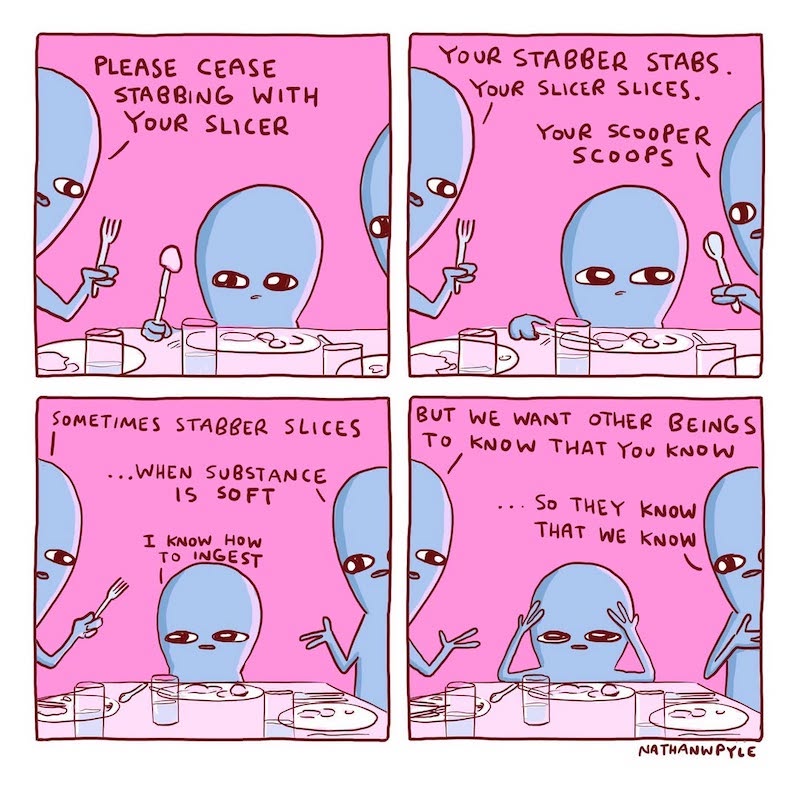
Nathan W. Pyle’s Strange Planet strip from 1/27/25:


Pyle’s beings on an alien planet cope with the sociocultural world of this one with their views framed in a variety of English that lacks the usual terms, so they concoct fresh ones (slicer for knife, stabber for fork, scooper for spoon, ingest for eat); in this strip, the subject is the education of the young in the etiquette of dining, and it comes with a meta-lesson

(more…)

Beanies, baby

January 31, 2025

🐅 🐅 🐅  three tigers for ultimate January, and a day continuing the theme of late-January early-death birthdays: Robert Burns, Wolfgang Amadeus Mozart, and Edward Sapir in an earlier posting of mine (“Luminous birthdays” from 1/26); now, Anton Chekhov two days ago and Franz Schubert today

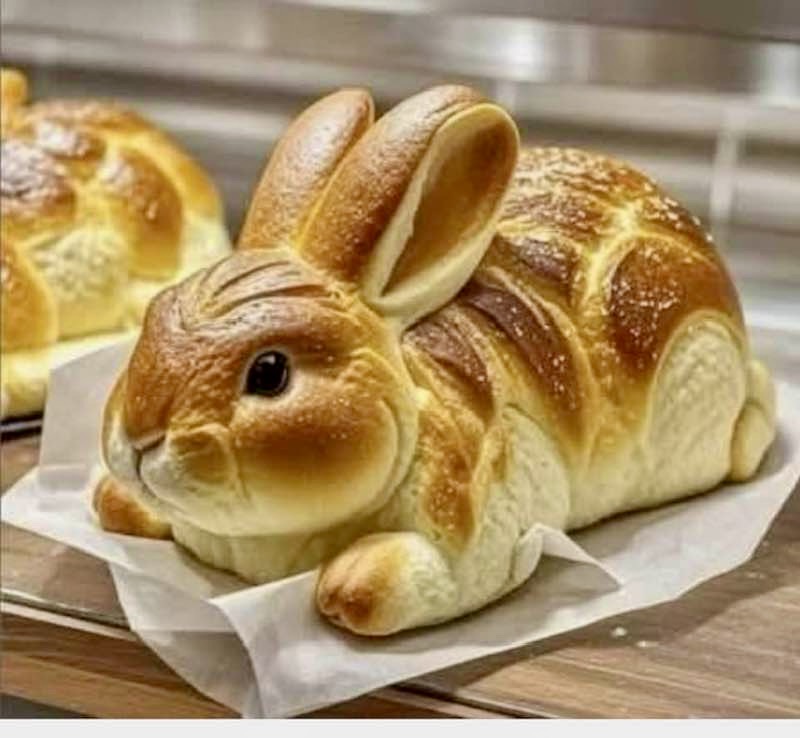
Meanwhile, tigers savage rabbits, but the rabbits of February are clamoring at the door, growing in size and ferocity, and are now prepared to chew up the tigers like mere blades of grass. A monument in bread to the coming triumph of these adorable but gigantic bunnies:


(#1) Today: from Benita Bendon Campbell, who got it from Jacqueline Martinez Wells

(more…)

Hooray for constructions, positive licensing, and GKP

January 30, 2025

Yesterday, Laura Michaelis (Univ. of Colorado-Boulder co-author of, among other things, the 2020 Cambridge book Syntactic Constructions in English) alerted me to an article by Philip Miller (Université Paris Cité) & Peter W. Culicover (Ohio State Univ. & Univ. of Washington), “Lexical be“, Journal of Linguistics (2025), 1-24 — truly, hot off the press — which argues, in elegant detail, for a constructional approach to syntactic description, involving the positive licensing of constructions (rather than (negative) constraints on syntactic structures), and also honors Geoffrey K. Pullum (Professor Emeritus of General Linguistics at the University of Edinburgh).

So, yes, a fair amount of technical stuff, showing a bit of how (some) linguists approach the description of the syntax of one language and how they dispute with one another over the form of such descriptions. (I’m mostly just an observer here, but you should know that everyone I just mentioned — Michaelis, Miller, Culicover, Pullum — has been a departmental colleague or co-author of mine, so I have to be seen as a participant-observer, as we say in sociolinguistics.)

(more…)

The homoerotic lure

January 17, 2025

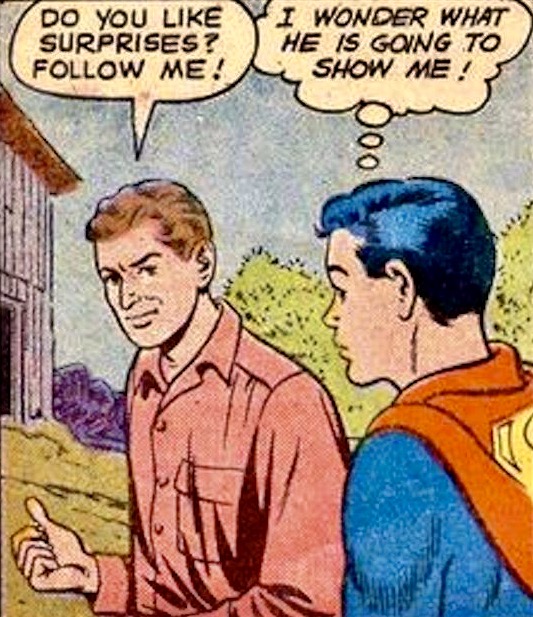
From Tim Evanson on Zuckie’s Playroom this morning, this snapshot from the superhero archives:


It’s a come-on, promising surprises, offering to show the boy delightful things; homoeroticism shimmers beneath his words

The lexical background, from NOAD:

noun come-oninformal a gesture or remark that is intended to attract someone sexually: she was giving me the come-on.

And then the great homoerotic come-on to a boy in film:

(more…)

“I am th’ skee-ball”: Zippy’s arcade poem

January 12, 2025

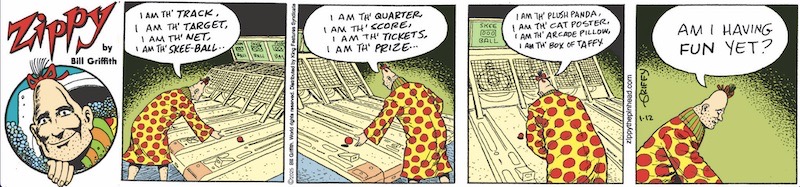
In today’s Zippy strip, the muu-muued Pinhead is at the arcade, celebrating the game of skee-ball in verse in which he identifies with — becomes one with — inanimate objects, the material elements of the game:


(#1) Zippy’s self-reflective poem, which I’ll title I Am Th’: three quatrains — of metered but unrhymed verse — that steadily build in complexity, to end in a self-reflective version of Zippy’s tag line Are we having fun yet?

Now: a few words on the poetry of I Am and then on to skee-ball, skee-ball machines, and the games of my childhood and adolescence.

(more…)