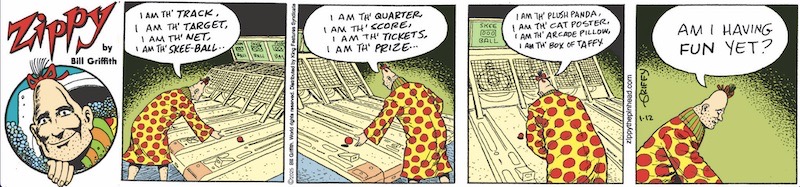
In today’s Zippy strip, the muu-muued Pinhead is at the arcade, celebrating the game of skee-ball in verse in which he identifies with — becomes one with — inanimate objects, the material elements of the game:
(#1) Zippy’s self-reflective poem, which I’ll title I Am Th’: three quatrains — of metered but unrhymed verse — that steadily build in complexity, to end in a self-reflective version of Zippy’s tag line Are we having fun yet?
Now: a few words on the poetry of I Am and then on to skee-ball, skee-ball machines, and the games of my childhood and adolescence.
The poetry of I Am. Three notable examples from poetry.
— John Clare’s I Am (1848): I am the self-consumer of my woes
— Walt Whitman’s Song of Myself (1892 version): I am the mate and companion of people, all just as immortal and fathomless as myself … I am the poet of the Body and I am the poet of the Soul … I am the teacher of athletes
— William Ernest Henley’s Invictus (1920): I am the master of my fate, / I am the captain of my soul.
These are assertions of roles and responsibilities; the am in them is the BE attributing characteristics to the referent of the subject. In Zippy’s poem in #1, in contrast, the poet imaginatively identifies himself with inanimate objects: I am th’ skee-ball. The am in it is the BE of identity.
The game of skee-ball (sometimes spelled skee ball or skeeball). From Wikipedia:
Skee-Ball is an arcade game and one of the first redemption games. It is played by rolling a ball up an inclined lane and over a “ball-hop” hump (resembling a ski jump [AZ: hence the name skee-ball]) that jumps the ball into bullseye rings. The object of the game is to collect as many points as possible by having the ball fall into holes in the rings which have progressively increasing point values the higher the ring is.
Skee-Ball was invented and patented in 1908 by Joseph Fourestier Simpson, a resident of Vineland, New Jersey.
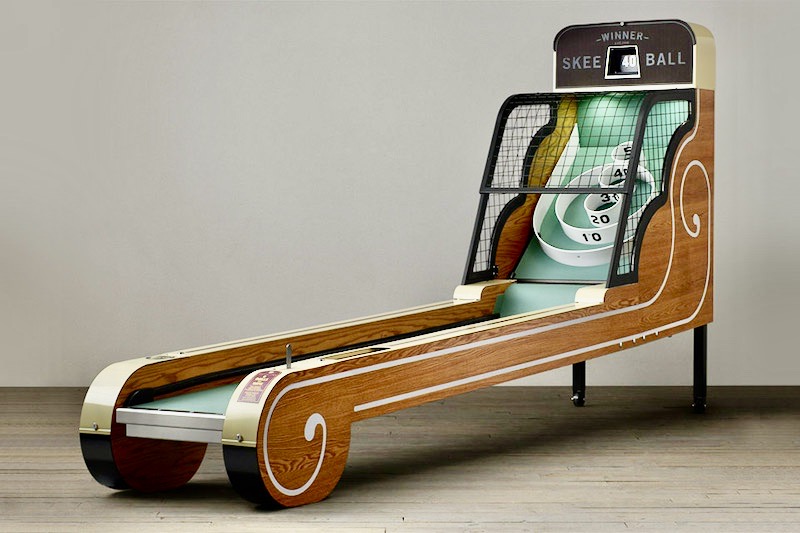
(#2) From Uncrate (“the leading buyer’s guide for men”, with categories Gear, Style, Cars, Shelter, Vices): If you’re feeling a little nostalgic for the days when games were simpler, it might be time to go with an original, the Classic Skee Ball Machine ($7,000). Channeling the vintage look of a 1930s skee ball machine, this one features a hand-finished oak exterior with brass details. With a retro flip scoring display, a pull-handle activation lever, and five balls included with the set, you’ll feel just like you (or your dad) did playing at carnivals and arcades.… Gameplay varies depending on the particular machine but, normally, a player, after inserting appropriate payment, receives a queue of (usually nine) balls made of either polished Masonite or heavy plastic and each approximately three inches in diameter. Each machine has an inclined ramp, 10–13 feet long, up which the player must roll the balls. A sudden increase in incline at the end of the ramp (called the “ball-hop”) launches the balls above the plane of the ramp toward a series of rings that direct the balls into holes of varying point values, with the smallest and hardest to reach usually giving the most points. The machine dispenses coupons to the player, based on scoring thresholds, either during the game or after the game ends. The coupons are typically traded at the arcade for prizes. Some machines award large coupon bonuses to players who attain or surpass a posted high score.
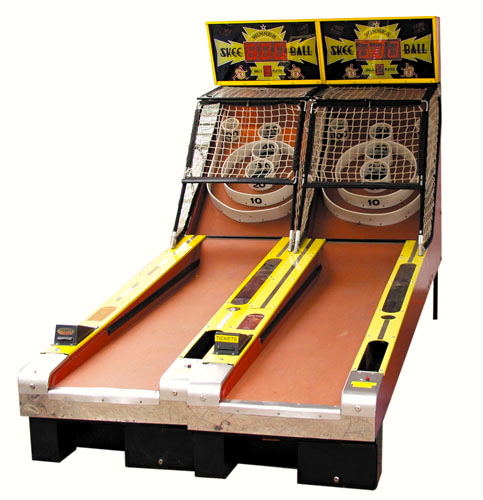
… More traditional skee-ball machines … do not include the two additional “100 points” holes, located on the uppermost corners of the machine, on either side of the “50 points” hole. [AZ: the machines in #1 and #2 are classic machines, without 100-point holes]
An earlier skee-ball Zippy on this blog: my 12/21/14 posting “Snowy lanes”:
(#3) Robert Frost’s Stopping by Woods on a Snowy Evening, taken into many strange places: Moe Howard of the Three Stooges, skee-ball, Fleer’s Dubble Bubble gum, a gondolier, William Blake’s poetry, a strip mall, Joe Biden, and a laundromat

With this illustration of skee-ball machines:
(#4) Two machines with 100-point holes
Childhood memories. As a child, I had little interest in aggressively competitive games and absolutely no aptitude for sports. I didn’t play baseball, basketball, touch football, handball, golf, or tennis; I didn’t bowl, roller skate, or ice skate. I was obliged to play volleyball, and actually enjoyed friendly games of croquet and badminton and, of course, miniature golf (all activities I could enjoy with only minimal competence). Tetherball was as seriously competitive as I got.
Digression on tetherball. From Wikipedia:
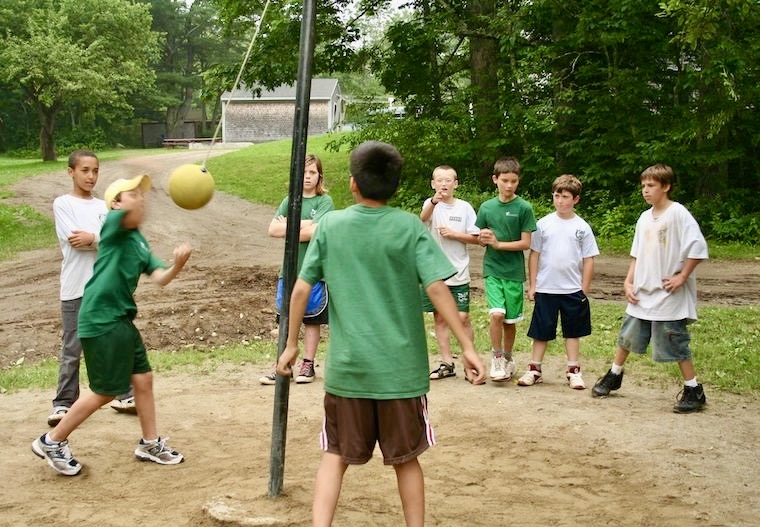
Tetherball is a game where two players use their hands to strike a [ball similar to a volleyball] which is suspended from a stationary metal pole by a rope or tether. The two players stand on opposite sides of the pole, and each tries to hit the ball one way; one clockwise, and one counterclockwise. The game ends when one player manages to wind the ball all the way around the pole so that it is stopped by the rope.
(#5) A game of tetherball (Wikipedia photo); I rather enjoyed bashing at the tetherball, though I almost never won — but there was not much skill involved, and no infliction of pain, so it was a lot like bumper cars
And then there was skee-ball, which was for me a solitary game that I could play at my own pace and (very) slowly refine my skills. I discovered it at Hershey Park, a big amusement park in Hershey PA, not too far from where my family lived (and they let me enjoy myself on my own time, unsupervised, while they enjoyed other things in the park). A source of great pleasure. And a demonstration that if I could do it in my own way, with enough time, there was a game I could be actually competent at. (And my parents were wise enough to see that this was a good thing, so they provided a steady supply of quarters for the machines. Yes, I eventually started winning prizes, mostly toys I had no use for, but these could be donated to services that gave gifts to needy children.)
Leave a Reply