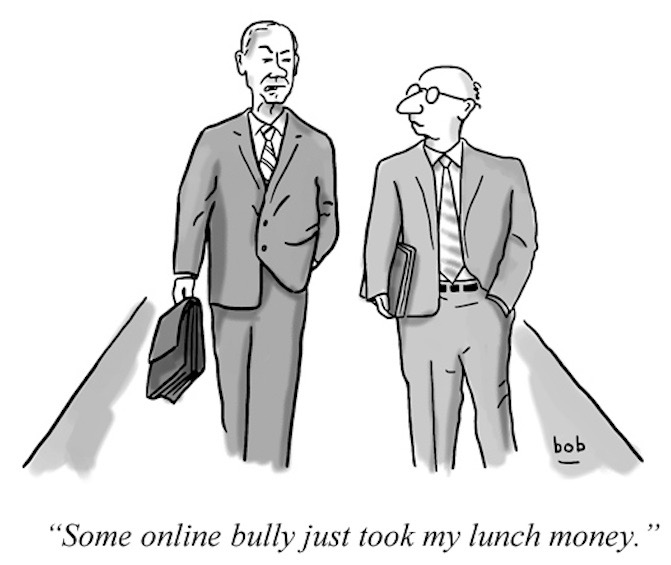
The cartoonist is bob, whose full name is Bob Eckstein, and the one-panel gag cartoon in question is a very recent one (from the May 2025 issue of Funny Times) and a pointedly topical one — and I greatly admire it:
bob’s lunch money cartoon; the cartoon — showing a middle-aged businessman who’s been somehow, absurdly, extorted for his lunch money online (just the idea of such a person having lunch money is funny) — would be entertaining in any circumstance, but in a world in which the US president is attempting to use online declarations to extort services and actions from various institutions (universities, law firms, media outlets, businesses), it’s painfully relevant
(For information about everything bob, see his official website)
The flip side of extortion is appeasement. So we are to assume that the businessman somehow appeased that bully by giving up his lunch money. Rather than fighting back — though it’s not clear to me what the online equivalent of punching the bully in the nose would be (but maybe Harvard is showing us the way). In any case, he probably believes be has gained, as Neville Chamberlain once thought, peace for his time. If so, he is doomed; today the lunch money, tomorrow the check at République. It never ends, it just gets worse, he’s on the hook, the poor sap.
So, to come: the English verbs extort and appease, with some lining-out of their meanings in detail, plus an excursus on Peace for / in our time.
(I know, I know, you let a linguist in the house, and suddenly you’re getting Little Lectures on Language. Life is perilous. Just be thankful I’m sparing you a gender and sexuality take on bob’s cartoon. There’s always a language point, in whatever, and there’s always a gender and sexuality take too, you just have to know how to look.)
In the dictionary: NOAD on the meaning of the two crucial verbs:
verb extort: obtain (something) by force, threats, or other unfair means: he was convicted of trying to extort $1 million from a developer. [AZ: to be contrasted with the closely related verb bribe: persuade (someone) to act in one’s favor, typically illegally or dishonestly, by a gift of money or other inducement; but the two acts are clearly subsorts of a single act-type, of using some kind of leverage to cause someone to provide you with something you desire]
verb appease: [with object] 1 pacify or placate (someone) by acceding to their demands: amendments have been added to appease local pressure groups. … [AZ: the flip side of extortion]
The elements of the meanings, abstracted, in detail, along with some of the syntax of the two verbs — all put together in formulas known as argument structures for each verb. For this we need a list of the things participating in the event denoted by the verb — participants that surface in the syntactic arguments of the verb — along with details of its syntax. Let’s just dive into things.
The participants in the two events (of extortion and appeasement):
two people: a BULLY and their MARK
some LEVERAGE: force or threats
a REWARD: payment, goods, or services
The argument structures for the verbs extort and appease:
BULLY extorts REWARD from MARK:
— BULLY uses LEVERAGE to require that MARK give REWARD to BULLY
e.g., Bruto Online extorted lunch money from Randolph Rockefeller (by threatening to expose the businessman’s addiction to snuff porn)MARK appeases BULLY with REWARD:
— MARK responds to BULLY’S LEVERAGE by giving REWARD to BULLY
e.g., Randolph Rockefeller appeased Bruto Online (from exposing his addiction to snuff porn) with his lunch money (by transferring it to Bruto via PayPal)
Now for the great appeasement event of the 20th century.
Peace for / in our time. From Wikipedia:
“Peace for our time” was a declaration made by British Prime Minister Neville Chamberlain in his 30 September 1938 remarks in London concerning the Munich Agreement and the subsequent Anglo-German Declaration. The phrase echoed Benjamin Disraeli, who, upon returning from the Congress of Berlin in 1878, had stated, “Lord Salisbury and myself have brought you back peace — but a peace I hope with honour.” The phrase is primarily remembered for its bitter ironic value since less than a year after the agreement, Germany’s invasion of Poland began World War II.
It is often misquoted as “peace in our time”, a phrase already familiar to the British public by its longstanding appearance in the Book of Common Prayer. A passage in that book translated from the 7th-century hymn “Da pacem Domine” reads, “Give peace in our time, O Lord; because there is none other that fighteth for us, but only thou, O God.” The phrase also appears in the English hymn “God the Omnipotent!” at the end of the refrain: “… give to us peace in our time, O Lord!” It is not known how deliberate Chamberlain’s use of such a similar phrase was.
Speeches: Chamberlain’s aeroplane landed at Heston Aerodrome on 30 September 1938 and he spoke to the spectators there:
The settlement of the Czechoslovakian problem, which has now been achieved is, in my view, only the prelude to a larger settlement in which all Europe may find peace. This morning I had another talk with the German Chancellor, Herr Hitler, and here is the paper which bears his name upon it as well as mine [shows paper to crowd]. Some of you, perhaps, have already heard what it contains but I would just like to read it to you: ” … We regard the agreement signed last night and the Anglo-German Naval Agreement as symbolic of the desire of our two peoples never to go to war with one another again”.
Later that day, he stood outside 10 Downing Street, again read from the document and concluded:
My good friends, for the second time in our history, a British Prime Minister has returned from Germany bringing peace with honour. I believe it is peace for our time. We thank you from the bottom of our hearts. Go home and get a nice quiet sleep.
Leave a Reply