From Joelle Stepien Bailard on Facebook on 10/5, passing on material from Tony Michaels’s Facebook page (“The Tony Michaels Podcast: Considered ‘The Rush Limbaugh of the Left’”), also from 10/5:
A Tony Michaels fabrication (see below)
From Joelle Stepien Bailard on Facebook on 10/5, passing on material from Tony Michaels’s Facebook page (“The Tony Michaels Podcast: Considered ‘The Rush Limbaugh of the Left’”), also from 10/5:
A Tony Michaels fabrication (see below)
An Ellis Rosen cartoon that came by on Facebook recently:
(#1) The hybrid creature the pomeranian-nimbus, being taken for a walk, on a leash, by its owner — so being presented as an extraordinary dog, a cloud canine; note that the woman’s dog recognizes the p-n as a dog, and appears to want to play with it (see the wagging tail)
(The name of the dog breed is standardly capitalized, because it’s a proper name denoting a creature originating in the geographical region of Pomerania, and I’ll use Pomeranian from here on.)
The compound Pomeranian-nimbus is a copulative N1 + N2 compound (like Swiss-American or hunter-gatherer), denoting a thing or things of both the N1 type and the N2 type. But in fact the creature is not just a mix of Pomeranian dog and nimbus cloud, but is actually a nimbus Pomeranian ‘Pomeranian dog that is (also) a nimbus cloud’ (your standard N + N compound in English is semantically modifier + head) — rather than a Pomeranian nimbus ‘nimbus cloud that is also, or at least resembles, a Pomeranian dog’. A nimbus Pomeranian, or, more compactly, a nimbopomeranian, a nimpom for short.
From Andrew Garrett on Facebook today:
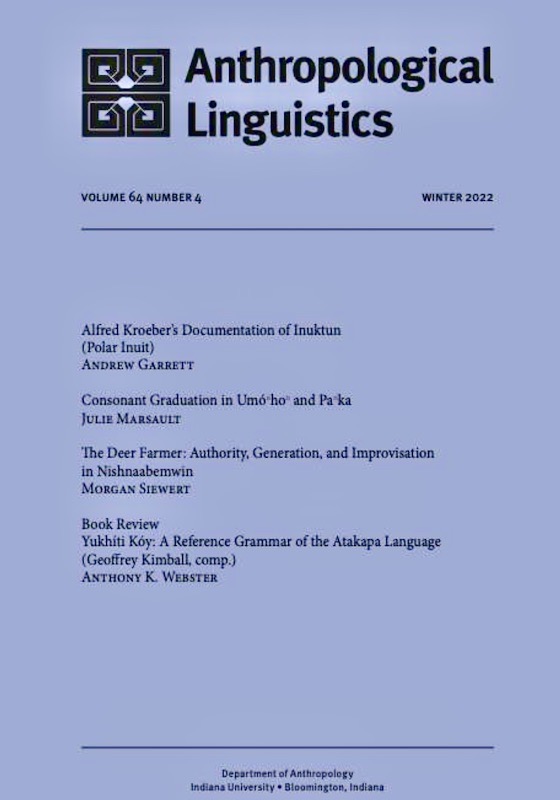
— AG: Glad to be in this (new, despite the ostensible date) issue of AL. The press perpetrated an amusing typo in Julie Marsault’s title:
(#1) Graduated consonants
I went right for the typo (quite likely to have been introduced by a spellchecker during the layout stage for the cover [but now see Michael Vnuk’s cogent critique of this idea, in his comment below]):
— AZ: Clearly, graduated consonants are like graduated pearls; they come in a series of sizes: bigger, louder, noisier. I can hear them now.
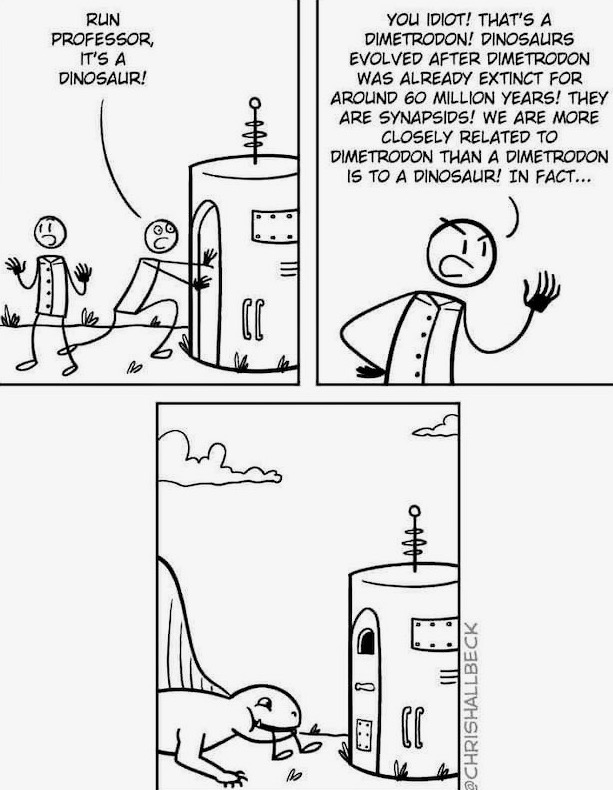
This Chris Hallbeck cartoon came by me on Facebook this morning — a strip packed with matters of science (paleontology, specifically), lexicography and usage (the senses of the noun dinosaur, and the contexts in which they’re used), and pragmatics (the way in which the noun is used in interactions, especially in language about language; in the enforcement of language norms; and, oh alas, in the relevance of things said to the interests of those participating in the speech context):
A Maximumble cartoon from 5/24/14, whose humor turns crucially on the pragmatic foolishness of the (now deceased) professor (in the face of a ravening monster, he stops to insist, irrelevantly in the context, that his companion must use the proper terminology, while the companion flees to safety); and which is based on the usage of the noun dinosaur — for a member of a clade of prehistoric reptiles bearing the zoological taxonomical label Dinosauria; versus, in non-technical American usage, for any dinosaurid creature, resembling the prototypical dinosaurs (many people have seen a family resemblance)
Encountered in going through stuff on Facebook: the episode “Fozzie encounters a bit of a language barrier” from “Rocky Mountain Holiday”, a 1983 Muppet special; in the episode, Fozzie Bear describes himself to Gonzo (a character of ambiguous species) following on reports of a bear in their vicinity:
Have you not noticed that I also am of the ursine persuasion … I’m a bear too and I speak fluent bearish
A huge ferocious bear appears, the main characters flee to Kermit the Frog, and Fozzie explains:
Gonzo! Gonzo! Just a slight dialect problem … she speaks Grizzly and I only speak Paddington
You can watch the episode on YouTube here.
(Nice ellipsis of the BEAR in grizzly bear (the name of a type of bear) and Paddington Bear (the proper name, on the pattern of FN + LN, roughly like Stanford Linguist) of a fictional bear, discovered in London’s Paddington Station), as if they were structurally parallel.
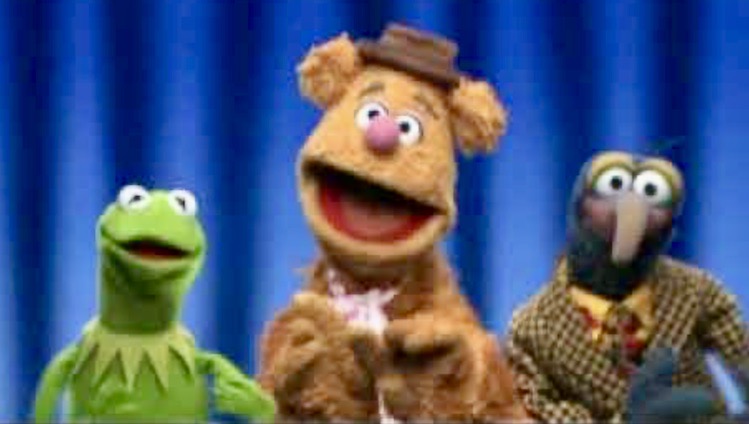
The principal characters:
Kermit, Fozzie, and Gonzo
(Swearing in French, and English, so not to everyone’s taste)
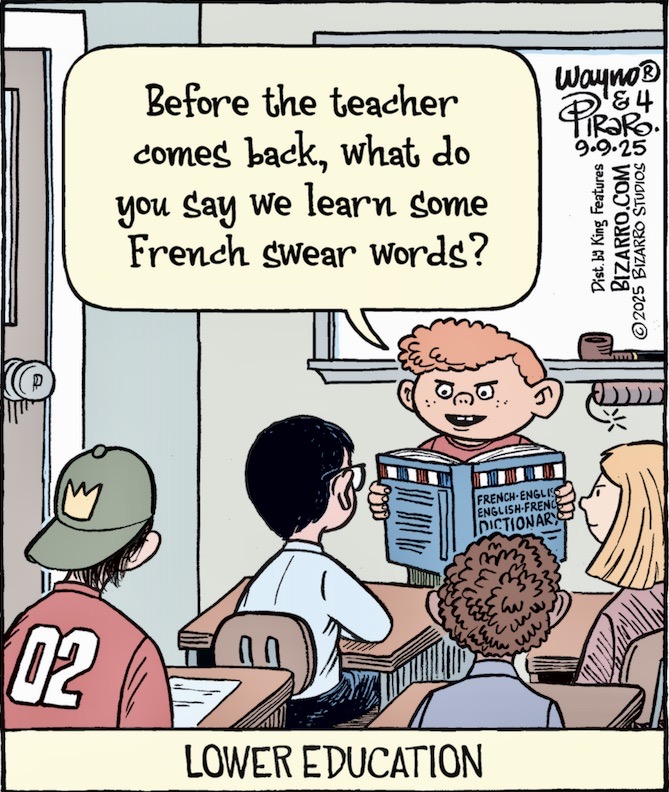
Today’s Bizarro strip, in which Wayno shows us what goes on in a lower education classroom:
MonkeyJack (as I’l call him) asks the question, expecting the answer, in chorus: Fuck, yeah! To which he will tell them all to shout it out the way he does, loud and clear: Putain ouais! (if you’re puzzled by the odd symbols in the cartoon — Wayno says there are 4 in this strip — see this Page)
But then there’s Wayno’s title, a play on higher education (sometimes known as tertiary or post-secondary ed): this semi-technical term has higher ‘closer to the high end, the top of something’ (of formal education here, so referring to university education); and it’s opposed to K-12 education, referring to school education, that is, primary and secondary ed. Though lower ‘closer to the low end, the bottom of something’ is the opposite of spatial higher, lower education seems rarely if ever used to refer to K-12 ed.
Then lower education becomes available for play, using one of the other senses of low. And if we’re going down there, might as well go raunchy, so we get low as a rough synonym of louche ‘disreputable, sordid’, the opposite of high ‘morally or culturally superior’ — and lower education, an education in the seamier side of things, in vulgarity, like swear words. And swear words in French, ’cause everyone knows everything’s dirtier in French.
And that’s today’s quick linguistic joke. Meanwhile, life has been amazing in some ways (people said the most wonderful things about me on my 85th birthday) but almost unmanageably difficult in most ways. I am hanging on.
In human beings, the mouth is the only bodypart that comes equipped with teeth. Well, there are fables of the fearsome vagina dentata and even — top men, beware! — of the occasional anus dentatus. Now the wonderful world of prehistoric nature brings us a penis dentatus. Or so we learn from the latest WIRED.
From WIRED Science, “An Ancient Penis Worm With Rings of Sharp Teeth Has Been Discovered in the Grand Canyon: The 500-million-year-old fossil, containing a species named in honor of the krayt dragons in Star Wars, is a much larger ancestor of phallic marine worms that can be found on the seabed today” by Marta Abba on 8/19/25:
Penis worms are marine creatures with a distinctly phallic appearance. There are more than 20 known species living across the world’s oceans today, as well as a number of extinct ones, like this new discovery. The researcher who made the find was searching for fossils in the Grand Canyon and named the species Kraytdraco spectatus in honor of the huge burrowing krayt dragons that appear in the Star Wars universe. Details of the discovery were published in the journal Science Advances.
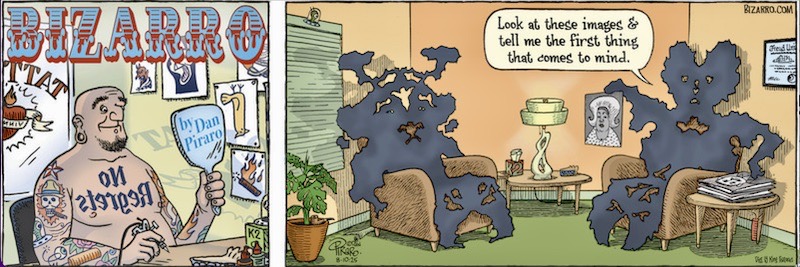
Today’s Dan Piraro Bizarro cartoon, in which the roles of ordinary life are Bizarro-reversed:
(#1) Those are living, breathing inkblots sitting in the chairs: a therapist inkblot showing a picture to a client inkblot; where you expect people, you get inkblot entities, and where you expect the picture of an inkblot, you get the picture of a person (in the title panel and the main panel, there are a ton of odd symbols; if you’re puzzled by them, see this Page)
Abstracting away from the details, we’re looking at two instances of the situation XXY:
— XXY: a situation in which three entities — two Xs (a therapist and a client) and a Y — are participants in an event in which the therapist X shows a reproduction of a Y to the client X
(all about the F-word and its uses, so obviously not for kids or the sexually modest)
Another posting that’s been hanging around for months. I argue that the OED treatment of the semantics of the sexual verb fuck is unsatisfactory, not compatible with the actual usage of English speakers for a long time now — apparently because earlier lexicographers, embracing normative views of sexual behavior, posited a single sense of sexual fuck, centrally denoting an agentive act of penis-in-vagina intercourse but with a large penumbra of vagueness, embracing many other sorts of sexual encounters. Then this inadequate treatment was adopted without comment or critique in Jesse Sheidlower’s The F Word. So that essentially all the authoritative literature on sexual fuck gets things wrong. I will explain; there will be no pictures.