Archive for the ‘Semantics’ Category
April 6, 2026
A Jacquie Lawson digital greeting card from my old friend Benita Bendon Campbell (who appears frequently on this blog) for Easter, featuring garden flowers, cresshead eggs (eggshells with human faces drawn on them and with green plants — cresses especially — sprouting from them, like hair), and, eventually, large amiable rabbits (not shown below). A penultimate shot of the developing scene:

(#1) A festival of spring flowers and cressheads
(more…)
Posted in Art, Compounds, Events and occasions, Language and plants, Language play, Lexical semantics, Semantics of compounds, Taboo language and slurs | 6 Comments »
March 10, 2026
My main helper these days has lived and worked in the US for many years, but he’s a native of Fiji. I call him Isaac in my postings, but his actual personal name is the Fijian version of the name, Aisake, and the syntax of his native language Fijian turns out to have lots of characteristics that are a surprise to, say, speakers of English. So I offer you some notes on the language, building on the material in the Wikipedia article on the language.
(more…)
Posted in Categorization, Fijian, Possession, Pronouns, Word order | 1 Comment »
March 6, 2026
A standard notice from the Instacart home-delivery service about a grocery order in progress from the Safeway supermarket:
You’ve still got time to shop
Add items until your shopper checks out
The intent is to convey the oldest intransitive phrasal verb check out: you can add items until your shopper has completed their search for items, informed the service of this, and left the store — 1b in the OED list below. But there are three other readings for check out, and the one that came to my twisted mind first was 4c ‘to die’. Evoking images of the fatal grocery order, which will never get delivered because the shopper dropped dead. (Presumably, the 4c reading had recently come by me in some other context, so it was somehow salient to me; my imagination is not normally so dark.)
(more…)
Posted in Ambiguity, Context, Intention, Lexical semantics, Pragmatics, Salience | 4 Comments »
February 19, 2026
From Ben Yagoda on Facebook today (2/19):
[about] today’s Philadelphia Inquirer investigation of Philly Managing Director Adam “No Show Jones” Thiel, who was away from the office for nearly five months last year, including time in the military reserve and (presumably) running his consulting firm, from which he reported income of more than $300,000. (That’s in addition to his city salary of $316,000.)
… The Inquirer article … shows continued morphing of the verb don from meaning ‘put on’ (don we now our gay apparel) to meaning ‘wear’. The newspaper reports: “Ahead of a snowstorm in January 2024, Thiel stood with [Mayor] Parker during a news conference about preparations. He donned a suit while snowflakes fell, and he reassured the city that the administration was ready for the service disruptions that bad weather can bring”.
For those of us who still hew to the old meaning, that’s quite a visual image.
(more…)
Posted in Lexical semantics, Style and register | 1 Comment »
December 3, 2025
A tv commercial for the laundry detergent Tide, heard this morning:
If it’s got to be clean, then it’s got to be Tide [1]
(with the deontic modal of obligation have got to, roughly ‘must’). At this point, I’ll simplify the example somewhat by using the one-word variant have to rather than have got to:
If it has to be clean, then it has to be Tide [2]
[1] and [2] catch your attention because they’re somehow jokey, some kind of play on words. The two parallel underlined stretches are word-for-word identical, but they’re not parallel in meaning, and we expect them to be. This semantic disparity makes [1] and [2] examples of what I’ve called zeugmoids. More on all that to come, but first I want to make the phenomenon clearer.
(more…)
Posted in Context, Figures of speech, Humor, Modality, Pragmatics, Salience, Zeugma | Leave a Comment »
November 15, 2025
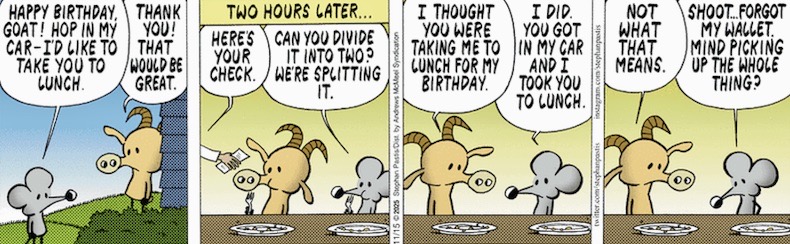
Today’s Pearls Before Swine, in which Rat lives up to his name:
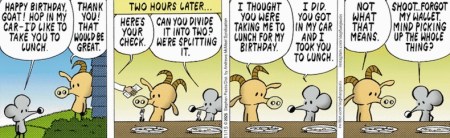
The crucial point: take you to lunch in the context of birthday greetings to Goat — in this context, clearly an instance of the phrasal idiom I’ll label take someone to (‘host someone at (an event), treat someone to (an event)’), and so understood by Goat (and, I think, by all readers of this strip); but then, in a kind of lexicographic bait and switch, Rat maintains that he meant only the caused-motion verb take (‘convey something to (an event at) some place’) and takes no responsibility for paying for the occasion
Then, in an appendix to this main discussion, I expose my bafflement at the treatment of the phrasal idiom take someone to in dictionaries: I can’t find one that lists it (while treat someone to is well covered).
(more…)
Posted in Ambiguity, Implicature, Language change, Lexical semantics, Lexicography, Linguistics in the comics, Semantics | 1 Comment »
November 10, 2025
In e-mail from Tony Velasquez on 11/8:
your 11/7 blog post about category errors and the potential for making jokes with them … reminded me of something I’m reading, How God Becomes Real, by Tanya Luhrmann …, who argues that knowing … that a god exists uses a different ontological attitude than knowing … that a table exists. She also points out that this attitude toward the spiritual has a lot of affinity with the sort of ontological attitude taken in play. It’s interesting to me to think that the attitude toward category errors you take that leads you to create jokes is opposed to a very different attitude to what could be called the category error, on Luhrmann’s thinking, that spiritual beings are real in the same sense that tables are real — an attitude that, instead of leading to play or jokes, often leads to violence and war.
(more…)
Posted in Ambiguity, Jokes, Language and religion, Language play, Lexical semantics, Philosophy, Semantics, Stanford | Leave a Comment »
November 2, 2025
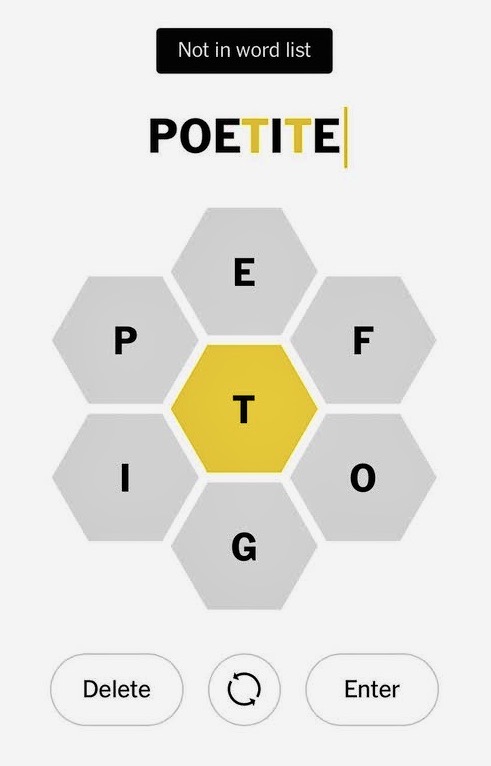
Faced with this judgment on Facebook today about the Spelling Bee puzzle from the New York Times,

(#1) POETITE: not a word (in the Spelling Bee dictionary)
Dennis Baron owlishly protested with word play incorporating a pun on concrete:
It’s the stuff concrete poems are made from.
Well played, Dennis!
(more…)
Posted in Ambiguity, Compounds, Derivation, Lexical semantics, Lexicography, Poetry, Puns, Word play | 1 Comment »
October 26, 2025
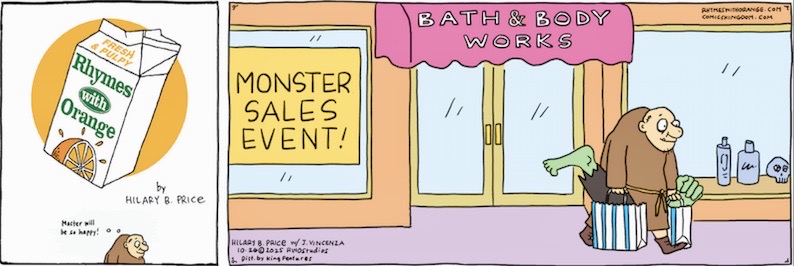
In today’s Rhymes With Orange strip, a sale at Bath and Body World:

A sale of body parts from and/or for monsters — not what comes to mind when you come across the N + N compound monster sale, which is a dauntingly large sale, one that’s (metaphorically) a monster
Now the details.
(more…)
Posted in Ambiguity, Language and the body, Lexical semantics, Linguistics in the comics, Metaphor, Semantics of compounds, Syntactic categories | 2 Comments »
October 21, 2025
Gretel Cunningham Young (of Columbus OH, where she grew up, with my daughter Elizabeth, many years ago) on Facebook yesterday:

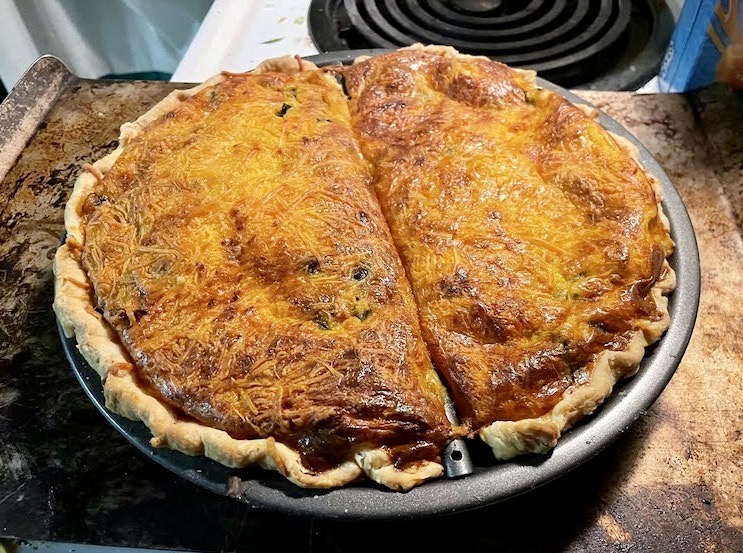
— GY: My goal was to make a half-vegetarian, half-carnivorous quiche, so I ordered this divided pan
Noting her reference to carnivorous quiche, plus an odd quirk in way English vegetarian is used, I reacted to her statement with some alarm (my response in an expanded and improved form here):
— AZ: But I don’t think I want to get near a carnivorous (‘meat-eating’) quiche, lest I be devoured by it. vegetarian quiche has the adjective vegetarian ‘(of food or diet), plant-based, excluding meat’, not the noun vegetarian ‘(of people) a vegevore, someone who eats only plant-based food; a non-carnivore, someone who does not eat meat’. A quiche that’s a vegetarian would not be a threat to me (as a being made of meat), but it would nevertheless be creepy, in a cannibalistic sort of way. The meaty correspondent to vegetarian quiche ‘quiche for vegetarians’ would be quiche for carnivores.
(more…)
Posted in Ambiguity, Compounds, French, Language and food, Lexical semantics, Puns, Semantics of compounds, Silliness, Slogans | 1 Comment »