In human beings, the mouth is the only bodypart that comes equipped with teeth. Well, there are fables of the fearsome vagina dentata and even — top men, beware! — of the occasional anus dentatus. Now the wonderful world of prehistoric nature brings us a penis dentatus. Or so we learn from the latest WIRED.
From WIRED Science, “An Ancient Penis Worm With Rings of Sharp Teeth Has Been Discovered in the Grand Canyon: The 500-million-year-old fossil, containing a species named in honor of the krayt dragons in Star Wars, is a much larger ancestor of phallic marine worms that can be found on the seabed today” by Marta Abba on 8/19/25:
Penis worms are marine creatures with a distinctly phallic appearance. There are more than 20 known species living across the world’s oceans today, as well as a number of extinct ones, like this new discovery. The researcher who made the find was searching for fossils in the Grand Canyon and named the species Kraytdraco spectatus in honor of the huge burrowing krayt dragons that appear in the Star Wars universe. Details of the discovery were published in the journal Science Advances.
Penis snakes and penis worms. From my 8/5/12 posting “Snake, worms, fish, clams, slugs”:
We are in the world of phallicity (of the creature in question) and non-subsectivity (of the compound penis snake; the penis snake is not a snake).
… Penis snake … is a resembloid compound: the creature is not a snake, but resembles one. So the compound is like trouser snake
… Compare penis worm, which is subsective:
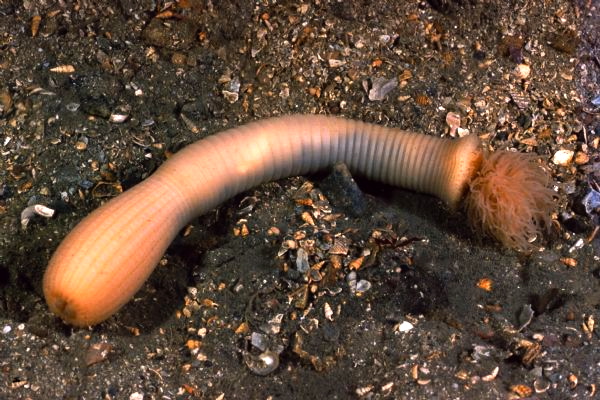
Priapulida (priapulid worms or penis worms, from Gr. πριάπος, priāpos ‘Priapus’ + Lat. -ul-, diminutive) is a phylum of marine worms. They are named for their extensible spiny proboscis, which, in some species, may have a shape like that of a human penis. They live in the mud, which they eat, in comparatively shallow waters up to 90 metres (300 ft). (link)
The creature:
What penis snake and penis worm share is the semantic relationship between the head noun and the modifying noun, which is resemblance: a penis worm is a worm that resembles a penis, and a penis snake is a snake-like creature that resembles a penis. (In trouser snake [‘penis’], the relationship is location rather than resemblance.)
For the ancient creature, we have to imagine sharp tooth-like appendages on the glans penis. Straight women and bottom men (AMZ raises his hand) gasp in empathetic pain at this point.
Teeth where teeth don’t belong. From Wikipedia:
Vagina dentata (Latin for ‘toothed vagina’) is a folk tale tradition in which a vagina is said to contain teeth, with the associated implication that sexual intercourse might result in injury, emasculation, or castration.
… Vagina dentata folktales have occurred in most cultures and throughout history. Such folk stories are frequently told as cautionary tales warning of the dangers of unknown women and to discourage rape.
Mutatis mutandis, the anus dentatus.
The Latin vocabulary.
— the adjective dentātus, -a, -um ‘having teeth, toothed’
— the feminine noun vāgīna ‘sheath, scabbard, vagina’
— the masculine noun ānus ‘ring, anus’
— the masculine noun pẽnis ‘tail, penis’
August 19, 2025 at 11:29 am |
I hadn’t known of the alternate meaning of pẽnis. This gives rise to a whole new way of thinking about that particular, erm, appendage.
August 19, 2025 at 11:44 am |
Not just alternative, but original. The metaphorical sense development ‘tail’ > ‘penis’ is a common one in many languages.
August 19, 2025 at 3:07 pm |
Closer to home, cats have penile spines. See a photo of one in the Wikipedia article. As well as many monkeys, including (lord help us) macaques.
August 19, 2025 at 9:35 pm |
There’s an interesting little museum in Reykjavik that has specimens of these and many other sorts of penises on display.
August 20, 2025 at 6:54 am
As well as various representations of mostly human penises. A delightful little museum; I visited it about 6 years ago.
August 20, 2025 at 7:43 am
Yes, I’ve posted a series of observations on the Phallological Museum in Reykjavik. The first, I think, was in my “Museum notes” of 4/27/14:
https://arnoldzwicky.org/2014/04/27/museum-notes/