Nathan W. Pyle’s Strange Planet strip from 1/27/25:
Pyle’s beings on an alien planet cope with the sociocultural world of this one with their views framed in a variety of English that lacks the usual terms, so they concoct fresh ones (slicer for knife, stabber for fork, scooper for spoon, ingest for eat); in this strip, the subject is the education of the young in the etiquette of dining, and it comes with a meta-lesson
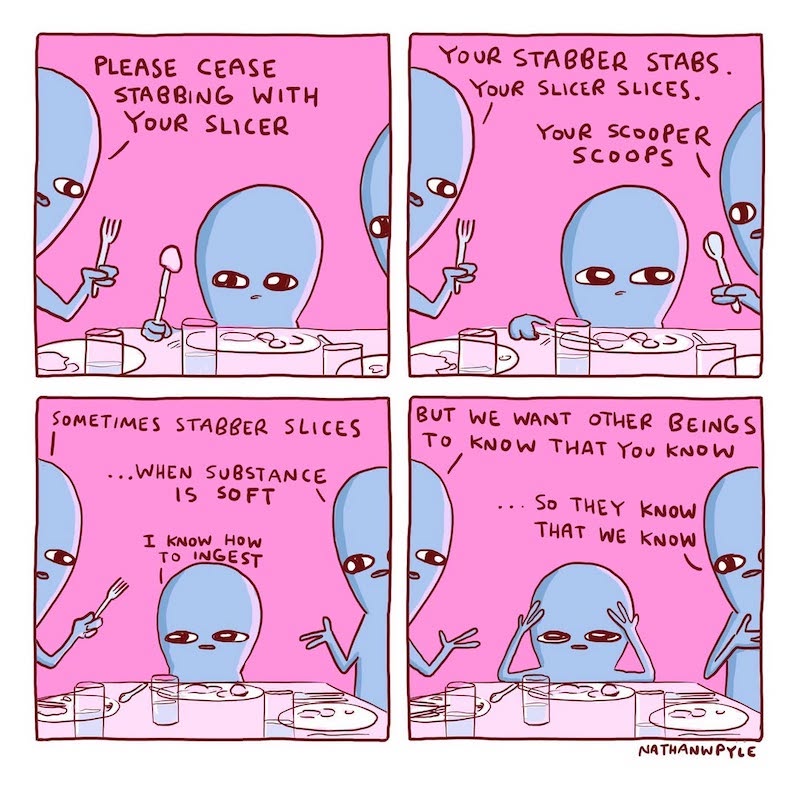
You can use your knife to pick pieces of food up, but that’s unconventional, impolite (in current Western etiquette); you can use (the side of) your fork to cut food into pieces, but only soft food; and so on. All this is etiquette; from Wikipedia:
Etiquette is the set of norms of personal behaviour in polite society, usually occurring in the form of an ethical code of the expected and accepted social behaviours that accord with the conventions and norms observed and practised by a society, a social class, or a social group.
But the alien parents on the strip go beyond instructing their child in the etiquette of dining, beyond enforcing sociocultural norms. They appeal to the impressions that their child’s conforming to etiquette will make on the audience of other people: it will show that the child understands the norms and also that since the child understands these norms they — the presumable source of the child’s knowledge — understand them too. So they are engaging in a two-level performance for others around them.
They are serving as actors in a sociocultural drama performed for an audience of other people, creating and maintaining the impressions others form of their child and (through the child) of them. This is the world the sociologist Erving Goffman analyzed in his 1956 book The Presentation of Self in Everyday Life; from a publisher’s overview of the book (which I’ve edited a lot):
Everyone in everyday social interactions presents themselves and their activity to others, attempts to guide and control the impressions others form of them, and employs techniques to sustain this performance, just as an actor presents a character to an audience.
Performing to satisfy the audience (on behalf of intimates). The alien child is supposed to perform to satisfy an audience of other beings on its own behalf, but also on behalf of its parents. Here I was reminded of a real-life example that distressed me profoundly when I first came across it, in a set of filmed interviews with upper-class gay men from various countries, talking about their experiences in coming out, in particular about the responses of their mothers to their becoming publicly known as gay.
A number of them reported being told that their mothers would rather that they have died than that they have come out to the world. Because, these mothers said, having openly gay sons threatened their social status; it reflected badly on them. What a monstrous idea.
Leave a Reply