(saintly male bodies seen through worldly eyes and treated in sometimes very plain talk, so not to everyone’s taste)
From Susan Benson Hamel yesterday:
Thought of you yesterday when I was in the Auckland art gallery and came across this delightfully coy St Sebastian by Guido Reni:
(#1) There are an astonishing number of St. Sebastians out there; this Reni really is wonderful (I said to SBH), in its dreamy gaze welcoming death, and all done with a single mortal arrow (plus, Reni dwells lovingly on the saint’s body, giving what many have seen as a homoerotic cast to the painting; and his private parts are just barely concealed, as in a cock tease)
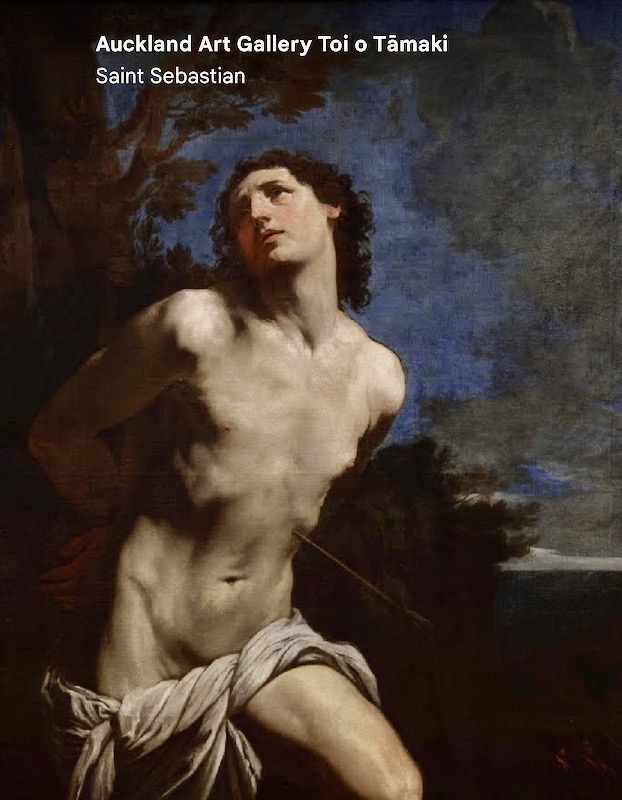
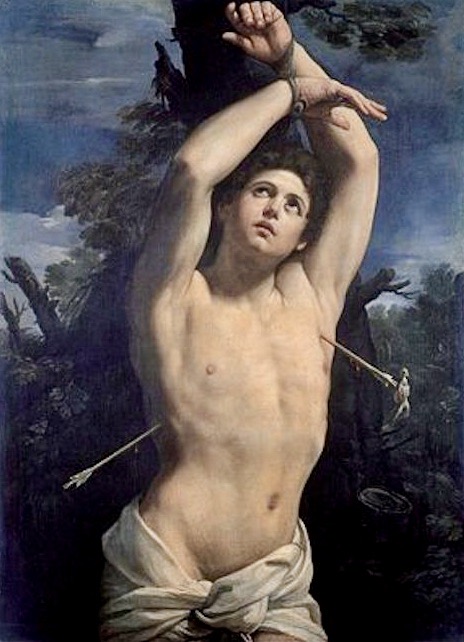
In this Reni Sebastian — he did six of them — the saint’s tree of martyrdom is there, but downplayed, and his arms are bound behind him at the waist, rather than above his head (a pose that produces what I’ve called a pitsntits presentation of the upper male body), as in this more famous Reni, from 1615:
(#2) An even more beautiful youth, with not so muscular a body and pierced by two arrows, but still the upward gaze and the teasing drapery
A parallel. From my 8/23/24 posting “A Mexican in Paris”:
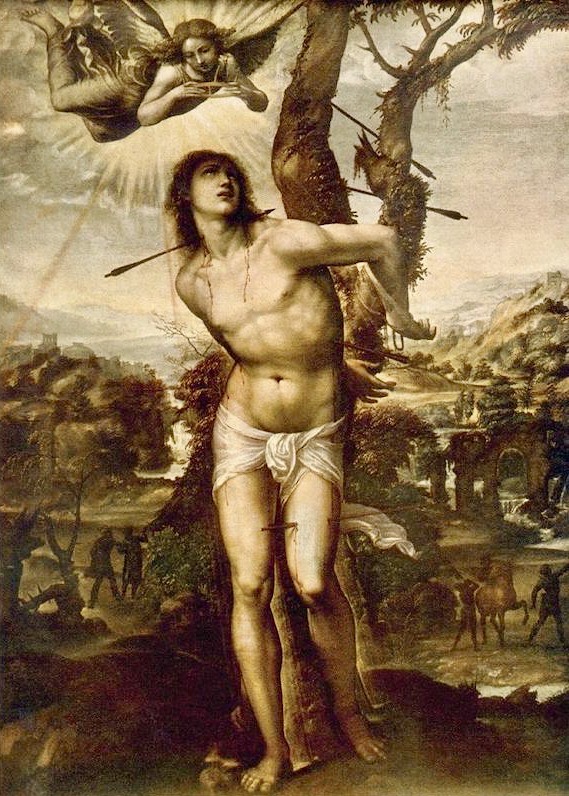
from the world of depictions of the martyrdom of Saint Sebastian, this … sensuous (and quite plainly queer) 16th-century painting by Il Sodoma (whose nickname means just what you think it does):
(#3)
A beautiful young man with a hot body, his nakedness barely covered — but he bleeds and his face is agonized; only one arrow in his body, but it’s an implement of war, not ornament, and it has pierced all the way through Sebastian’s neck, and there are further arrows embedded in the tree
Guido Reni. From Wikipedia:
Guido Reni (4 November 1575 – 18 August 1642) was an Italian Baroque painter, although his works showed a classical manner, similar to Simon Vouet, Nicolas Poussin, and Philippe de Champaigne. He painted primarily religious works, but also mythological and allegorical subjects. Active in Rome, Naples, and his native Bologna, he became the dominant figure in the Bolognese School that emerged under the influence of the Carracci.
… Circa 1615 in Bologna, Reni created one of his most reproduced works, Saint Sebastian (sometimes called by the Italian San Sebastiano) [#2 above]. The painting is thought to have been a commission for a member of the papal court, due to the presence of lapis lazuli in the blue of the sky, an expensive material usually supplied by clients. Reni painted Saint Sebastian a total of six times, though the 1615 rendition is arguably the most recognizable. Notably, the painting has been adored by Oscar Wilde and other gay artists throughout history.
Among Reni’s other subjects are several that have engaged me on this blog: Acis and Galatea; and especially St. Michael the Archangel (I have a thing for winged men). On the latter:
(#4) The Archangel Michael Defeating Satan (ca. 1636)

A beautiful-youth Michael rather than a mature-warrior Michael, shown here dispatching the Prince of Darkness (Reni also did a David with the head of Goliath).
Leave a Reply