Archive for the ‘Compounds’ Category
May 19, 2023
Coming on the heels of my 5/18 posting “A fellatio-adjacent pitch for The Wiener the World Awaited”, Oscar Mayer’s heralding their new wiener on wheels, the Frankmobile. Here’s the story from the Out Traveler website (for Out magazine), “Say Goodbye to America’s Favorite Wiener on Wheels: The unexpected move is part of the rollout of Oscar Mayer’s beefy new hot dog recipe” by Jordan Valinsky of CNN Business on 5/17:

(#1) THE ALL BEEF BEEF FRANK FRANKMOBILE, that’s what it says on the label
(more…)
Posted in Compounds, Homosexuality, Language and food, Language and the body, Language in advertising, Phallicity, Semantics of compounds, Signs and symbols | 1 Comment »
April 18, 2023
A footnote to yesterday’s posting “DISNEY ON ICE”, which was about (among other things) ice shows, in the sense ‘shows on ice, entertainment productions primarily performed by ice skaters’. The N + N compound ice show is then a location compound, conveying that the referent of N2 is located with respect to the referent of N1, as being in or on it. So now a few words about the (many) interpretations of compounds.
(more…)
Posted in Brevity vs. Clarity, Compounds, Semantics of compounds | 1 Comment »
April 9, 2023
An exercise in nostalgia (much transformed) for Easter lunch today: sandwiches of slices of Kentucky country ham — KCH for short — and melted cheddar cheese. The nostalgia is in the ham:

(#1) Thinly sliced ham from Broadbent B & B Foods in the little country town of Kuttawa KY (in Lyon County in far (south)western Kentucky)
To come: on country ham the compound noun and country ham the foodstuff; on my personal history with KCH (associated in my household with Christmas rather than Easter); and on the Broadbent company.
(more…)
Posted in Compounds, Holidays, Language and food, My life, Semantics of compounds, Style and register | 4 Comments »
February 13, 2023
 (#1)
(#1)
Thanks to this year’s alignment of the Gregorian and Roman Catholic church calendars and the schedule of official US holidays, the month of February 2023 has two periods of presidential pleasure in it — festivals of Lincoln and license (food and sex) embracing first 2/12 (Lincoln Darwin Day), 2/13 (today, LDV Day), and 2/14 (Valentine’s Day), and then 2/20 ((US) Presidents Day) and 2/21 (Mardi Gras).
(more…)
Posted in Compounds, Gender and sexuality, Holidays, Language and food, Language of sex, Logos, Mascots, Phallicity, Poetic form, Semantics of compounds, Signs and symbols, Underwear | 1 Comment »
January 25, 2023
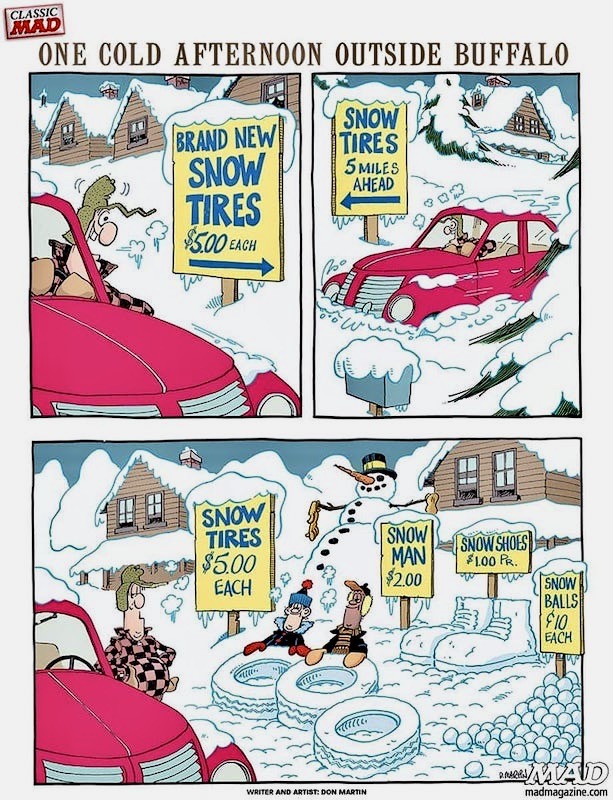
A classic Don Martin Mad magazine cartoon for the winter season, illustrating the utility and flexibility of N + N compounds in English — and also their enormous potential for ambiguity, which has to be resolved in context:
 (#1)
(#1)
Four examples of N1 + N2 compounds in English, all four highly conventionalized to very culture-specific referents. In these conventionalized uses, two (snow tire, snowshoe) are use compounds (‘N2 for use in some activity involving N1’), two (snowman, snowball) are source compounds (‘N2 made from N1’). But N + N combinations are potentially ambiguous in multiple ways; this lack of clarity is the price you pay for the great brevity of these combinations (which lack any indications of the semantic relationship between the two elements).
So: we get snow tire and snowshoe understood as source compounds in #1: ‘(simulacrum of a) tire made of snow’, ‘(simulacrum of a) shoe made of snow’.
I’ll turn to the four snow + N2 compounds in #1 in just a moment, but this presentation is now interrupted by breaking news from the snow-cartoon world, a wonderful wordless cartoon by snowman maven Bob Eckstein in the 1/30/23 issue of the New Yorker, which has in fact not yet arrived in my mailbox.
(more…)
Posted in Brevity vs. Clarity, Compounds, Context, Linguistics in the comics, Pragmatics, Semantics, Semantics of compounds | 1 Comment »
December 30, 2022
The Wayno / Piraro Bizarro for New Year’s Eve Eve is a goofy amalgam of two different cartoon memes with an egregious pun; Wayno’s title is “Reclusive Russets” (russets being a type of potato). No, of course it doesn’t cohere; that’s what makes it delightful (remember that this strip is called Bizarro).

(#1) If you’re puzzled by the odd symbols in the cartoon — Dan Piraro says there are 5 in this strip — see this Page.
The Potato Head meme (all three characters are Potato Heads) and the seeker and the seer meme (one character is seeker, the other two seers), plus some CRAB / CARB play on the compound noun hermit crab, mountain-top seers being hermits who have removed themselves from ordinary life, and potatoes being carbs, specifically starches (complex carbohydrates )
(more…)
Posted in Abbreviation, Comic conventions, Compounds, Gender and sexuality, Language and animals, Language and food, Linguistics in the comics, Metaphor, Puns, Race and ethnicity, Semantics of compounds | 2 Comments »
December 4, 2022
Remarkable e-mail. Two days ago (12/2), a message on Sutter Health’s My Health Online site with the header:
Sutter Palo Alto Center Laboratory Patient Experience Questionnaire
This is an 8-noun pile-up — not by any means a record, but definitely notable, and absolutely baffling as an announcement of a request for feedback from patients using Sutter Health’s services, in particular the services of the laboratory at Sutter Health’s PAMF Palo Alto Center (which I use with regrettable frequency).
I am now going to complain, briefly but with great feeling, about a range of things, starting with Sutter’s extraordinarily user-unfriendly, intensely corporate-oriented on-line interface. That 8-noun pile-up is fine for corporate-internal use in labeling its files, but it’s no way to get people to do a favor for you, which is what filling out an opinion survey for them is.
This is a follow-up to yesterday’s posting “In the mail: the sleep of reason produces snowmen”, on e-mail announcing the holiday issue of the New York Review of Books. Just notes on stuff that turns up in my e-mail.
(more…)
Posted in Abbreviation, Compounds, Initialisms, Language and medicine | Leave a Comment »
October 25, 2022
A follow-up to my 10/20/22 posting “The Funny Aperitif Board”, with its entertaining word confusion between appetizer and aperitif — but now getting serious about the two categories involved in the compound appetizer board:
the foodstuff category to which appetizers belong (call it SMALL-START-FOOD);
and the implement category to which food-service boards and platters belong (call it FOOD-SERVER-THING)
I’ll put off the funny part — the (intentionally) phallic appearance of the appetizer board in question — for a third posting in this series, taking off from my 9/11/22 posting “Plush life” (with its distinction between four modes of phallicity). But before we go on to ransack the modern English lexicon, let’s stop to appreciate the inspiration for all of this, the Grassooze appetizer board, laden with meal-preliminary foodstuffs:
(more…)
Posted in Categorization and Labeling, Compounds, Errors, Furnishings and tools, Language and food, Phallicity, Word confusions | 3 Comments »
October 19, 2022
… and, eventually, how to abracadabra things out of sight. Yes, it’s Verbing Day on AZ Blog!
Politics and real estate: to door knock. It started on the Rachel Maddow Show on MSNBC on 10/11, with the cite presented here in its larger context:

(#1) to door knock / door-knock ‘knock on doors’ (in political canvassing): a N + V verb, whose origin lies in a back-formation from the synthetic compound door knocking / door-knocking
The semantics / pragmatics of the synthetic compound is specialized — not merely knocking on doors, but doing so in specific sociocultural settings (political canvassing and door-to-door solicitations by real estate agents, in particular) — and this specialization is shared by the 2pbfV (two-part back-formed V)
(more…)
Posted in Back formation, Compounds, Context, Conversion, Innovations, Lexical semantics, Nouning, Pragmatics, Semantics of compounds, Synthetic compounds, Verbing | 1 Comment »
September 28, 2022
From recent American broadcast news interviews, yielding notable examples of familiar phenomena: the 2pbfV (2-part back-formed V) family-plan ‘do family planning’; and the phrase-final truncation of a formulaic expression, not give a rat’s ass ‘not care at all’, in the truncated not give a rat’s.
Both phenomena illustrate a drive towards brevity of expression (which makes life easier for the speaker), balanced against the hearer’s need for clarity of expression: to work out what the speaker intended to convey, the hearer must be able to supply crucial background knowledge (they have to know the compound noun family planning, with its specialized sense; they have to know the negative-polarity idiom (not) give a rat’s ass ‘not care at all’ and appreciate the zing in its vulgar minimizer rat’s ass), so the speaker must assess those abilities and craft their speech to suit their audience. It’s a complex dance, and like social dancing, it happens in the moment, on the fly, using practiced patterns while collaborating to make something new.
(more…)
Posted in Back formation, Brevity vs. Clarity, Formulaic expressions, Synthetic compounds, Truncation | Leave a Comment »