🎄🕯 Christmukkah Day, with flowers and music
Flowers and music in a digital greeting card; winter flowers out my window; and then the gift of more music, jazz Beethoven.
🎄🕯 Christmukkah Day, with flowers and music
Flowers and music in a digital greeting card; winter flowers out my window; and then the gift of more music, jazz Beethoven.
🎄- 2: 12/23, so it’s Festivus; the last day of Saturnalia; and now, according to a front page story in today’s New York Times (“In Some Parts, It’s Christmas Adam Before Eve: Churches Are Adding Day to the Holiday, With a Side of Ribs”), it’s Christmas Adam, the day before Christmas Eve (it’s a joke, son)
Meanwhile, today’s found mantra is Zesty Pickle — repeat as needed until you reach the desired state of tangy pungency. It came to me in a commercial for Chick-Fil-A’s classic chicken sandwich:
Crispy chicken, zesty pickle, it’s tough to top the original
But then the piquant phallicity of zesty pickles pushed me onto another path, into the tale of a fickle fly:
zesty pickle
frisky pepper
pesky stuck zipper!
… no plucky pickles past this point
(#1) The pickle-pepper tale
From Tim Evanson on Facebook yesterday, this cover art by J.C. Leyendecker (1874-1951): The Literary Digest of 6/12/1909:
(#1) Homoerotic soft porn in the style of classical sculpture (complete with a laurel wreath for the author au naturel); the laurel wreath identifies the writer as an incarnation of Apollo, the god of poetry, who is often depicted with a laurel wreath (recalling his desire for Daphne, a nymph who was transformed into a laurel tree to escape the god’s advances); meanwhile, the writer is nude, because he’s a god (the model for this drawing was JCL’s favorite model, also his partner in life, Charles Beach (1881-1954))
I’m a writer (among other things), and I mostly work in my underwear, but I don’t write commando. Well, I’m no Charles Beach, and certainly no Apollo.
Steven Levine on Facebook yesterday, contemplating Poussin’s The Adoration of the Golden Calf (1633-34) at the National Gallery in London:
(#1) [SL:] Those golden idol worshipping Israelites were pretty hot. I didn’t learn this in Hebrew school
Note: Poussin’s canvases are mostly huge — far too large to be appreciated properly in reproductions like the ones I’m giving you — and sprawling, crowded with characters (voluptuous women and studly men plus, where appropriate, adorable cherubs) in motion in an assortment of encounters, the whole scene illustrating some biblical or mythological theme, set in a wild natural landscape under a dramatic sky. (The celebration of the picturesque famously characterizes the Romantic movement in the arts, but in Poussin it flourished in the Baroque.)
Now: notes on Poussin; then on his religious painting on the Golden Calf theme in #1; then on to a mythological painting, Acis and Galatea; to a mythological painting in which six different encounters on a single theme (metamorphosis into a flower) are gathered together: The Empire of Flora; and, finally, to a mythological painting focused on sheer physicality: Bacchanale.
Then I will digress to Renoir’s Luncheon of the Boating Party, evoked for me by Poussin’s character-packed canvases. Then from Poussin’s surname, I drift to the tasty French dish poussin, and from this young chicken (typically roasted), I drift further to other chickens, young men considered as desirable sexual objects. Which brings us back to those steamy Israelites worshipping the Golden Calf. It’s the curse — or gift — of the associative mind.
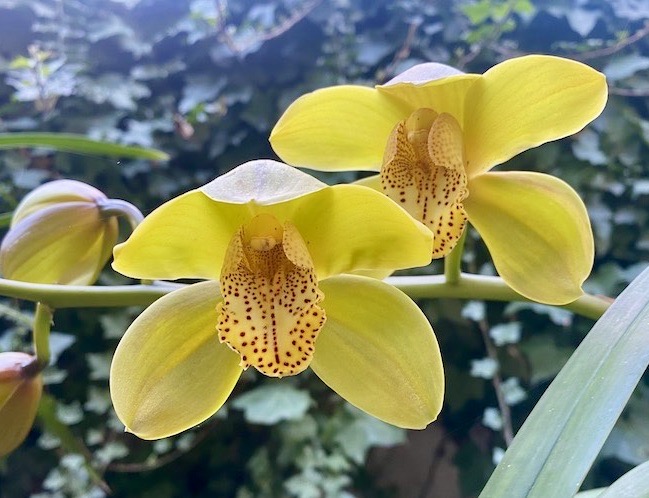
Or: the first flower of winter.
Today appeared the first fully open flower on my cymbidium orchids, on the plant I named Rogue Yellow last year, when its buds opened fully a month early, in the second week of December:
Rogue Yellow’s first two fully open (slightly greenish) blossoms, in December 2023
So: this year even earlier, in the last week of November, on Thanksgiving Eve Eve. Its flower stalk shot up, two feet in two days, at Halloween, then gathered itself up to burst, today, into floral fireworks heralding winter. (Meanwhile, chilly rains have come.)
🏈 🏈 today’s the Big Game in these parts — Stanford vs. UC Berkeley, 12:30 (PT), blessedly at Berkeley; the rain has given way to overcast skies, with occasional sunny breaks
From sun to sun, art to art: it starts with a Ukrainian sculpture of Icarus (who recklessly flew too close to the sun, defying the gods, and so plunged to his death); moves through a Russian painting of Icarus with his father Daedalus (who warns his son not to fly too high or too low); from there to van Dyck’s earlier painting of this same scene; which leads to a van Dyck self-portrait with a sunflower, a Helianthus that’s turned to him as to the sun itself: perhaps the painter as an incarnation of the sun god Apollo.
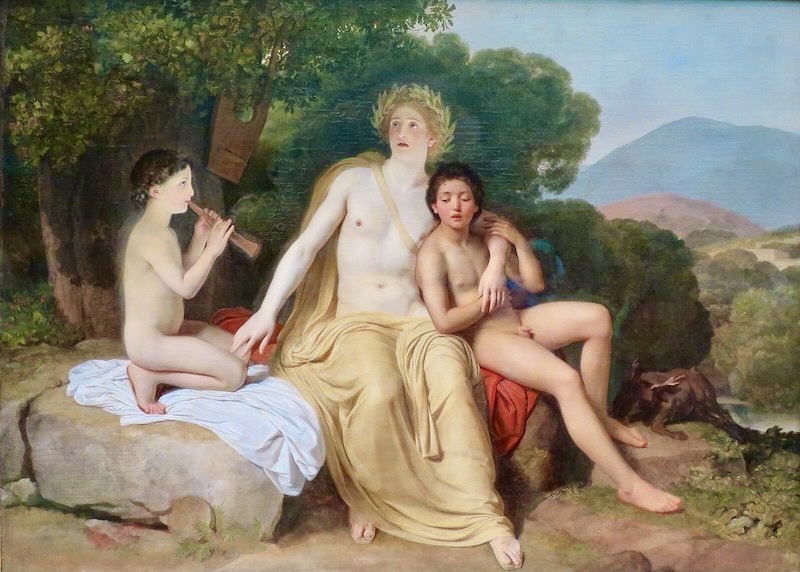
Encountered on Pinterest on 10/28, in a collection of mostly homoerotic images — Pinterest strives to cater to your interests, and mine aren’t hard to suss out — this painting, identified as being an early 19th-century work by Russian painter Alexander Ivanov (an artist completely unknown to me):
(#1) My first response was that the painting was truly creepy, looking to modern eyes like high-class kiddie porn: a beautiful young man (wearing a laurel wreath, therefore noble or divine), naked but with drapery over his lower body (his gaze fixed dreamily on something in the middle distance), embracing a totally naked young teenage boy (whose eyes are closed, apparently in enjoyment), while another fully naked boy, considerably younger, plays a wind instrument (apparently an aulos, an ancient Greek double-reed) for his companions’ pleasure; a lyre hangs from a tree in the background
A gauzily Romantic painting, set in a rough scenic wilderness, apparently of some classical or mythological subject in which music plays a significant role. Ok, so the beautiful young man is probably the god Apollo, famously skilled at the lyre (bonus: by far my favorite of the pantheon of ancient Greece and Rome). In this painting as the god of music and also the protector of the young. The boys are naked because they are true pre-pubertal innocents. Or just because the scene is set in the Arcadian wilderness, suffused with divine presence, a territory in which the gods and those within their aura have no need for the garb of ordinary mortals. Well, certainly not in artworks; consider the famous Apollo of the Belvedere statue (my 9/23/24 posting “Godlike beauty” has a section on the Belvedere Apollo and his full-frontal divinity).
So I tracked down #1: it’s Alexander Ivanov’s Apollo, Hyacinthus and Cyparissus making music and singing (painted during 1831-34), which I’ll call AH&C for short. At this point, things just got puzzling. The Russian painter Ivanov (1806-58) was new to me; he turns out to have a remarkable life history (summarized below). And then there’s the scene in #1.
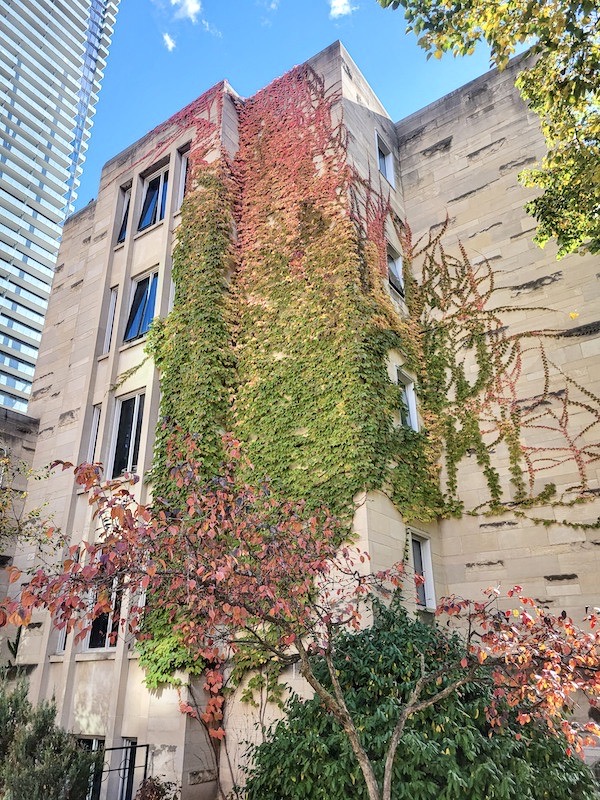
From Nathan Sanders on Facebook on 10/26:
(#1) [NS:] I love when ivy changes colours! — at University of Toronto.
— AZ to NS: That is indeed lovely. It’s Parthenocissus tricuspidata, so-called “Boston ivy”, a vining plant in the grape family closely related to Virginia creeper, and not related at all to English, or common, ivy, Hedera helix (which I have growing all over my little patio). English ivy is evergreen; Boston ivy is deciduous, its leaves turning color gorgeously in the fall before dropping off.
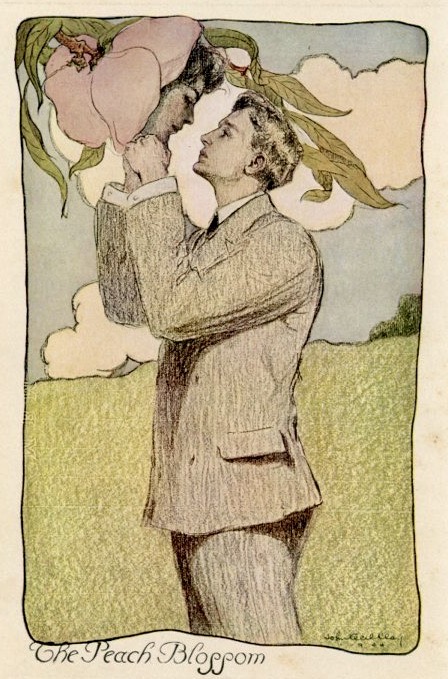
This remarkable image — In Love’s Garden: “The Peach Blossom” (from 1904) — appeared on my Pinterest feed this morning:
(#1) A peach blossom, with a bit of stem attached, and a female face, adored by a young man (the word sentimental comes to mind); to very modern eyes. just the combination of the word peach and the image of the flower will probably instead evoke buttocks (as the object of sexual desire), in the peach emoji 🍑 used in sexting — though this was obviously far from the artist’s intention 120 years ago
A bit of clicking from the Pinterest image led to the Prints with a Past site (“antique prints dating from the late 1700s through early 1900s”), where color prints of #1 are offered for sale. There the artist was identified as John Cecil Day (US). A search on this name got me nothing; well, illustrators are generally under-appreciated, and Day might have been a niche artist, of little note even in his own time.
But searches will turn up lots of things that aren’t what you asked for but have names similar to your search terms. And so my search for John Cecil Day brought me to an illustrator named John Cecil Clay, who looked an awful lot like my guy. I pulled up my copy of #1, got out my big magnifier, and looked at the signature. Yes, for sure, John Cecil Clay, famous enough to have a Wikipedia page. And the creator of a series of In Love’s Garden illustrations, of flowers that were also women. The Prints with a Past staff had misread the signature.
With the right name on hand, I could find more flowers from Clay’s garden. Two more of these, and then on to the fascinating story of Clay’s life; and a final note on sexting with emoji.
From Tim Evanson, on Facebook this morning, his image for 16 days to Halloween:
(#1) Hunky Halloween Hamlet, let’s call him Hunklet, contemplating Peter Pumpkin (who really should have a grinning face carved in him) instead of Yorick’s grinning skull
The Shakespearean context (written as connected text rather than as poetic lines):
(#2) “Here hung those lips that I have kissed” — so Hamlet cries in iambs dread
(though I note that #1 could be read as God — or Zeus / Jupiter — surveying the Earth; everybody sing: “He’s got the whole world in His hands”)