🎄🕯 Christmukkah Day, with flowers and music
Flowers and music in a digital greeting card; winter flowers out my window; and then the gift of more music, jazz Beethoven.
A Window to Winter. A Jacquie Lawson digital greeting card (from Helen Aristar-Dry and Tony Aristar) that gradually assembles a vase of flowers on a windowsill — “observe a beautiful wintry scene from a warm and cosy windowsill”, says the Lawson site — while the Polovtsian Dances from Borodin’s 1890 opera Prince Igor — specifically, the “Gliding Dance of the Maidens”, which was transformed into the song “Stranger in Paradise” from the musical Kismet (1953) — plays in the background. The flowers, fully assembled:
(#1) The holly and the ivy, plus roses, hellebores (“winter / Christmas roses”), and more
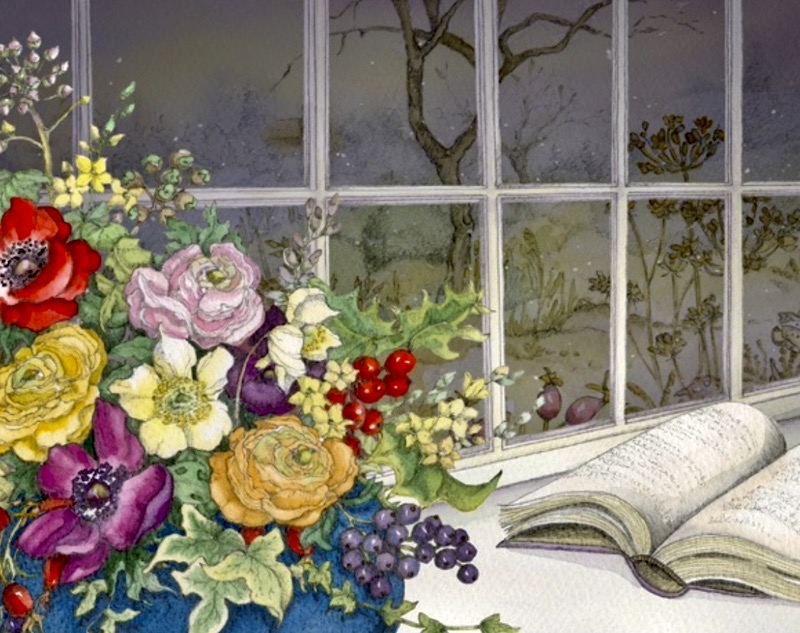
The red and the yellow. Originally intended for posting on 12/21, the 🥶Winter Solstice🥶 (in my hemisphere), but life has been difficult. It goes back to a 12/10 report to family about the previous day:
Did some garden work with [my caregiver] León [Hernández], but not as much as intended, ’cause it’s cold. On the other hand, two cymbidiums [cymbidium orchids], of different colors [red, well reddish-brown, and (lemon) yellow], are now in full bloom, with more stems shooting up all the time. L views the whole thing as a little miracle and is much delighted. Got him to move the flowering ones so that I can see them from my work chair.
I can see them as I type this, the red (a small spike of blossoms) and the yellow (a big showy spike). Plus a third spike of buds, just about to open, whose color will be a New Year’s surprise.
On the red (and my other winter-blooming cymbidiums), see my 2/25/11 posting “Rough winds”. The reddish-brown one was the first of them, a birthday present from me to my man Jacques in January 1986 (and has since been divided into clones many times). The yellow one came along later; it’s always the first to bloom. Traditionally, it was the herald of the new year, but it’s been opening up earlier and earlier as the years go by. I’ve taken to calling it Rogue Yellow. Last year it was fully open by mid-December. This year, as reported in my 11/26/24 posting “Rogue Yellow for Thanksgiving Eve Eve”, it was even earlier.
Photos of the red and the yellow, taken on 12/19 (just last week!) by Ned Deily:
(#2) Original Red, compact and dependable
(#3) Rogue Yellow, stretching showily for the heavens
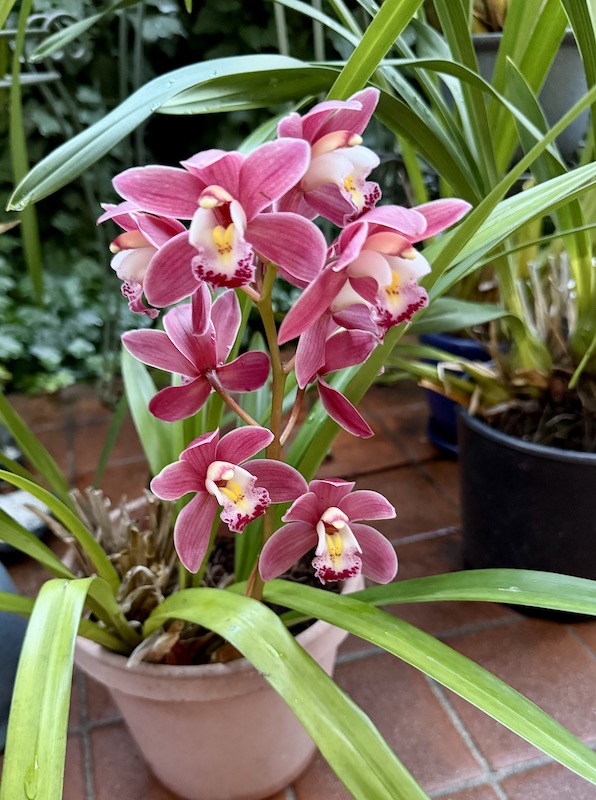
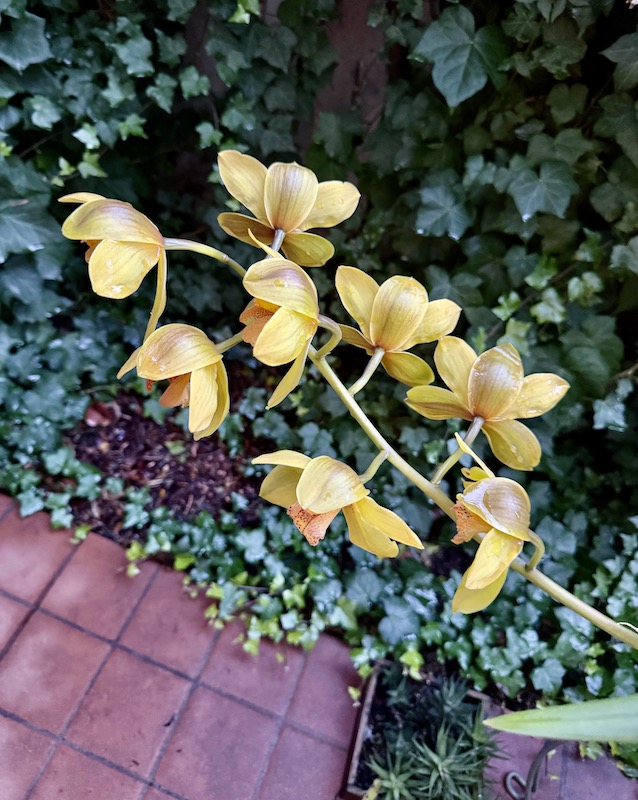
It’s my way to see symbolism in many things, and that includes these two orchids, in which I see Jacques (in Original Red, of course, because it’s directly connected to him, but also because it’s solid, dependable, and unassuming) and me (in Rogue Yellow, precocious and showy, making a bold statement). And then the contrary symbolism in the size of the flower stalks, Jacques being the strong tall one.
And now I can look out my window while I’m working at the computer and see us.
The gift of music. And then Elizabeth Daingerfield Zwicky sent me an album of music to entertain me in difficult times: Jon Batiste’s Beethoven Blues album (2024). Jazz riffs on themes from Beethoven. Sometimes playful, sometimes stunning, always intense.
About Batiste, from Wikipedia:
Jonathan Michael Batiste (born November 11, 1986) is an American singer, songwriter, multi-instrumentalist, bandleader, composer, and television personality.
… Jon Batiste was born in Metairie, Louisiana, [and …] grew up in Kenner, Louisiana. Batiste is a member of a New Orleans musical dynasty, the Batiste family, that includes Lionel Batiste of the Treme Brass Band, Milton Batiste of the Olympia Brass Band, and Russell Batiste Jr.
… At 17, Batiste released his debut album, Times in New Orleans. He attended St. Augustine High School and New Orleans Center for Creative Arts … and graduated in 2004. He then went on to attend the Juilliard School, receiving a Bachelor of Music in 2008 and a Master of Music in 2011, both in jazz studies
… Batiste cites, among the artists who have most influenced his artistic and musical choices, Mahalia Jackson, James Brown, Louis Armstrong, Bruce Springsteen, Stevie Wonder, John Coltrane, Nina Simone, Miles Davis and Django Reinhardt.
… Batiste was born into a family active in the struggle against racial segregation in the United States … Batiste is a supporter of civil rights, the fight against racism, participating, publicly, in numerous demonstrations, including the marches promoted by the Black Lives Matter movement.
December 25, 2024 at 11:38 am |
I am glad to hear you love the Jon Batiste album, because I love it too but wasn’t sure my taste was solid there and was kinda holding back til I heard a classical-music-loving friend chime in. Some of it is a little obvious or superficial, maybe, but I think a lot is just brilliant and beautiful, and some even extends Beethoven’s ideas to make me appreciate the music more. I have only heard excerpts on YouTube and Fresh Air, but I think I am about to buy the whole thing, as I totally trust your taste in music. There was a place on one interview I heard where he was talking about W. African polyrhythms being implied — in Beethoven’s 5th, I think it was — and I just couldn’t hear what he was getting at. I have a Cuban drummer friend whose take I can get, but if you have Thoughts, I am eager to hear them
December 25, 2024 at 11:40 am |
Oh, and there was an extended interview on CNN.
December 25, 2024 at 1:16 pm |
A few random thoughts.
Batiste’s Beethoven’s Fifth piece strikes me as primarily thematic variations (variations being one of Beethoven’s specialties, and also the cornerstone of jazz). I don’t hear polyrhythms, though elsewhere Beethoven sets 2 against 3. It’s possible that Batiste holds to the view that Beethoven’s music shows his West African roots (he says only that polyrhythms are “implied”, whatever that means).
Like many musicians (and visual artists), Batiste talks about his works mostly at a very high level of abstraction, because for him that’s the relevant level of planning; all the rest (with all the stuff analysts chart out) is just realizing the larger plan. (Though Beethoven himself was a fanatic for planning compositions at the micro level.) I often lose patience with this way of talking, but I understand where it comes from.