This remarkable image — In Love’s Garden: “The Peach Blossom” (from 1904) — appeared on my Pinterest feed this morning:
(#1) A peach blossom, with a bit of stem attached, and a female face, adored by a young man (the word sentimental comes to mind); to very modern eyes. just the combination of the word peach and the image of the flower will probably instead evoke buttocks (as the object of sexual desire), in the peach emoji 🍑 used in sexting — though this was obviously far from the artist’s intention 120 years ago
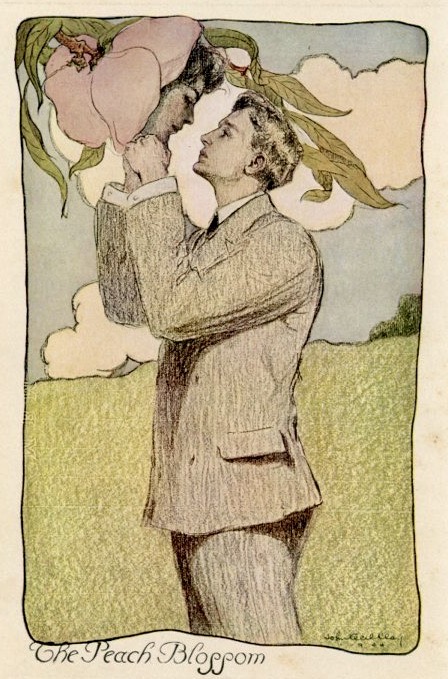
A bit of clicking from the Pinterest image led to the Prints with a Past site (“antique prints dating from the late 1700s through early 1900s”), where color prints of #1 are offered for sale. There the artist was identified as John Cecil Day (US). A search on this name got me nothing; well, illustrators are generally under-appreciated, and Day might have been a niche artist, of little note even in his own time.
But searches will turn up lots of things that aren’t what you asked for but have names similar to your search terms. And so my search for John Cecil Day brought me to an illustrator named John Cecil Clay, who looked an awful lot like my guy. I pulled up my copy of #1, got out my big magnifier, and looked at the signature. Yes, for sure, John Cecil Clay, famous enough to have a Wikipedia page. And the creator of a series of In Love’s Garden illustrations, of flowers that were also women. The Prints with a Past staff had misread the signature.
With the right name on hand, I could find more flowers from Clay’s garden. Two more of these, and then on to the fascinating story of Clay’s life; and a final note on sexting with emoji.
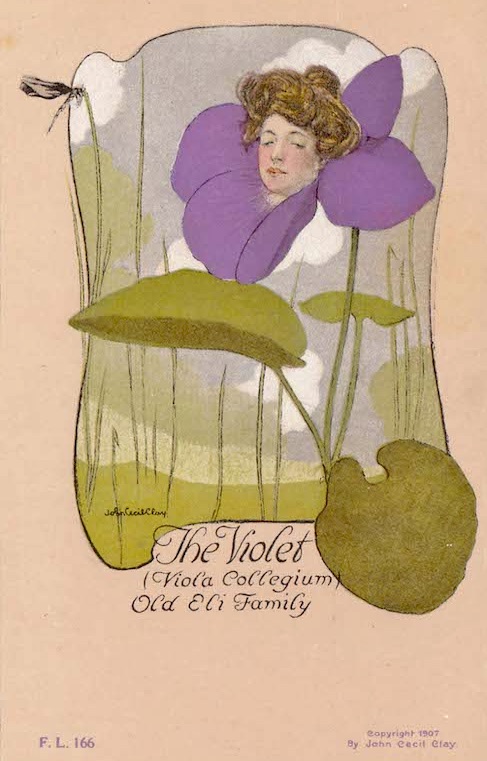
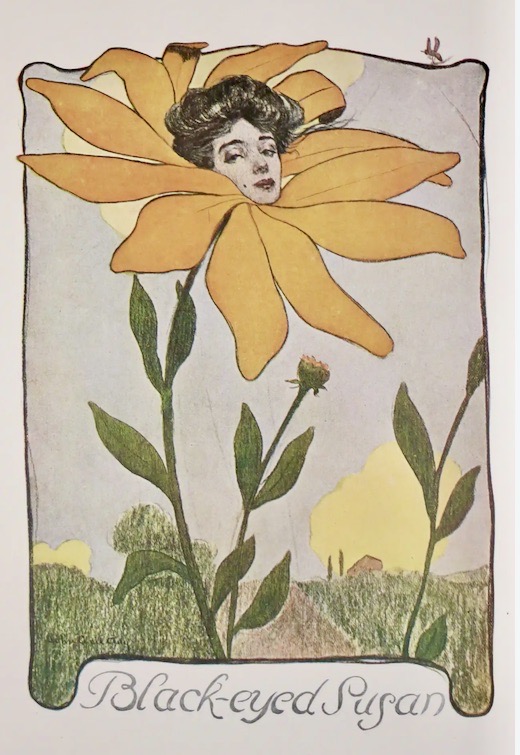
Two more In Love’s Garden. From the 37 plates in the set, grounded in a sensibility that seems to have disappeared with the Great War. My parents, both born in 1914, would have found the In Love’s Garden illustrations ludicrously old-fashioned. They’re pictures from a time long gone.
In any case, Violet and (Black-Eyed) Susan:
(#2) The dragonfly is a nice touch
(#3) With these two, you can begin to appreciate the turn-of-the-century hair styles; also to wonder about the significance of heavy-lidded eyes
The life of Clay. Discovering Clay’s name led me to a posting on the Postcard History site, “John Cecil Clay: An American Illustrator” by George Miller (a University of Delaware professor who’s all about postcard history) from 11/7/21. Miller’s posting tells me way more than I could possibly ever want to know, and he’s really into the postcards, so he treats everything else as subsidiary detail. On the other hand, he’s a completist, so he gives us everything he knows, and I can just excise the postcard stuff and the inventories of illustrations.
Finally, Miller seems not to believe in paragraphing. Even for the beginning of new sections of his text. So I’ve taken the liberty of breaking his material into paragraphs. (I have a lifetime of editing copy; paragraphing isn’t an onerous task.)
Writing a biographical sketch of a commercial artist or illustrator is like doing a jigsaw puzzle with no idea of what the final product is supposed to look like. Since the art world does not consider such people as “real” or “serious” artists, they are normally excluded from the standard reference works. Deprived of easy answers, you’ve got to gather little pieces of evidence from a dozen sources and hope that a fairly coherent story will emerge.
John Cecil Clay was born on April 2, 1875, in Ronceverte, West Virginia, a small town in Greenbriar County near the southeastern edge of the state. He was a member of the Art Students League of Washington, D.C., and a pupil of Henry Siddons Mowbray in New York City. By the late 1890s Clay was in New York, where he achieved a degree of popularity for his crayon sketches of New York actors and public figures which were published in city newspapers.
In December of 1904, at the age of 29, Clay exhibited some of his portraits done in black and white at his studio on West 30th Street. Among the portraits were those of Richard Mansfield, the actor, and authors Booth Tarkington, Joel Chandler Harris, and Mark Twain. In addition to his newspaper sketches, Clay did illustrations for magazines. His major work was done for Life magazine, the predecessor of the photo-journalistic Life we remember. Clay’s first work for Life appeared in April 1902 and from then until September 1907, he was a frequent contributor.
Clay also created two books, both of which were published by Bobbs-Merrill of Indianapolis: In Love’s Garden (1904) and The Lover’s Mother Goose (1905). He collaborated with Oliver Herford, a popular humorist and illustrator, on another four books: Cupid’s Almanac and Guide to Hearticulture (Houghton, 1908); Cupid’s Cyclopedia (Scribner’s, 1910); Cupid’s Fair-Weather Booke (Scribner’s, 1911); and Happy Days (M. Kennerley, 1917). In addition he illustrated at least one novel — Thomas Bailey Aldrich’s Marjorie Daw (1908).
By 1915, Clay resided on Winfield Avenue, in Mamaroneck, New York, and worked from “The Players,” 16 Gramercy Park, in New York City. At some undatable point — but probably in the mid to late 1920’s — he suffered a paralytic stroke and was forced to retire. In April 1928, a group of friends presented him with a volume of paintings, etchings, and drawings done especially for him. The friends included James Montgomery Flagg, Oliver Herford, and Howard Chandler Christy. He died on May 24, 1930, at his home “Butterfly Farm,” in Mamaroneck.
… In Love’s Garden. In Love’s Garden … was a Christmas gift-book published by Bobbs-Merrill Company of Indianapolis, Indiana. It consists of 37 color plates, each of which features a woman’s head as a blossom of a flower. Most of the plates carry an appropriate line of verse. Interspersed with the plates are poems by authors such as Shakespeare, James Russell Lowell, Paul Laurence Dunbar, James Whitcomb Riley, and Tennyson, which deal with love and nature.
… The book was apparently quite popular and certainly is too handsome a thing to ever throw away. As a result, copies of the book, which Life sold in a decorated box for $3, are still fairly available today, as are the individual plates which have been removed from the book.
His art. Clay’s designs are all “sketches” originally done in what appears to be crayon or charcoal; he was not a painter and did not work in oil. His work as a newspaper artist demanded that he be able to sketch quickly. Instead of having his subjects “pose” for their portraits, Clay was forced to use whatever moments he could.
Talking about his sketch of actor Richard Mansfield, Clay remarked: “There would have been no use in attempting to get a satisfactory sketch of Mr. Mansfield in one sitting. I made that sketch in eight sittings of about six minutes each. Mr. Mansfield gave me the time between acts, in his dressing-room. Of course it wasn’t the easiest way to work, but it was the only way, in that case. Mr. Mansfield is a very nervous man and a long sitting would have driven him wild. As it was, he came off the stage full of his role, all enthusiasm and spirit. For a few moments he held the mood. After that I put away my work and waited until the next evening.”
Sexting with emoji. From my 3/19/17 posting “Sexting with emoji:
For sexting purposes, various emoji with relatively literal uses have become widespread conventional symbols for bodyparts and acts. For some time, the Eggplant emoji [🍆] has been the conventional penis symbol, although recently it’s been challenged by two other emoji, Banana [🍌] and Hot Dog [🌭].
… Then, there’s the Peach [🍑] emoji, usually representing a butt or bottom (either buttocks or anus), but also sometimes used as a vaginal symbol, where it’s now in competition with the Taco emoji [🌮]
Leave a Reply