Encountered on Pinterest on 10/28, in a collection of mostly homoerotic images — Pinterest strives to cater to your interests, and mine aren’t hard to suss out — this painting, identified as being an early 19th-century work by Russian painter Alexander Ivanov (an artist completely unknown to me):
(#1) My first response was that the painting was truly creepy, looking to modern eyes like high-class kiddie porn: a beautiful young man (wearing a laurel wreath, therefore noble or divine), naked but with drapery over his lower body (his gaze fixed dreamily on something in the middle distance), embracing a totally naked young teenage boy (whose eyes are closed, apparently in enjoyment), while another fully naked boy, considerably younger, plays a wind instrument (apparently an aulos, an ancient Greek double-reed) for his companions’ pleasure; a lyre hangs from a tree in the background
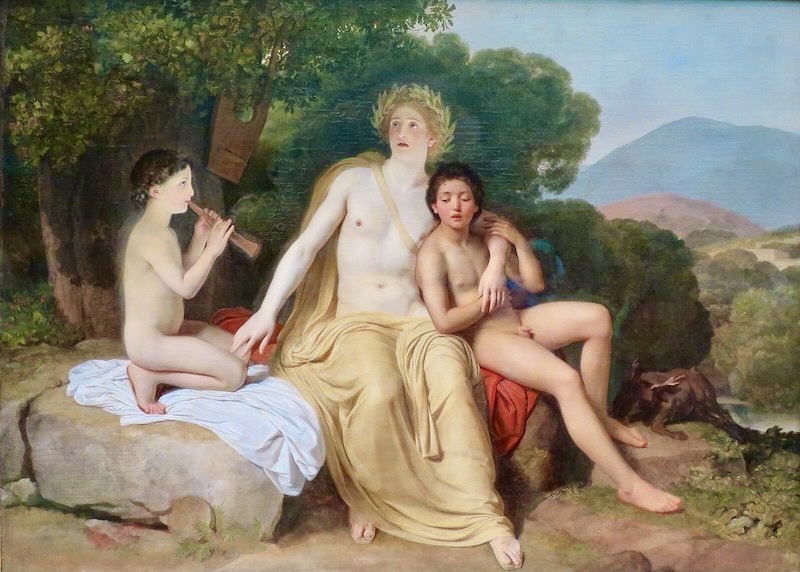
A gauzily Romantic painting, set in a rough scenic wilderness, apparently of some classical or mythological subject in which music plays a significant role. Ok, so the beautiful young man is probably the god Apollo, famously skilled at the lyre (bonus: by far my favorite of the pantheon of ancient Greece and Rome). In this painting as the god of music and also the protector of the young. The boys are naked because they are true pre-pubertal innocents. Or just because the scene is set in the Arcadian wilderness, suffused with divine presence, a territory in which the gods and those within their aura have no need for the garb of ordinary mortals. Well, certainly not in artworks; consider the famous Apollo of the Belvedere statue (my 9/23/24 posting “Godlike beauty” has a section on the Belvedere Apollo and his full-frontal divinity).
So I tracked down #1: it’s Alexander Ivanov’s Apollo, Hyacinthus and Cyparissus making music and singing (painted during 1831-34), which I’ll call AH&C for short. At this point, things just got puzzling. The Russian painter Ivanov (1806-58) was new to me; he turns out to have a remarkable life history (summarized below). And then there’s the scene in #1.
H and C were two of A’s male lovers (summary below), but as vigorous young men, not boys — an athlete and a hunter, neither of them described as a musician (but maybe tutelage in music automatically came along with A’s love-making), and apparently never described with one another; the scene in #1 seems to be all Ivanov’s fantasizing, not a depiction of an event from mythological lore. Then, I don’t know which of the boys is H, which C, so I don’t know which of them is making music on an aulos. Meanwhile, A has his lyre at the ready (but isn’t actually strumming it), while the other boy is neither making music nor singing, and A isn’t either (unless he’s mastered the art of singing with his mouth closed); so AH&C’s “making music and singing” seem to be largely imminent, not yet in the scene. Well, apparently the painting is unfinished (even after three years of Ivanov’s fiddling with it); maybe Ivanov was planning to have A get his lyre down off the tree and open his mouth in song. That would have been lovely.
Here I would like to quote some critical and analytical literature on the painting, to clear all this up. But there isn’t any, just a description of the painting at the Tretyakov Gallery in Moscow (quoted in full below, in translation), and it’s mostly useless. (At least one museum site that catalogues the painting laments the absence of such analysis.) What I’ve written above probably has more detail than any existing description — but I am no art historian, just a guy with a little bit of relevant knowledge, saying what he sees.
But now, on to the meat.
Ivanov. From Wikipedia:
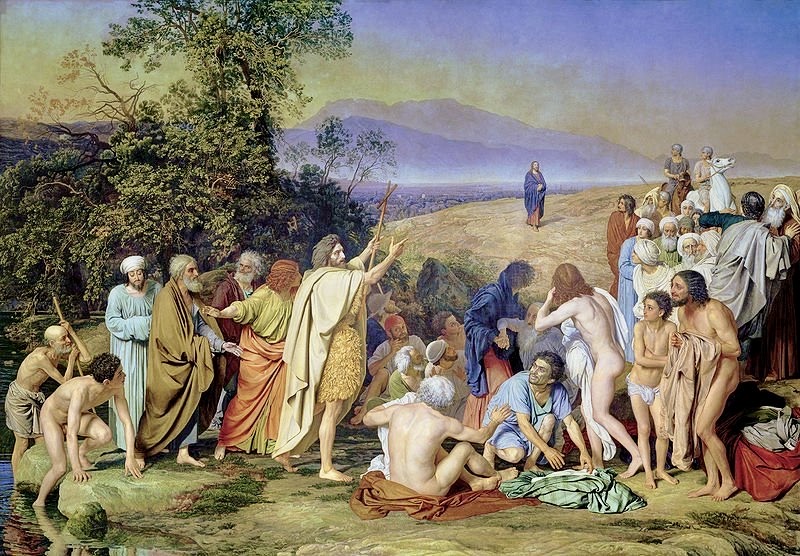
Alexander Andreyevich Ivanov (Russian: Алекса́ндр Андре́евич Ива́нов; 28 July [O.S. 16 July] 1806 – 15 July [O.S. 3 July] 1858) was a Russian painter who adhered to the waning tradition of Neoclassicism but found little sympathy with his contemporaries. He was born and died in St. Petersburg. He has been called the master of one work, for it took 20 years to complete his magnum opus The Appearance of Christ Before the People.
… He spent most of his life in Rome, where he befriended Gogol and was influenced by the Nazarenes.
His magnum opus:
(#2) The Appearance of Christ… [at a mass baptism by immersion] by Alexander Ivanov (painted during 1837-57); he was bitterly disappointed when it was poorly received during his lifetime, but after his death it came to be seen as a Russian masterpiece
On the Nazarenes, from Wikipedia:
The epithet Nazarene was adopted by a group of early 19th-century German Romantic painters who aimed to revive spirituality in art. The name Nazarene came from a term of derision used against them for their affectation of a biblical manner of clothing and hair style.
In 1809, six students at the Vienna Academy formed an artistic cooperative in Vienna called the Brotherhood of St. Luke or Lukasbund, following a common name for medieval guilds of painters. In 1810 four of them, Johann Friedrich Overbeck, Franz Pforr, Ludwig Vogel and Johann Konrad Hottinger (1788–1827) moved to Rome, where they occupied the abandoned monastery of San Isidoro. They were joined by Philipp Veit, Peter von Cornelius, Julius Schnorr von Carolsfeld, Friedrich Wilhelm Schadow and a loose grouping of other German-speaking artists. They met up with Austrian romantic landscape artist Joseph Anton Koch (1768–1839) who became an unofficial tutor to the group. In 1827, they were joined by Joseph von Führich (1800–1876).
The principal motivation of the Nazarenes was a reaction against Neoclassicism and the routine art education of the academy system. They hoped to return to art that embodied spiritual values, and sought inspiration in artists of the Late Middle Ages and early Renaissance, rejecting what they saw as the superficial virtuosity of later art.
In Rome, the group lived a semi-monastic existence as a way of re-creating the nature of the medieval artist’s workshop. Religious subjects dominated their output, and two major commissions allowed them to attempt a revival of the medieval art of fresco painting.
The Tretyakov description of #1.
The subject of this unfinished painting is the artist’s fantasy on several Greek myths. Apollo, the god of the sun, art, music and poetry [AZ: also of archery, healing, oracles, knowledge, and the protection of the young], is playing music along with his favorites in nature’s lap. Ivanov said he wanted to portray “nudity instead of a life class”, in other words, to combine classical beauty with a lively romantic feeling. He makes studies from classic sculptures (for example, the head of Apollo of the Belvedere or a bas-relief depicting sleeping Endymion), but he tries to animate the images filling them with warmth and light.
Hyacinth and Cyparissus. From the Wikipedia entry on Apollo (a gigantic entry, a labor of love, with 455 reference notes):
Hyacinth (or Hyacinthus), a beautiful and athletic Spartan prince, was one of Apollo’s favourite lovers. The pair was practicing throwing the discus when a discus thrown by Apollo was blown off course by the jealous Zephyrus and struck Hyacinthus in the head, killing him instantly. Apollo is said to be filled with grief. Out of Hyacinthus’ blood, Apollo created a flower named after him as a memorial to his death, and his tears stained the flower petals with the interjection αἰαῖ, meaning alas. He was later resurrected and taken to heaven. The festival Hyacinthia was a national celebration of Sparta, which commemorated the death and rebirth of Hyacinthus.
Another male lover was Cyparissus, a descendant of Heracles. Apollo gave him a tame deer as a companion but Cyparissus [out hunting] accidentally killed it with a javelin as it lay asleep in the undergrowth. Cyparissus was so saddened by its death that he asked Apollo to let his tears fall forever. Apollo granted the request by turning him into the Cypress named after him, which was said to be a sad tree because the sap forms droplets like tears on the trunk.
A note. That mortal lovers of the gods tend to come to unfortunate ends, and then go on to be transfigured into flowers, trees, animals, or geographical features (like streams). As a result, much of the natural world that surrounds us resonates secretly with the affectional and sexual companions of the gods. Think of that when you force a hyacinth bulb into bloom or walk along an allée of tall cypress trees.
November 19, 2024 at 3:26 pm |
I have seen The Appearance of Christ Before the People at the Tretyakov. It is huge and is stunning, one of my favorite paintings. Ivanov is sometimes called the master of a single work because he spent so much time on that one. Smaller reproductions do not give it justice, and a full size reproduction is not very practical. Ivanov undoubtedly would be more famous if he had not spent so much of his career on a single piece that can only be fully appreciated in person.
November 19, 2024 at 3:38 pm |
Yes. I meant to comment on its enormous size. I haven’t seen it in person, but I was reminded of some gigantic Hudson River School paintings that I *have* seen in person and truly cannot be appreciated properly in reproductions.