🏈 🏈 today’s the Big Game in these parts — Stanford vs. UC Berkeley, 12:30 (PT), blessedly at Berkeley; the rain has given way to overcast skies, with occasional sunny breaks
From sun to sun, art to art: it starts with a Ukrainian sculpture of Icarus (who recklessly flew too close to the sun, defying the gods, and so plunged to his death); moves through a Russian painting of Icarus with his father Daedalus (who warns his son not to fly too high or too low); from there to van Dyck’s earlier painting of this same scene; which leads to a van Dyck self-portrait with a sunflower, a Helianthus that’s turned to him as to the sun itself: perhaps the painter as an incarnation of the sun god Apollo.
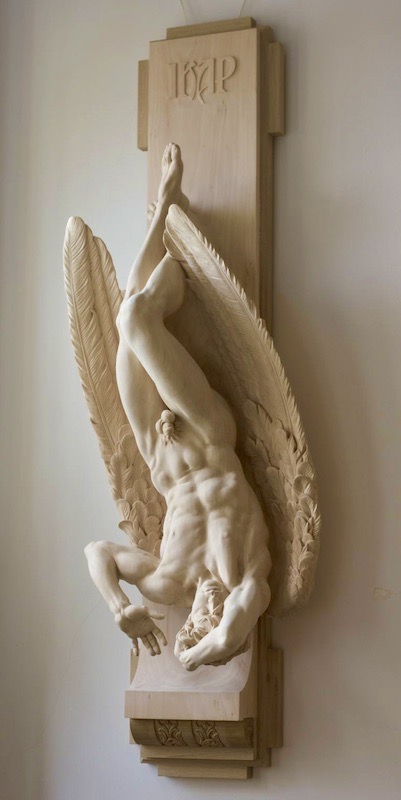
Bogdan Goloyad, Icarus, 2015. Icarus as a victim of the sun. In my 11/20/24 posting “Icarus, nude, falling”:
(#1) The wooden sculpture (mounted on a vertical surface) catches Icarus in desperate mid-fall
Text from Pinterest about Icarus:
In Greek mythology, Icarus was the son of the master craftsman Daedalus, the creator [working for King Minos of Crete] of the Labyrinth [designed to hold the Minotaur]. [Icarus and Daedalus] attempted to escape from Crete by means of wings that Daedalus constructed from feathers and wax. Icarus [recklessly] ignored his father’s instruction not to fly too close to the sun. When the wax in his wings melted, he tumbled out of the sky and drowned in the sea.
The wages of hubris. But then, if you were Oscar Wilde, you would find the cost worth the experience; his poem “Icarus” (not published during his lifetime):
Never regret thy fall,
O Icarus of the fearless flight
For the greatest tragedy of them all
Is never to feel the burning light
Pyotr Ivanovich Sokolov, Daedalus and Icarus, 1776. #1 came to me via Pinterest. After I posted about it, Pinterest (which thrives on association) supplied me with this Russian painting about Icarus:
(#2) (full title) Daedalus Attaching Wings to Icarus, by Pyotr Ivanovich Sokolov (1753-1791), in the State Tretyakov Gallery in Moscow

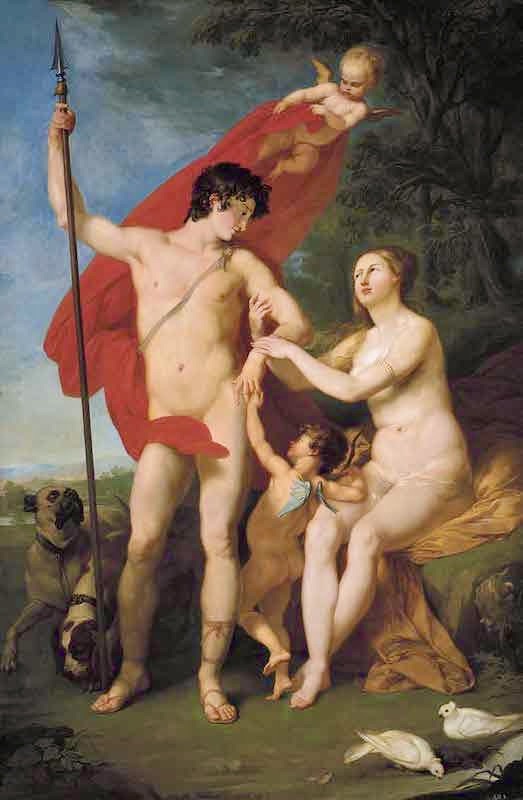
From Russian art sources (which provide a wretched translation into English, so here I give a few notes paraphrasing these sources): PIS was born a serf; on the death of his owner, he was enrolled at the age of 10 in the Imperial Academy of Arts, then studied painting in Rome; he returned to Russia, eventually becoming an academician there. He was primarily a historical painter, specializing in scenes from mythology, like #2. Two more such scenes, to give you some feel for his style:
(#3) Adonis and Venus, 1782: Venus’ attempted seduction of the handsome hunter Adonis
(#4) Hermes and Argus, 1776: more divine lustfulness, as Hermes / Mercury (in the helmet) has put the all-seeing Argus (guardian of Hera’s / Juno’s heifer Io, in the background) to sleep so that Zeus / Jupiter can pursue her for sex

Some of the figures are idealized, but most are clearly drawn from life; PIS had a good eye for both faces and bodies. In particular, in #2, his Icarus is ethereally idealized, while his Daedalus is a (flattering) portrait of a real man. (They both have curly hair, because they’re, well, Greek.)
Anthony van Dyck, Daedalus and Icarus, 1615-25. In trying to find more information about the Sokolov painting in #2, I came across an earlier Daedalus and Icarus, which was probably Sokolov’s model for #2; Sokolov did variant copies of older masterworks as a kind of commentary and as a teaching tool. In any case, we’re going still further back in time. The painting:
(#5) The wings alone are remarkable (and the flowing silky drapery is delicious); then there are the two characters, both caught in mid-gesture as they talk with one another — the preternaturally beautiful boy with his cascading blond hair and his headstrong pursed lips; the anxious disheveled father sternly offering his advice

On the artist, from Wikipedia:
Sir Anthony van Dyck (Dutch: Antoon van Dyck; 22 March 1599 in Antwerp, Spanish Netherlands – 9 December 1641 in London, England) was a Flemish Baroque artist [influenced especially by Peter Paul Rubens] who became the leading court painter in England after success in the Spanish Netherlands and Italy.
… Van Dyck is best known for his portraits of the aristocracy, most notably Charles I, and his family and associates. He was the dominant influence on English portrait-painting for over 150 years. He also painted mythological, allegorical and biblical subjects, including altarpieces, displayed outstanding facility as a draughtsman, and was an important innovator in watercolour and etching.
And then the Wikipedia article presented me with a wonderful van Dyck that wraps up this 400-year tour back in time with Icarus.
van Dyck, Self-Portrait with a Sunflower (painted after 1633). The portrait:
(#6) van Dyck points to a giant sunflower, a flower that is turned towards him the way this flower turns towards the sun as it moves through the sky during the day — suggesting to me that the artist is the analogue of the sun and the embodiment of Apollo, the god of the sun

Now it turns out that there is considerable art-critical discussion of how to interpret the sunflower in this painting — and the gold chain the artist is fingering. The beginning of a longer Wikipedia exposition of these matters:
The portrait features the artist Anthony van Dyck looking over his shoulder at the viewer. His gaze centres on the viewer, as if calmly startled by the presence of an onlooker. His right hand is poised to touch the bottom petals of a yellow sunflower. His left index finger and thumb hold a gold chain that extends across his right shoulder and down his posterior side. This is a visual trick of calling attention to the chain and the message it portrays. This chain is understood to be a gift the artist received from his patron, Charles I. The gold chain holds a medal with the king’s likeness on it, but is concealed by the artist’s right arm sleeve. He is portrayed to be outdoors in nature, as seen by the clouds in the background. He is clothed in a richly-dyed pink overcoat with a white shirt visible on his collar, shirt cuffs, and a slender slit on his back. The light source is radiating from the bottom left corner, illuminating the outer petals of the sunflower. This gives the visual effect of the sunflower “shining” on Anthony van Dyck’s face in approval, a common interpretation of the sunflower.
Well, nobody seems to bring up Apollo. I, of course, have Apollo on my mind; see my 11/19/24 posting “The Ivanov puzzle”.
November 23, 2024 at 5:47 pm |
Thank you. An excellent post
November 23, 2024 at 6:09 pm |
My favorite Icarus painting is Breughel’s “Fall of Icarus” where everyone is doing their thing and Icarus fell in the water in the corner.
November 23, 2024 at 7:02 pm |
Oh my, yes. I’ve been trying very hard not to get into The Art of Icarus, in toto, but to cleave to one line of associations; this turned out to be a long day’s work. But you and other readers are of course welcome to strike out in other directions.