Archive for the ‘Formulaic language’ Category

The same great classic rock

April 8, 2024

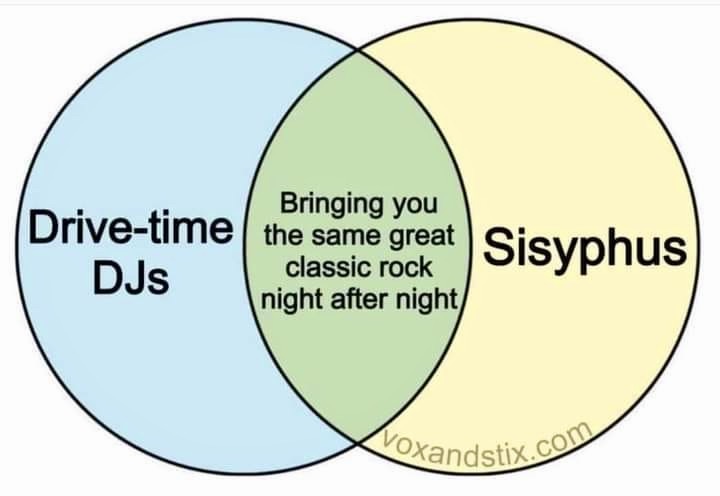
☀️ 🌑 for Solar Eclipse Day, Sisyphus and drive-time DJs intersect in a Venn diagram, where they generate a wonderful even-handed pun:


(#1) The hinge is the ambiguous NP great classic rock; what Sisyphus and drive-time DJs share — what’s in the area in the diagram that represents the intersection of the categories in the two circles — is that they’re people who bring you the same great classic rock every night (but in two different senses of the great classic rock)

We understand what the categories are in a Venn diagram from the labels on the intersecting circles and on the areas of their intersection, which are meant to be informative (and clear in their reference). But of course the labels are expressions in some language, which means that ambiguous expressions can be exploited for a joke. As in #1.

(#1 came to me on Facebook from from pun enthusiast Susan Fischer, the syntactician and psycholinguist specializing in sign languages; the ultimate source is the vox + stix website, on which see below)

(more…)

Stock expression goes country

April 1, 2024

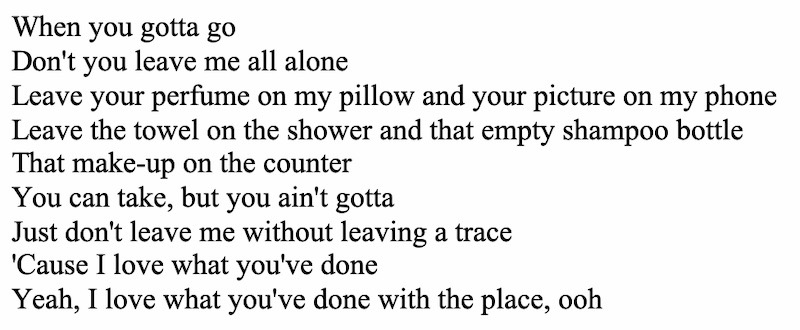
A real-life example of the LWYDW stock expression I looked at in my earlier posting today (“I love what Scrivan did with the rabbit pun”, here), in a poignant love song by the country / country pop group Rascal Flatts: “Love What You’ve Done With The Place”, on their Back To Us album (2017):


Refrain from the song, in which a guy details the touches of his lover’s presence in his place

(more…)

Love what Scrivan did with the rabbit pun!

April 1, 2024

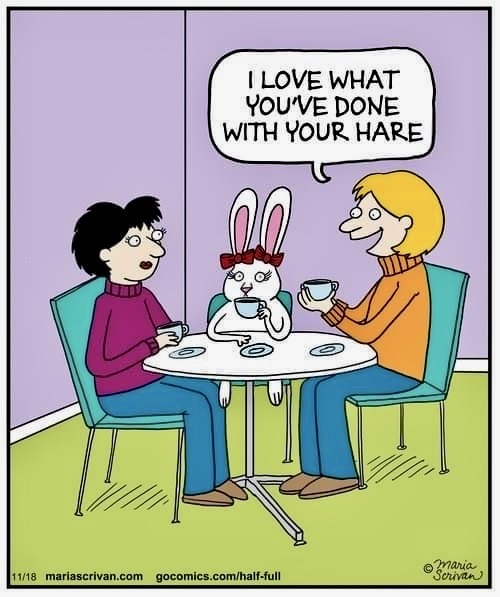
🐇 🐇 🐇 three rabbits to inaugurate the new month, 🃏 🃏 🃏 three jokers for April Fool’s Day, and 🌼 🌼 🌼 three jaunes d’Avril. yellow flowers of April, all this as we turn on a dime from yesterday’s folk-custom bunnies of Easter to today’s monthly rabbits; for this intensely leporine occasion, a Maria Scrivan hare-pun cartoon:


(#1) (phonologically perfect) pun hare on model hair, taking advantage of I love what you’ve done with your hair as an common exemplar of the stock expression (I) love what you’ve done with X; a cartoon posted on Facebook by Probal Dasgupta, who reported, “Even I groaned at this one”

Things to talk about here: my use of turn on a dime just above; Easter + April Fool’s; the yellow flowers of April (which will bring us to Jane Avril — Fr. Avril ‘April’); and the stock expression (I) love what you’ve done with X.

(more…)

Stand Up To Hate

April 1, 2024

That’s what the fuzzy sign said that was being passed around on Facebook, in appreciation of its unintended ambiguity: it’s supposed to be exhorting us to oppose hate (with noun hate), but it could be telling us to do our hating on our feet (with verb hate); consider some parallels in which the N and V readings are pulled apart:

Stand Up To Hatred [N reading]  OR  Stand Up To Execrate [V reading, with understood object]

Stand Up To Yelling [N]  OR  Stand Up To Yell [(intransitive) V]

Stand Up To Urination [N]  OR  Stand Up To Urinate [ (intransitive) V]

I’ll look at the ambiguity in detail in a little while. But first some words about slogans, like the one on that fuzzy sign.

(more…)

Everyday beheadings

March 29, 2024

For some time now, I’ve been collecting examples of a scheme of English derivational morphology I’ve called beheading, as in

crude (Adj) oil (N) -> crude (N), where the derived item crude ‘crude oil’ is a Mass N (like oil)

commemorative (Adj) stamp (N) -> commemorative (N), where the derived item commemorative ‘commemorative stamp’ is a Count N (like stamp)

A great many of the examples come from jargons, the vocabularies of specific occupational or interest groups, like people in the energy business or philatelists — or medical professionals (N attending ‘attending physician’), food preparers, servers, and sellers (N Swiss ‘Swiss cheese’), and so on. More generally, most beheadings are notably context-specific. But some come from everyday language and don’t need much contextual backing.

Here, after a somewhat more careful account of what beheadings are, I’ll add a few everyday beheadings to supplement the ones in my files (see the Page on this blog). Then I’ll veer all the way to the other pole and note that with enough contextual backing, completely novel beheadings can be coined and understood. Finally, I’ll cite the everyday beheading that inspired this posting: three squares a day ‘three square meals a day’, from US President Joe Biden, which I put off because some commenters took it — or, possibly, the idiom square meal itself — to be outdated, hence a sign of Biden’s being old and out of touch, a development that merited some discussion on its own. But there are plenty of cites, including a NOAD entry for the beheading square; and then all those comments vanished from the net, so I had no one to bash.

(more…)

Kissing the proverbial you know what

December 20, 2023

From the Raw Story site, “‘The stain is on you’: Ex-RNC chair slams GOP for silence on [GP]’s call for blood purity” by Matthew Chapman on 12/18/23 (in this story [GP] refers to (Helmet) Grabpussy), beginning:

The Republican Party at large owns former President [GP]’s increasing descent into fascistic and racist rhetoric, former GOP chair Michael Steele told MSNBC’s Katie Phang [sitting in for the host of “The Beat With Ari Melber”] on Monday.

This comes as [GP] stated at a rally that immigrants are “poisoning the blood of our country,” language that has clear roots in Nazi Germany — and Sen. Lindsey Graham (R-SC) defended it furiously when cornered by reporters.

“Michael, it is not just [GP] that’s doing the bad thing, it’s the enablers that are doing the bad thing,” said Phang. “We all know why they are kissing the proverbial you know what. And, when you have somebody like Marc Short [Republican operative, chief of staff to Vice President Mike Pence] saying ‘I doubt that [GP] has read Mein Kampf,’ I don’t disagree with him, I don’t think he has the capacity to read, but it is not the point. These people enable [GP] to be able to say this with zero consequence.”

In the crucial quote, boldfaced above, Phang was choosing between two idioms, both of the form kiss + object, both expressing submission to someone: the elevated idiom (with the C[ount] Sg object noun ring):

kiss someone’s ring or: kiss the ring

and the vulgar slang idiom (with the M[ass] Sg object noun ass):

kiss someone’s ass or: kiss ass

In any case, Phang chose to indicate that she was using a formulaic expression, via the formula-signaling adjective proverbial modifying the head noun of the object. She said kiss the proverbial X and not kiss proverbial X, and that would seem to indicate that she was using the elevated idiom (with ring), which comes with a definite article, and not the vulgar idiom (with ass), which is anarthrous: kiss the ringkiss the proverbial ring; kiss asskiss proverbial ass.

But we can feel pretty sure that she was aiming for the vulgar idiom, because she also used a scheme for avoiding taboo words (like ass ‘buttocks’ or ‘anus’): the filler you know what replacing the taboo item (I’m not going to kiss (his) you know what, He told me to stick it up my you know what).

The result is that at first glance she just looks confused, mixing features of the two competitors for a submission idiom. But it turns out that the syntax of formula-signaling proverbial is more complex than I had thought, and she was saying exactly what she intended.

(more…)
Country names and food

December 11, 2023

Country names, take me home
To the place at the table where I belong

(with apologies to John Denver and his collaborators)

This posting is, first of all, about bare-bones pun jokes, typically a one-line set-up followed by the pun in a pay-off line.

In this case, on a theme (food and eating), with the puns all from a domain (of country names); the classic pun name on this theme from this domain is Hungary (punning on hungry). I will illustrate with three Hungary-based bare-bones jokes.

Then, name-domain + theme puns (in this case, country + food puns) can be arranged in a cascade, which can be performed by a single joke-teller or framed as repartee between two performers. The classic country + food cascade is triggered by Hungary (Greece, Turkey, and Chile are other possible triggers); I’ll call it the Hungary For Food Riff, HFR for short. HFR comes in many variants; here I give two repartee versions: one relayed to me by Probal Dasgupta on Facebook on 12/9, the other I found in net collections of puns on Hungary later that day.

(more…)

Analogical extension as a joke form

December 8, 2023

Now for a joke type that isn’t pun-based. Instead, like snowclones, these jokes are based on formulaic expressions, and involve replacing items in the formulas by (semantically) analogous items; they are analogical extensions of the formulas. One popped up in today’s Wayno / Piraro Bizarro:


(#1) To understand this cartoon, you have to retrieve the conventionalized N + N compound dog whistle, the basis for dog tuba (if you’re puzzled by the odd symbols in the cartoon — Dan Piraro says there are 3 in this strip — see this Page)

From NOAD:

(compound) noun dog whistle: [a] a high-pitched whistle used to train dogs, typically having a sound inaudible to humans. [b] [usually as modifier] a subtly aimed political message which is intended for, and can only be understood by, a particular group: dog-whistle issues such as immigration and crime.

It’s sense a that’s relevant to #1, which shows a guy playing a tuba at a high pitch humans can’t hear (note that the other guy is struggling to hear anything at all) but dogs can (note the dog stopping up its ears in pain). So: the dog is experiencing not a dog whistle, but (preposterously) a dog tuba.

(more…)

The elf season

December 1, 2023

It’s December, and as the Christmas elves appear, there comes a startling elfshelfism joke (in abbreviated form), on Facebook today. I got it from Ryan Tamares, who got it from Britannic Xen Osiris Zane, who got it from someone else, and who knows where such memic material originated.


(#1) Yes, Spock on a cock: the science officer of the starship USS Enterprise, riding a monstrously large rooster (across a bleak alien landscape)

To get to the punchline Spock on a cock, you have to recognize the figure of Spock (from popular-culture tv and movie fiction) and also recall that cock — most commonly used for raunchy reference to the penis — is also a somewhat antique or specialist word for a rooster. (As a result, #1 is not only a joke, but also a slightly dirty joke.)

As described in my 12/22/22 posting “Elfshelfisms”, the elfshelfism is a riddle form presented visually, and depends on rhyme (perfect rhyme or half-rhyme), with example punchlines: lemur on a femur, Dolly [Parton] on a tamale, and sonorants on cormorants.

(more…)

James and the knock-knock joke

November 27, 2023

One Big Happy strip, recently in my comics feed:


(#1) James (mis-)takes Ruthie’s meta-commentary — her talk about what’s going on in her interaction with James — to be part of that interaction, to be her next move in the routine of the knock-knock joke, and shows that he understands that routine, by producing the appropriate next move in the routine

James might be a dirty-faced urchin, but he knows his joke routines. And, in the last panel, is probably wondering how on earth Ruthie’s going to make a pun out of jeezy-peezy-I-forgot-the-joke.

So: mastering the routine of the knock-knock-joke is one thing, but then the routine incorporates another type of joke, the pun joke, which has its own requirements. In addition, the knock-knock joke requires not just any pun, but a (phonologically) imperfect pun, the more distant the better, so that its punch line will have genuine surprise value.

(more…)