Archive for the ‘Formulaic language’ Category

CAR WASH HOT DOG

October 23, 2024

Today’s Zippy strip displays our Pinhead’s onomatomania, as he chants CAR WASH HOT DOG over and over, to his evident pleasure. I was entertained by the notion of a car wash hot dog, which struck me as ludicrous, conjuring up the image of sodden, sudsy frankfurters in buns:


(#1) But then I remembered that Zippy’s obsessively reiterated chants are never sheer inventions on his part, but are always found mantras, so car wash hot dogs must be a real thing — and so they are, on the understanding  ‘hot dogs at a car wash, hot dogs with a car wash, hot dogs and a car wash’, or, as they are sometimes advertised, car wash / hot dog sales

This was all news to me; I didn’t recall ever having heard of selling a car wash along with hot dogs and didn’t think the two things were a natural pairing. But there they were, lots of them, car wash / hot dog sales for very local causes.

Why had I never heard of them? Because they are not just an American thing (unknown in the UK, Australia, and so on, even in Canada), but a very specific regional American thing, apparently confined to a narrow band of the southeastern US, from Florida to West Virginia. (Zippy’s Dingburg is in Maryland, which is, with West Virginia, at the very northern edge of this band). I have lived in the middle Atlantic, New England, mid-America, and California, but not in the southeast, and so I missed out on C. W. H. D. (as Bill Griffith’s title for #1 has it).
(more…)

A Swiss philological moment

October 20, 2024

Wayles Browne writes from Cornell:

you might spare a posting for Jacob Wackernagel, the Swiss philologist, who was the first to make sense of second-position clitics (https://langsci-press.org/catalog/book/270), born 11 December 1852; and for Jost Winteler, the other Swiss philologist and author of Die Kerenzer Mundart des Kantons Glarus in ihren Grundzügen dargestellt (1876), who may or may not have been a predecessor of phonemic theory, but who definitely was a mentor to young Albert Einstein after the latter moved to Switzerland. Winteler was born 21 November 1846.

This is that posting, First, I have added Wackernagel (12/11/1852) and Winteler (11/21/1846) to my e-calendar.

Then, from my reply to WB:

I used to be an authority on second-position clitics, even have a t-shirt that says PUT YOUR CLITICS IN SECOND POSITION.
As for Winteler, Canton Glarus is where the Zwickys come from — mostly from Mollis.
Meanwhile, I happen to be wearing my Swiss-flag gym shorts. Hail, Helvetica! and all that.

(more…)

This idiom has had the radish

September 25, 2024

In e-mail on 9/24 from Masayoshi Yamada, Emeritus Professor of Linguistics, Shimane University (author of, inter alia: A Dictionary of Trade Names and A Dictionary of English Taboo and Euphemism), substantially edited:

Recently, I happened to read the newspaper comic strip Zits; on September 23 and 24, the main character Jeremy uses the expression “I had the radish”. One of the few dictionaries which defines it:

have had the radish ‘to be no longer functional or useful; to be dead or about to perish’. Local to the state of Vermont. Primarily heard in US. (Farlex Dictionary of Idioms, 2024) (Free Dictionary link)

However, I don’t have any clue to its etymology: why radish? And is it so local to Vermont? I have no idea which language source the Farlex Dictionary is based on. [AZ: It cites the Free Dictionary, which aggregates information from many sources, so that’s not especially helpful.]

I pointed out to MY that in the strip, Jeremy decides to just invent (make up) some expression, to see if he can get it accepted. And picks had the radish. Presumably in the belief that no one had ever used it as an idiom. The first three strips (in strips to come, Jeremy eventually concedes that his idiom has had the radish):

(more…)

Put on some pants, ranger!

September 14, 2024

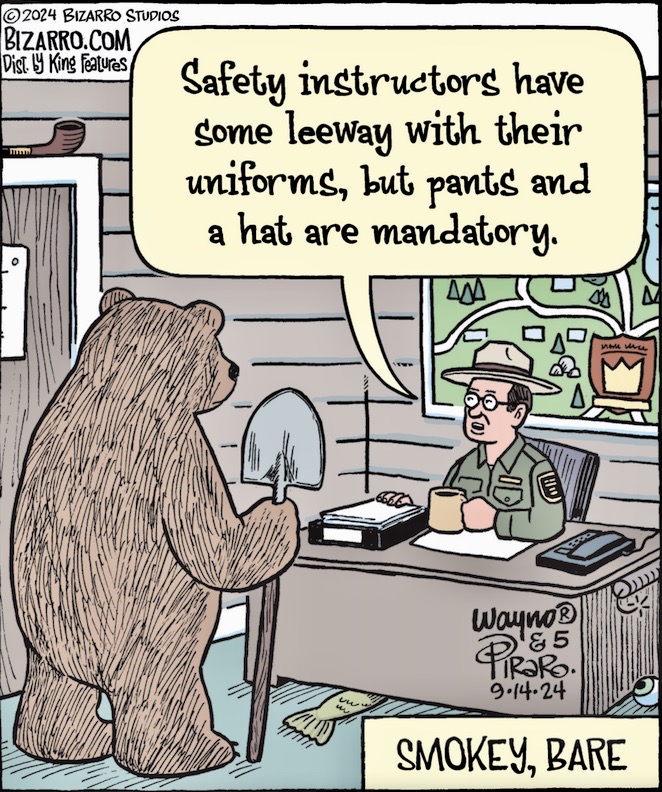
Today’s Wayno / Piraro Bizarro — Wayno’s title: “Forestry Union Negotiations” — plays with the homophones bear and bare in a fresh way, turning on the fact that Smokey the Bear (in those American public service ads for fire safety) is in fact a National Park Service ranger (who happens also to be a talking bear), and so would be required to dress in ranger garb:


(#1) The cartoon, in which Smokey appears on duty with his shovel for fighting fires, but regrettably bare: sans hat and (AmE) pants — also shirt and boots (regulation NPS wear is a gray shirt and green pants) (if you’re puzzled by the odd symbols in the cartoon — Dan Piraro says there are 5 in this strip — see this Page)

Now: a little background on Smokey, followed by some other playing with bear and bare. (By the way, though these are homophones for many English speakers, including most Americans, there are English varieties in which they are distinct — but quite close phonetically, so the word play still works just fine.)

(more…)

From the annals of setup / payoff formula puns

July 31, 2024

A particularly elaborate example, which came to me yesterday on the Americana Music Society site on Facebook — on this site because it’s all about Johnny Cash. The story begins:

Few people know that before he was famous, the late Johnny Cash tried a chip full of salsa served backstage in Possumneck, Mississippi that changed his life. It was spicy and tangy and smoky and so good that he just couldn’t get it off of his mind. Unfortunately, there was no jar, no label.

Now, there have been rumors that Johnny had kind of an addictive personality. He would sometimes disappear for days on end. People attributed it to drugs or alcohol. The truth is that he would roam the country searching for the special hot sauce of his dreams. He heard rumors and whispers of the deadly condiment and followed them to countless dead ends. He stopped at every Tex Mex restaurant, truck stop, and Mexican grocery in the South without finding what he sought.

(more…)

closure

July 20, 2024

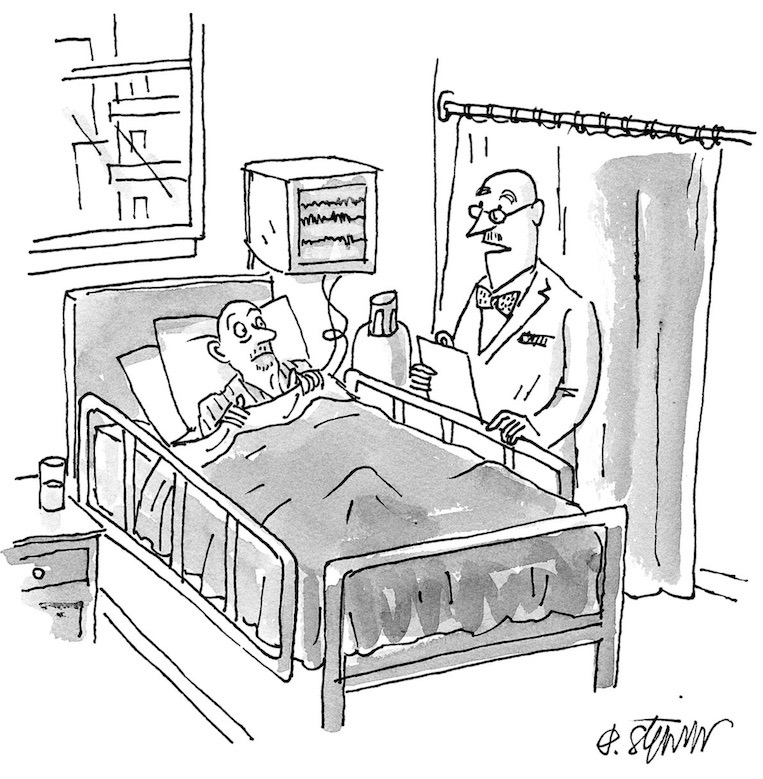
In e-mail from Larry Horn on 7/18, this Good News / Bad News (GN/BN) joke cartoon by New Yorker cartoonist Peter Steiner from 6/18/24 (in The New Yorker issue of July 1):


“First the good news, Mr. Edmonds: you’re going to get closure.”

(#1) Doctor to patient in hospital, offering the truncated variant of GN/BN, with (the dire) BN omitted (to be supplied by the reader from the context)

This is closure as in sense 3b from NOAD:

noun closure: … 3 [a] a sense of resolution or conclusion at the end of an artistic work: he brings modernistic closure to his narrative. [b] a feeling that an emotional or traumatic experience has been resolved: I am desperately trying to reach closure but I don’t know how to do it without answers from him.

In a GN/BN joke, the GN carries a sting in its tail, made overt in the BN. In #1, the GN is that the patient’s ordeal of illness is coming to an end — by his imminent death (the BN), which nobody says aloud.

Things to talk about. First, GN/BN, as treated in earlier postings on this blog (prominently featuring Larry Horn). Then, another joke form with a sting in its tail, kin to GN/BN: Genie’s Wish.

(more…)

Six Zippy balls

July 18, 2024

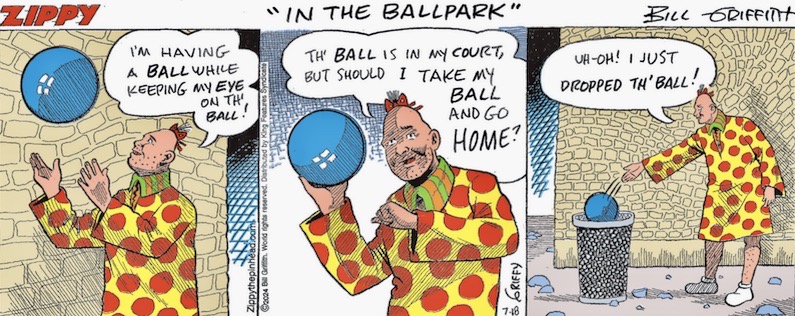
Zippy is known for his enthusiasm for specific words, is given to playing with them in public. Today’s Zippy strip shows our Pinhead drifting happily through six encounters with ball, in the title (In the ballpark) and five times in the text:


(#1) In four idiomatic expressions and then, in panel 3, when we’re set up to expect idiomatic drop the ball ‘make a mistake’, Zippy goes all literal on us by, just, dropping the ball

The four idioms: have a ball, keep one’s eye on the ball, the ball is in someone’s court, take one’s ball and go home.  One use of ball ‘formal social gathering for dancing’, followed by three uses of ball ‘spherical object’ in the context of playing games or sports. The effect in the text is to switch from one way of thinking to another: the social gathering image gives way immediately to three game-playing images, and then Zippy gets literal.

Now to look at the lexical resources Bill Griffith is tapping in this strip. But first, a diversion to six actual (game-playing) balls.

(more…)

Frivolity is a stern taskmaster

June 17, 2024

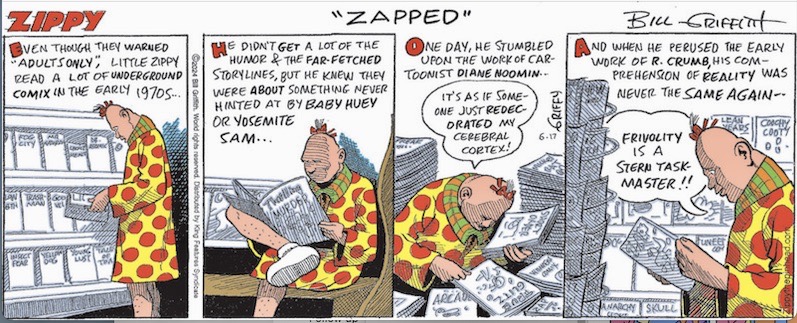
The oxymoron-flavored punchline of today’s Zippy strip:


(#1) “Frivolity is a stern taskmaster”: it had the feel of a play on some existing quotation, so I searched on “stern taskmaster” — only to discover that frivolity is a stern taskmaster is indeed a famous quotation, widely attributed (without specific source) to … Bill Griffith’s Zippy the Pinhead!

At first, I hoped that one of the trackers of quotation sources — especially the Quote Investigator – would have taken this one on, but no luck there, so it was on to a long and tedious search through the Zippy archives. From which I emerged with an apparent winner, in a 2008 strip (though there was a 2003 strip with Jack Kerouac is a stern taskmaster in it; and a 2023 strip entitled “Stern Taskmaster” — both of which I’ll show you).

Then some investigation of stern taskmaster, which turns out to be a common collocation, one of the big three Adj collocations with the N taskmaster: hard, tough, and stern. Not (yet) fixed expressions — catchphrases, slogans, or even idioms — but something more than the fresh combinations of Adj and N into nominal phrases, approaching stock expressions.

(more…)

Charlie on the couch

April 20, 2024

Today’s Wayno / Piraro Bizarro is a Psychiatrist cartoon with a stylized tunafish on the couch:


(#1) To understand this cartoon, you need to recognize that the patient’s not any old tuna, but Charlie, the celebrity mascot for the StarKist brand, whose widely advertised decades-long goal in life is to taste good (while — sorry, Charlie — his pursuit of good taste constantly frustrates this ambition, an experience that seems have led him to seek therapy) (if you’re puzzled by the odd symbols in the cartoon — Dan Piraro says there are 6 in this strip — see this Page)

There’s a surprisingly rich history here (but one that might be specifically North American, so that the cartoon might be baffling to many of my readers). Summarized in this entry on the tv tropes site:

(more…)

Two cartoons on (unstated) formulaic themes

April 9, 2024

Aka: Piccolo’s bull and Rubin’s cow: cattle days in CartoonLand. A little post-eclipse diversion: cartoons that make allusion to, or illustrate a pun on, some formulaic expression, but without actually mentioning that expression, so they present challenges in cartoon understanding. Two that have come by me recently: a Rina Piccolo Rhymes With Orange cartoon of 4/5 (alluding to the idiom bull in a china shop, which is something of a favorite of cartoonists); and an old Leigh Rubin Rubes cartoon that re-surfaced in Facebook (punning on the nursery-rhyme line the cow jumped over the moon).

Oh, I’ve given it all away. Well, you can still  appreciate Piccolo’s and Rubin’s ingenuity.

(more…)