In e-mail from Larry Horn on 7/18, this Good News / Bad News (GN/BN) joke cartoon by New Yorker cartoonist Peter Steiner from 6/18/24 (in The New Yorker issue of July 1):
“First the good news, Mr. Edmonds: you’re going to get closure.”(#1) Doctor to patient in hospital, offering the truncated variant of GN/BN, with (the dire) BN omitted (to be supplied by the reader from the context)
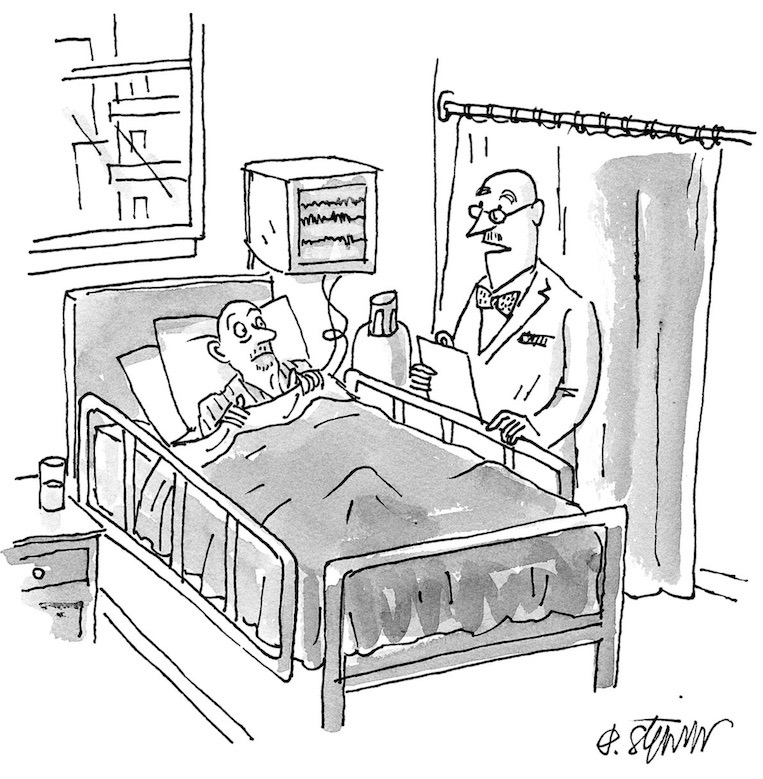
This is closure as in sense 3b from NOAD:
noun closure: … 3 [a] a sense of resolution or conclusion at the end of an artistic work: he brings modernistic closure to his narrative. [b] a feeling that an emotional or traumatic experience has been resolved: I am desperately trying to reach closure but I don’t know how to do it without answers from him.
In a GN/BN joke, the GN carries a sting in its tail, made overt in the BN. In #1, the GN is that the patient’s ordeal of illness is coming to an end — by his imminent death (the BN), which nobody says aloud.
Things to talk about. First, GN/BN, as treated in earlier postings on this blog (prominently featuring Larry Horn). Then, another joke form with a sting in its tail, kin to GN/BN: Genie’s Wish.
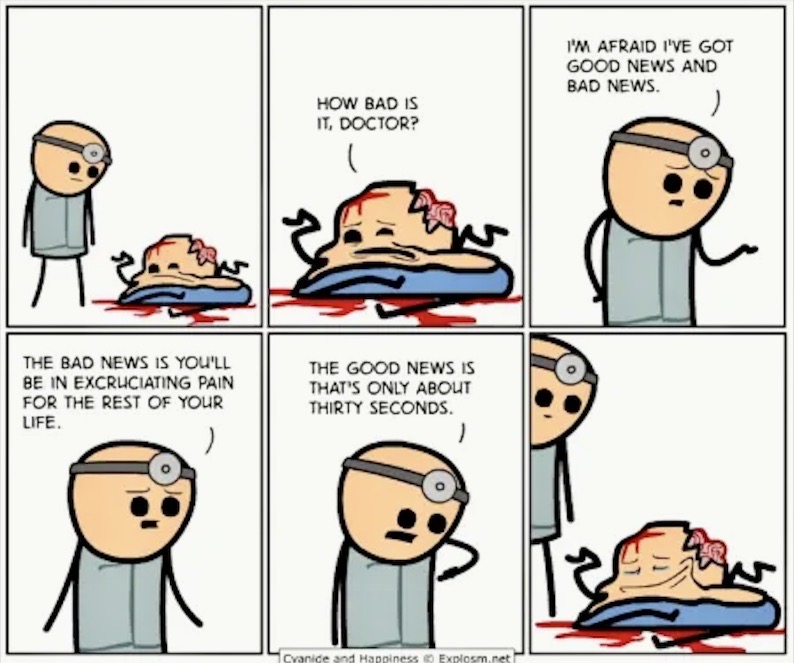
Previously on this blog. My 7/7/19 posting “GN/BN” begins with a Cyanide and Happiness comic strip (below), provides a survey of the GN/BN discussion on this blog, and then segues into a guest posting by Larry Horn (in his guise as Prof. Laurence R. Horn, the eminent authority on semantics and pragmatics) on the topic.
(#2) Cyanide and Happiness specializes in dark BN/GN jokes; formally, BN/GN is a reversed variant of GN/BN — but the sting is still in the tail, in what’s labeled as GN (once again, imminent death)
Genie’s Wish. A joke format (presented verbally or in a comic strip) involving a finder — someone who finds a magic lantern and rubs it — and a genie — a magical being that materializes from the lamp and grants the finder three wishes (Good News!). Classically, the joke comes with a sting in its tail, in the way the third wish is fulfilled, with disastrous consequences for the finder (Bad News!).
An example (“A Man’s Biggest Wishes”), from the Jokes By BabaMail site:
A man is walking through the woods, and he finds a magic lamp on the ground. Instinctively, he picks the lamp up, rubs the side of it with his sleeve, and out pops a genie. The genie thanks the man for freeing him, and offers to grant him three wishes. The man is ecstatic and knows exactly what he wants. “First,” says the man, “I want a billion dollars.” The genie snaps his fingers and a briefcase full of money materializes out of thin air. The man is wide eyed in amazement and continues, “Next, I want a Ferrari.” The genie snaps his fingers and a Ferrari appears from a puff of smoke. The man continues, “Finally, I want to be irresistible to women.” The genie snaps his fingers and the man promptly turns into a box of chocolates.
Similarly, a wish for some large amount of money is satisfied by having the finder’s most beloved die and leave them the money in an insurance policy. An ill-intentioned genie can transform any kind of gold into rubbish.
(The joke form has its roots in the Aladdin folktale; see my 3/10/21 posting “genealogy, genie-ology”, on genies and the Aladdin story.)
There are of course many variants. Sometimes only one wish, sometimes all three wishes go awry, sometimes the fulfillment is silly rather than actually disastrous (the desired Ferrari is a toy, the desired 12-inch penis is misunderstood as a 12-inch pianist — see my 5/2/13 posting “The 12-inch pianist”), and so on.
But always the Good News of getting wishes followed by the Bad News of the way they’re fulfilled.
July 21, 2024 at 6:24 am |
Similarly, a wish for some large amount of money is satisfied by having the finder’s most beloved die and leave them the money in an insurance policy.
See also W.W. Jacobs’ short story The Monkey’s Paw, in which a magical object grants seemingly benign wishes in various horrible ways.
July 21, 2024 at 6:32 am |
Oh, thank you. I recalled the short story (though not its title or the nature of the magical object), but thought it was by Saki (H.H. Munro) and then couldn’t find it. This is exactly what I was trying to dredge up from memory.
July 22, 2024 at 6:57 am
I remembered the title, which enabled me to look up the author.