A One Big Happy strip, recently in my comics feed:
(#1) James (mis-)takes Ruthie’s meta-commentary — her talk about what’s going on in her interaction with James — to be part of that interaction, to be her next move in the routine of the knock-knock joke, and shows that he understands that routine, by producing the appropriate next move in the routine

James might be a dirty-faced urchin, but he knows his joke routines. And, in the last panel, is probably wondering how on earth Ruthie’s going to make a pun out of jeezy-peezy-I-forgot-the-joke.
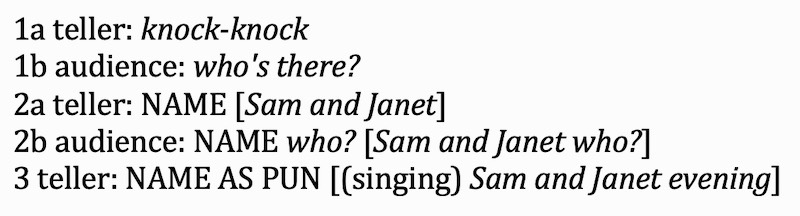
So: mastering the routine of the knock-knock-joke is one thing, but then the routine incorporates another type of joke, the pun joke, which has its own requirements. In addition, the knock-knock joke requires not just any pun, but a (phonologically) imperfect pun, the more distant the better, so that its punch line will have genuine surprise value.
The knock-knock routine. A dialogue between the joke teller and their audience, framed as the teller knocking on the audience’s door and then identifying themselves via an expression to be treated as a name; this little play involves two exchanges, and then the punchline revealing that the name is in fact an outrageous pun, the basis for which is recoverable via the context of the punchline — as in this example from the Wikipedia entry on knock-knock jokes:
Knock, knock!
Who’s there?
Rufus.
Rufus who?
Rufus the most important part of your house.
(with Rufus as a pun on roof is). The routine in outline form, with my favorite knock-knock joke of all time as an additional example; having seen this example, you could imagine that Ruthie might somehow have come up with a way to treat jeezy-peezy-I-forgot-the-joke as a pun on something:
(#2) That’s “Some Enchanted Evening”, the song from the 1949 Rodgers and Hammerstein musical South Pacific
Learning the routines. From my 3/2/16 posting “Learning to tell jokes”:
[A] One Big Happy, in which Ruthie works at telling jokes:
(#3)
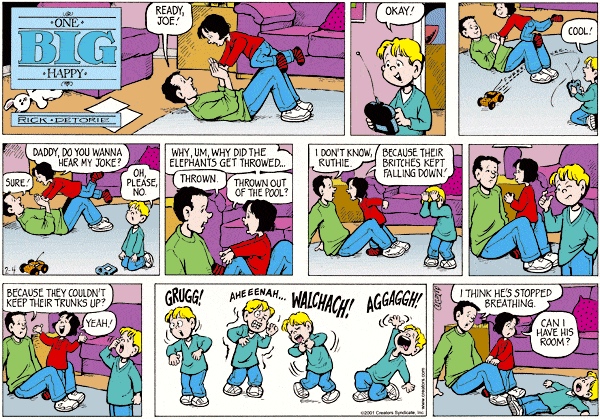
Part of acquiring a language is acquiring a large assortment of social routines using that language — including joke patterns. Linguists studying conversation have looked at the acquisition of a number of different joke types, for example knock-knock jokes, where they see the gradual unfolding of the abilities involved in producing and appreciating jokes. For instance, many jokes turn on puns, so that a child has to learn that exact wording can be crucial to the joke; paraphrase won’t do. But children often fail to appreciate that, while still understanding that laughter is called for at a certain point in the joke.
There’s the famous elephant-duck joke, which goes:
Joke-teller: How do you get down off an elephant?
Audience: I dunno.
Joke-teller: You don’t get down off an elephant, you get down off a duck! [Laughter]
The word down (ambiguous as between an adverbial and a noun) is crucial here, but children sometimes fail to appreciate that, which leads to several forms of misfiring. The adverbial is omissible, so that some children omit down throughout: “How do you get off an elephant? … you get off a duck!” [Laughter nevertheless]
Others omit it only in certain places, presumably because three occurrences of the word seems needlessly repetitious.
Ruthie in this OBH paraphrases the punchline she’s heard (“because they couldn’t keep their trunks up”), which turns on the ambiguity of the noun trunks, referring either to bathing trunks or to the elephantine body-part. Unfortunately, Ruthie’s version (“because their britches kept falling down”) loses the body-part sense, but she still thinks it’s funny. Not so her older brother.
Bonus: Ruthie’s exclamation. Back in #1, Ruthie exclaims jeezy peezy. From GDoS:
excl. jeezle-peezle! (also jeezle! jeezy-peezy! jeezy-wheezy!) (US) a mild oath, euph. for Jesus! [cf. jeez / jeeze / geez / geeze, jeezum (and other variants) ‘a mild expression used to show surprise or annoyance’ (NOAD)]
To which I add two exclamations in earlier postings on this blog:
— from 1/18/11: “Jeezum Crow”
— from 2/18/11: “Jeezamarooni”
Historically, the /ǰiz/ element in all of these is a euphemism for Jesus, but Ruthie might well not appreciate this fact about jeezy peezy; the expression might be a mere exclamation for her, with no connection to the religious figure Jesus at all, just something you say to express surprise or annoyance.
(I can recall my astonishment as a child when I was told, by some adult authority figure, that I shouldn’t use gee and jeeze, because they called on Jesus and so were almost the same thing as swearing. I don’t recall being told something similar about golly and God, but now, golly gee, I see that there’s (merely) a historical connection there too. And in any case, exclamatory God! doesn’t count as a swear word for me at all, though Jesus! is a low-level swear word for me, probably because I understand that it would offend some Christian friends of mine that I respect .)
There’s a distinction here between
(a) mere exclamations (like yikes!, expressing surprise or dismay)
(b) consciously euphemistic exclamations, which connote swear words (like fudge! and sugar!, used similarly) and can therefore invite criticism as swearing indirectly, or at least provoke discomfort
and (c) exclamatory swear words (like fuck! and shit!, used similarly)
While there’s large-scale agreement about the character of some exclamations, on others there’s room for some variation. For me, jeeze is a mere exclamation, but for others it seems to be consciously euphemistic.
November 28, 2023 at 8:27 am |
At one time I was pretty convinced that any expression (or name or quasi-name) with the initials J.C. could be understood as a “minced oath” on the name Jesus Christ. In particular, this was explained to me with the examples Jeepers Creepers and Jiminy Cricket (especially as the character from the Disney animated “Pinocchio”). Later I wondered about the organization called “Junior Chamber of Commerce” but widely shortened to “the Jaycees” (and spelled thus, in their own materials). [In most places a Chamber of Commerce is an organization of the business establishment; but the Junior Chamber or Jaycees seems to be more like a lodge.]
November 28, 2023 at 9:13 am |
😀 Oh my — secret encodings everywhere! John Calhoun, Jeff Conaway, Jacques Cousteau, Jim Crow, Jefferson County, junior college, …
December 9, 2023 at 2:40 pm |
An editorial e-newsletter from *Jewish Currents* drew my attention to their article-end symbol, a sort of kerned sans-serif “JC”. Whatever the complications of their editorial stance (indeed it’s complicated), at least it’s clear they aren’t intentionally encoding “Jesus Christ”!