My last posting of news for penises was back in 2011, but this morning brought two more items on Facebook: penis print pants and the return of the Healthy Penis to the streets of San Francisco.
Archive for April, 2013
More news for penises
April 23, 2013Acronymic pun
April 22, 2013John Gintell, just back from the NEFFA festivities, has posted this Pearls Before Swine cartoon from January 27th on Google+:

Big GROAN (great roar of acronymic nausea).
Zao Wou-Ki
April 22, 2013(About art, and my life, rather than language.)
In the NYT national edition today (but apparently printed first on the 11th), an obit (by Paul Vitello) for painter Zao Wou-Ki, “Zao Wou-ki, Abstract Painter, Dies at 92”:
Zao Wou-ki, a Chinese émigré who merged Eastern and Western aesthetic traditions in his abstract paintings — helping to shape avant-garde art in postwar Europe and attracting a newly wealthy Asian following that made him one of the most commercially successful living artists in either hemisphere — died on April 9 in Nyon, Switzerland.
… Mr. Zao’s paintings, which are in the collections of the Museum of Modern Art, the Guggenheim and the Tate Modern, among others, have sold at auction in recent years for between $1 million and $2 million each. Since 2011, when sales of his paintings totaled $90 million, art journals and art dealers have frequently referred to him as the top-selling living Chinese artist.
Finding his own identity in that label — as a Chinese artist — was the crucible of Mr. Zao’s artistic vision.
Leaving China just ahead of the Communist takeover, Mr. Zao settled in 1948 in Paris, where his first sustained exposure to Western Modernist painting left him feeling ambivalent about the classical forms of landscape and calligraphic ink painting in which he had been trained. He loved the work of the Impressionists and Expressionists, and of contemporary artists like Jackson Pollock and Franz Kline.
But through nonobjective Western painting, especially the work of Paul Klee, who was influenced by traditional Chinese and Japanese art, Mr. Zao gained new insights into what the British art historian Michael Sullivan called “the Abstract Expressionist element in his own tradition.”
Putting aside the issue of money in the art market (now a feature of virtually all artists’ obits), there’s the remarkable blending of Chinese and European Modernist artististic traditions in Zao’s work (the Times renders his name with family name first, Chinese-style). And a story from my life.
Brief mention: the probably unintentional pun
April 22, 2013From today’s “Metropolitan Diary” in the national edition of the NYT (apparently printed in NYC on the 16th). “Proust at the Morgan Library” by Tom Hughes:
The scene: the Morgan Library exhibition in honor of the 100th anniversary of Marcel Proust’s novel “Swann’s Way,” the first in his seven-volume series “In Search of Lost Time.” [aka “Remembrance of Things Past”]
The exhibition occupies the Thaw Gallery, an intimate space where you can’t help but overhear your neighbors’ conversations. A husband strides in excitedly, towing his wife, who appears a bit mystified.
Husband (staring intently at one of Proust’s manuscripts, written longhand in school composition books — clearly he is a fan): “This is amazing.”
Wife: “What’s the big deal with Proust again?”
Husband: “It’s a long story.”
Husband presumably meant that it’s a long story to explain what’s going on with Proust’s masterpiece. But then he could also be understood as saying that Proust’s À la recherche du temps perdu is a long story, which indeed it is — a very long story indeed.
Gay greens: the Big Two
April 22, 2013In my Columbus OH household, the residents had a name for a particular category of foodstuffs, especially as salad ingredients: gay greens, taking in, for instance: arugula (or rocket), radicchio, watercress, mâche (or corn salad), fennel, (curly) endive, Belgian endive, flat (or Italian) parsley, and basil (especially the fancy varieties). (Sprouts of all kinds are hippie greens.) The association with queers comes primarily from these being fashionable foodstuffs, connected in many people’s minds with fancy cooking, adventurous dining, and foodie enthusiasm — activities that are also associated with gay men. Plus the widespread attitude that green salads are “unmanly” food: Real Men eat red meat, not green salads.
(The association of these foodstuffs with queers will no doubt come as a surprise to many Italian-Americans, not to mention actual Italians, who are accustomed to them as everyday ingredients.)
Today I’ll look at the Big Two of the gay greens, arugula and radicchio (noting that I am very fond of them both).
More on modern communications
April 22, 2013Today’s Zits:
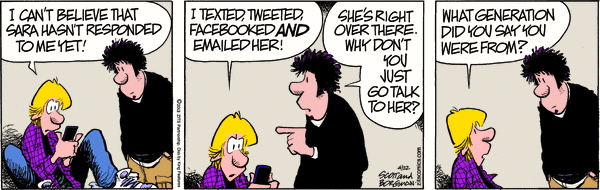
The latest in a series of strips depicting young people as rejecting the telephone and face-to-face interaction in favor of modern communications technology.
As a bonus, though this isn’t hot news, there’s the verbing of the noun Facebook. Plenty of examples around, for instance this one:
Honoring those who Facebooked themselves out of their jobs
The Facebook Fired blog is a painfully modern collection of stories memorializing those who are collecting unemployment thanks to posts on Facebook or similar public disclosures. (link)
Brief mention: men and women in Maryland
April 22, 2013On a postcard (with a pile of images of and information about the state of Maryland) from Chris Ambidge on Saturday, the news that the state motto is
Manly Deeds, Womanly Words
Sigh: men act, women talk. At least in Maryland.
Side note: the Pinhead town of Dingburg is in Maryland.
ranunculus
April 21, 2013On the heels of my primrose posting, here’s one on another seasonal flower in these parts, the ranunculus (a flower especially of the late winter and early spring). Very pretty in an overblown sort of way, and with an odd etymology.
primroses
April 21, 2013As we slide into summer in these parts, the winter-blooming flowers are coming to the end of their season; from this posting, about cyclamens:
Winter in northern California is brightened by a number of flowers that thrive in that season: English primroses, anemones, violas (including pansies), and snapdragons, for example. And cyclamens …
(And cymbidium orchids, discussed here.) Now, while they’re still blooming, some words on primroses (including an etymological essay on the name primrose, which has nothing to do with primness.)
The IvanFest
April 20, 2013April 28th-30th in Cordura Hall at Stanford: Structure and Evidence in Linguistics, a conference honoring Ivan Sag. Program here.
A few more details:
Sunday 4/28, 2:30-5:30: Elisabet Engdahl, Ted Gibson, Philip Hofmeister and Laura Staum Casasanto, Carl Pollard, Stefan Müller, Geoffrey Pullum
Monday 4/29, 2:00-5:40: Jorge Hankamer, Pauline Jacobson, Jong-Bok Kim and Peter Sells, Philip Miller, Jonathan Ginzburg, Joanna Nykiel, Roger Levy, Farrell Ackerman and Rob Malouf and John Moore
Tuesday 4/30, 2:00-5:40: Erhard Hinrichs and Tsuneko Nakazawa, Gosse Bouma, Frank Van Eynde, Lauri Karttunen and Annie Zaenen, Stephen Wechsler, Alex Lascarides, Gert Webelhuth, James Blevins
[Added 4/21, in answer to questions about the participants: The invited participants are from Ivan’s collaborators and students — a very large group of people. (Ivan’s university colleagues who were not his collaborators or students, and his teachers who were not also collaborators, were not invited.) And preference was given to people from outside Stanford.]