That’s country as in “country music” and country singer Kevin Fowler, who recently released the obscenity-laced but kiddy-safe “Pound Sign #?*!”, using spoken obscenicons to achieve this effect. It’s going on a new Linguist’s Playlist, on Linguistic Examples.
Archive for July, 2010
Country obscenicons
July 16, 2010Ken ‘n’ Joe: an item?
July 15, 2010(I don’t think there’s going to be anything of redeeming linguistic value in this posting, so I’ve categorized it as Not About Language. You’ve been warned. It’s also gay, sexy, and frivolous. You’ve been warned again.)
Following up on my doll-and-action-figure posting, Mara Chibnik wrote me that a couple of weeks ago she saw (in New York City) a one-act play by Andrew Black called “Don’t Toy With Me”. She goes on,
GI Joe drops in on Ken, and they’re about to enjoy their newfound relationship when (Malibu) Barbie walks in on them. The bit I liked best was the embarrassment of Ken’s offered confidence: “I’m, uh, not anatomically correct.”
Ah, the liaison between Joe and Ken that so many gay men have fantasized about.
On the run in 1972-74
July 15, 2010Once again, it started with something that turned up on a random iTunes playlist. This time it was the Rolling Stones’ “T**d on the Run” (as the famously modest iTunes listings put it, for fear the printing of turd would damage the minds and morals of the young), from the Exile on Main Street album, released in 1972 and re-released earlier this year. In the intervening years, I’d forgotten about the song; more about it in a moment. But I was immediately struck by its nastiness, and by the possibility that it was a slam on “Band on the Run”, the big hit by (pre-Sir) Paul McCartney and Wings, from the album of the same name. And then there’s Pink Floyd’s “On the Run”, from Dark Side of the Moon, at about the same time. (more…)
Dolls and action figures
July 14, 2010It all started when I went searching the web for action figure vs. doll. You see, I have two articulated (and therefore posable) plastic figures of adult humans with removable and exchangeable clothing (and accessories) — yes, I will (sort of) explain, eventually, how a man of my age and station comes to have such things — and objects of this sort are called either dolls (like Barbie) or action figures (like G.I. Joe), according to whether females (mostly girls) or males (mostly boys) play with them, respectively (which means that since the figures function as, among other things, potent models for adult gender roles, dolls of this sort are themselves mostly female, while the corresponding action figures are mostly male).
The crucial factor in the distinction is then not objectively in the figures, but in the function they serve in our culture — a state of affairs that you can find all over the place, as scholars of categorization and the vocabulary that accompanies it have pointed out many times. Objective properties of referents are far from irrelevant, but the functions of those referents play a major role as well, sometimes a deciding role.
Back to the figures. The neat “dolls are for girls, action figures are for boys” split turns out to fail in both directions. The figures I have are meant for use by males (and are themselves male) but are called dolls, while (I discovered in my web searches) there’s a whole universe of figures that are meant for use by females (and are themselves largely female) but are called action figures. On the one hand we have Billy dolls, on the other figma figures. (I didn’t expect these objects or their names to be familiar to you, because each is embedded in a (sub)culture that is not mainstream North American/Western European.)
“Waiting for my rocket to come”
July 13, 2010The title of Jason “I’m all about the wordplay” Mraz’s first album, just jam-packed with potential ambiguities, most of them probably irrelevant in the context of his songs, or inconsequential, though several readings obtrude, and some of the ambiguity was surely intended. But as I said in my previous posting, I’m not going to try to adjudicate these matters. Here I’m all about surveying the ambiguity-littered landscape.
Short shot #50: nudge nudge, wink wink
July 13, 2010“Update” note on p. 1 of the local Daily “News you can’t get on the Internet” Post of June 19-20:
UNHAPPY ENDING: Los Gatos police have arrested the owner of the Come and Go Foot Station (yep, that’s the name) for operating a massage parlor without a license.
Nudge nudge, wink wink. Say no more. With a bow to the Daily Post in this direction.
Fair and balanced
July 12, 2010Another cartoon by William Haefeli on gay male life, this time in the May 31 New Yorker:
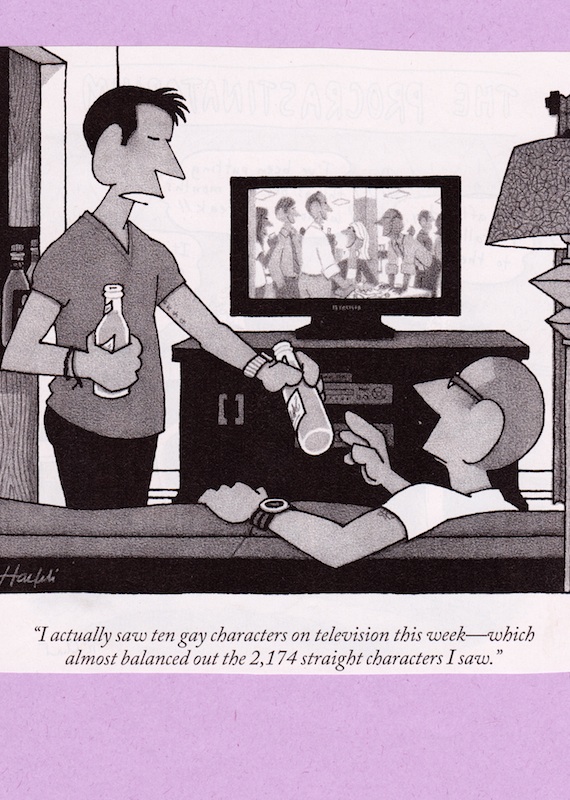
(Note that the cartoon guys seem to be getting the Haefeli Channel on their tv. Or maybe that’s just the way everyone looks in HaefeliWorld.)
Several things here, some linguistic, some not.
I’m all about the wordplay
July 12, 2010“Song for a Friend” by Jason Mraz came by today on an iTunes random playlist, and I recalled that Mraz was on my iTunes because of suggestions from Nassira Nicola for language-related musical items (performer names, album titles, song titles, lyrics mentioning language-related stuff), among them Mraz’s song “Wordplay”. Here’s the chorus from the song (minus the la-la-la bits):
Now listen closely to the verse I lay
It’s all about the wordplay
The wonderful thing it does
Because, because
I am the wizard of ooh’s and ah’s and fa-la-la’s
Yeah the Mister A to Z
They say I’m all about the wordplay
Libfix pun, or something
July 11, 2010A weekend cartoon from Hilary Price, with a pun on thong and the thon part of the libfix -athon:
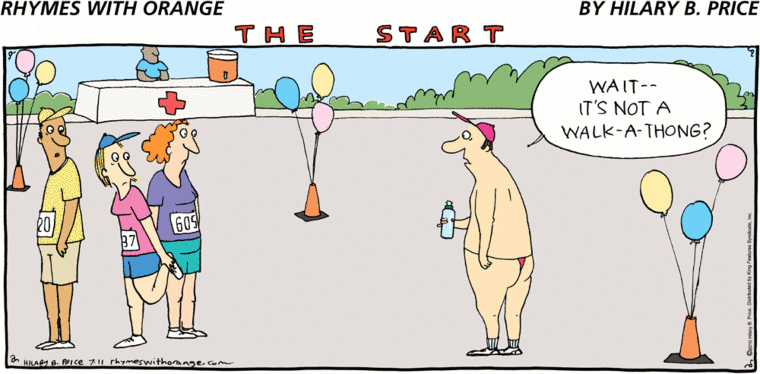
Well, it’s complicated. Price is making a pun. But if the guy who’s speaking were a real person, rather than a character in a cartoon, we might see walk-a-thong as an eggcorn, a kind of misunderstanding that improves on the meaning of walkathon, with the speaker then acting on the supposition that thongs were involved in a walking event.
Or if someone announced a Walk-a-Thong as an event, then we might see walk-a-thong as a kind of intentional portmanteau, of the substitution type (analogous to inadvertent substitution blends), so that it would be understood as combining the meanings of walkathon and thong as well as their forms, to produce a new item meaning something like ‘walkathon in a thong’.
It all depends on who’s speaking and what they have in their heads.
On the zeugma watch
July 11, 2010A BBC News summer fluff piece coordinating a literal and a figurative sense of transitive drop (in the passive):
The southern Californian city of Laguna Niguel has been enjoying an annual ritual, in which locals and visitors bare their bottoms at passing trains.
For 30 years, the city has hosted “Mooning Amtrak” as crowds line up along the railway tracks, dropping their trousers when a train passes by. [there is a photo]
… The event even has its own website, this year proudly headed “31st Annual Mooning of Amtrak”…
It features directions to Camino Capistrano, the road where trousers and dignity are dropped each year, and helpfully lists train times through the day, so that people can schedule their disrobing.
Hey, boy! Drop your dignity and show us what you’ve got!
(Hat tip to Chris Ambidge on soc.motss.)