Archive for July, 2010

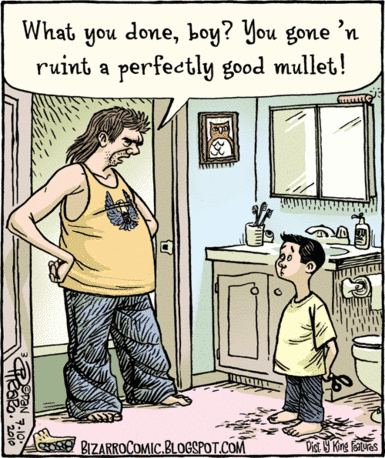
Domestic class rebellion: a good haircut ruint

July 10, 2010

(Not a good walk spoiled, but a good haircut ruined.)

Kids often rebel, boldly or subtly, against their parents on norms associated with social class, ethnicity, propriety, gender, and the like. Here’s a Bizarro kid going against his working-class dad:

(more…)

More from Dick Dative

July 10, 2010

A footnote to my posting on Dick Dative and the Experiencers…

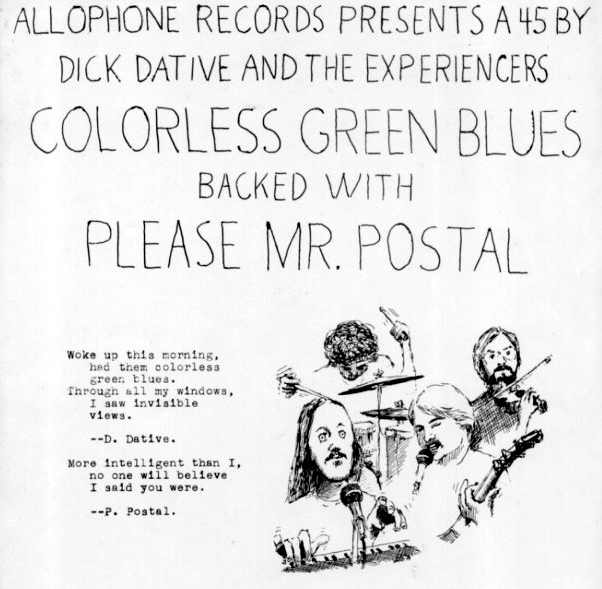
On dating the music: Charles Ulrich has written to say that the recordings were made in 1979 and released in 1980 — 30 years ago, sigh. Charles is able to be so sure about this because he remembers doing research the summer of 1979 in the Pomona College library on the quotations in the lyrics, and distributing the flyer below at the annual meeting of the Linguistic Society of America, in Los Angeles that December (which is where I ordered my copy):

(I’ve cropped off the order form, just in case someone might be tempted to send $1.50, plus $.50 for postage and handling, to an address that Charles hasn’t lived at for a very long time.)

unsatisfactoriness and unsatisfaction

July 9, 2010

In a note on my little posting on the zero-nouning of the adjective unsatisfactory, in which I mentioned the (somewhat awkward) default –ness nominalization unsatisfactoriness, commenter TC floats, somewhat hesitantly, the possibility of a –tion nominalization unsatisfaction.

Here a few quick remarks on the two items in dictionaries and on the Web.

(more…)

Short shot #49: noun that adjective!

July 9, 2010

Gail Collins (“My Boyfriend’s Back”, op-ed in the NYT, July 8th) wanted an abstract noun, and pressed an adjective into service:

We have been dealing with a lot of imperfect apologies recently, but this one [from Levi Johnston, ex-boyfriend of Bristol Palin, daughter of Sarah] hits a new level of unsatisfactory.

The common template — not really an idiom, short of a cliché, but in fashion in some parts — “(hit/reach) a new level of N” is what Collins went for here to convey ‘unsatisfactory to an unprecedented degree’, but then there’s no established abstract nominalization of unsatisfactory (the awkward unsatisfactoriness would be the default, and the other options, like unsatisfactority and unsatisfactoritude, are entertaining but absurd), so she went for direct conversion of the adjective to a noun, with things like “a new level of bad” around as models.

Colloquial but, to my mind, effective.

Varying formulas

July 8, 2010

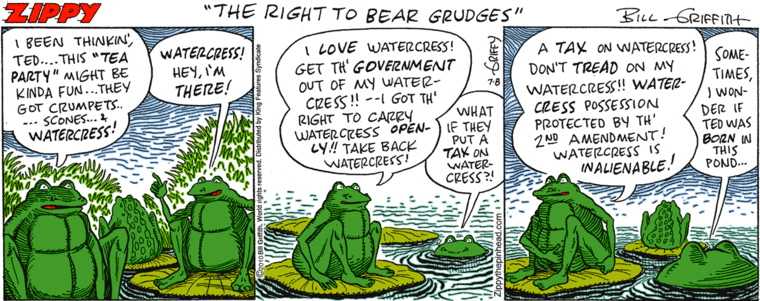
Ted the Frog, watercress, and formulaic language:

Are “get the government out of my watercress!!”, “the right to carry watercress openly”, “take back watercress!”, “don’t tread on my watercress!!”, “watercress possession protected by the Second Amendment” snowclones?

I think not. As I said in my “Figs of Fear” posting,

Word play that takes off on titles (of books, films, tv shows, rock bands, whatever), quotations, proverbs, clichés, idioms, and so on is all over the place, and folding such examples in with clear examples of snowclones pretty much reduces the notion of snowclone to vacuity.

Ted’s substitutions of watercress for other expressions in Tea Party slogans are, of course, particularly silly — and are meant (by Bill Griffith) to mock those slogans. For those of you who have been largely insulated from this stuff, here are the Tea Party models:

(1) get the government out of my life!
(2) the right to carry (fire)arms/(hand)guns/weapons openly
(3) take back America!
(4) don’t tread on me!
(5) gun possession protected by the Second Amendment!

(1) has the most variants, with “personal life”, “way”, and “backyard” close to “life”, and “Medicare” (along with “healthcare”, “health insurance”, “bed pan”, and the related benefit “Social Security”, plus “car insurance” related to “health insurance”) close behind, and then financial references (“business”, “bank account”) and an assortment of other things, like “oil spills”. The liberal-activist models for these Libertarian sentiments are things like “bedroom”, “marriage”, and “uterus”, especially as used by fags and feminazis.

(2) echoes the Second Amendment to the U.S. Constitution (but with “carry” for “bear” and with several variants on “arms”), though it introduces the modifier “openly” (“right to carry” laws permit either carrying openly or carrying in general, including carrying concealed weapons).

(3) has models in feminism (with “the night”, from anti-rape demonstrations) and campus activism (with specific university names, most recently “Santa Cruz” and “NYU”).

(4) is a direct quote of the motto on the Gadsden flag (with its coiled rattlesnake), as appropriated by Tea Partiers.

And (5) is another, but looser, Second Amendment reference.

Lots of playful variation on formulas.

(Then there is resistance to taxation, another Tea Party focus: “no taxation without representation!”, though the form of that motto isn’t played on in the strip.)
Seventy

July 7, 2010

[poetry, not about language]

Seventy

Richard Starkey 7/7/40
Arnold Zwicky [not a Beatle] 9/6/40
John Lennon 10/9/40
Paul McCartney 6/18/42
George Harrison 2/25/43

July 7, once again
Ringo ages
A year, just
Two months before
I do.

The senior
Beatle is
Older than
I am,
But just barely;

John was, is, a month older,
Paul and George older
Still, a couple of
Years, yet

They all were a
Generation
After me.
Ringo especially.

Ringo welcomes the
New decade, so
I guess
I should
Go along.

…..

A photo, not of Ringo (or any Beatle), not of me — but of a guy, possibly Swedish, photographed by Walter Hirsch — as amended by Robert Cumming for my 60th birthday:

Ok, I changed my mind. Here’s a version of something about language (and Ringo Starr) I just posted to the American Dialect Society mailing list:

All over the media: the news that “former Beatle” Ringo Starr celebrates his 70th birthday today. It’s clear what is meant; the reference is to his having been a Beatle before they split up, oh so long ago now.  So he was a Beatle and he isn’t now, but that’s not because of a change in him (as with “former President”), but because of a change in the Beatles.

In tensed clauses, the verb be in the past is neutral as between the ways in which it could come about that

SUBJ be INDEF-NP (“Ringo was (once) a Blupp”)

was true at a time in the past but is no longer true now.  So is

once INDEF-NP (“Once a Blupp, Ringo …”)

However, for me

ex-NOM (“ex-Blupp”) and former NOM (“former Blupp”)

have only the understanding that the status of the referent of the larger expression has changed, and not that the status of the referent of the NOM has changed.

Alas, I have no easy way to pack this second understanding into a NOM.  Some other people seem to allow both understandings for “ex-Blupp” and “former Blupp”, with the appropriate one picked out using real-life knowledge, the way “once a Blupp” works for me.

Of course, I understand these people perfectly well; it’s just that I wouldn’t say it their way.

Dick Dative and the Experiencers

July 6, 2010

My adventures in Music with Linguist’s Names recently led me — see the comments here — back to Dick Dative and the Experiencers (Charles Ulrich and friends), from the distant past. Ned Deily has now transformed my old 45 rpm vinyl recording into sound files (and cleaned up the sound a good bit), so now you can appreciate them too.

(Ordinarily I don’t post sound files, for fear of life-destroying legal consequences, but in this case there seems to be no copyright, just two songs recorded for fun — on the ad hoc label Allophone Records — for the enjoyment of linguist friends.)

You can hear “Please Mister Postal” (all example sentences certified as genuine, lifted from Paul M. Postal’s writing) by clicking here.

And you can hear “Colorless Green Blues” (based on Chomsky’s famous invented example “Colorless green ideas sleep furiously”, now over 50 years old) by clicking here.

Vergissmeinnicht

July 5, 2010

[I’m taking a break from constructing playlists, writing about portmanteaus and puns, and all that good stuff, to post a bit of magic-realist fiction about Sundance and Butch. This is Not About Language. And there are moments of hot-hot man-man sex in plain language, so it’s not for kids or the sexually modest. Otherwise, I reserve metacommentary for another posting.]

(more…)

Images of masculinity

July 4, 2010

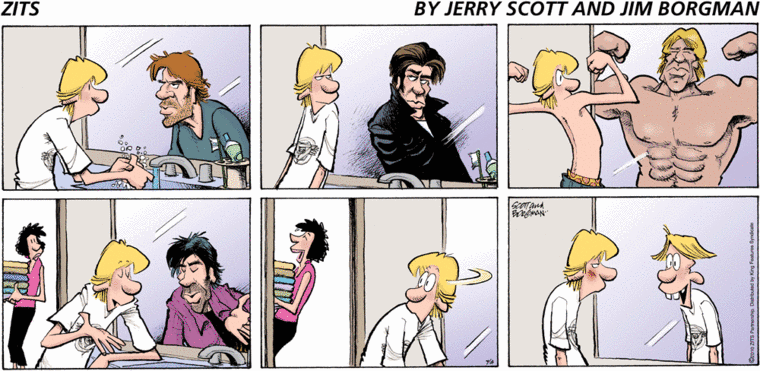
In a poignant episode of Zits, the teenage Jeremy tries out a series of images of grown-up masculinity — what kind of man will I, can I, be? — only to be deflated by seeing himself through his mother’s eyes:

Yes, there’s going to be damn little about language in my brief discussion, so if that’s what you’re after, maybe you should just appreciate the cartoon and go on to something else.

(more…)

Revolutionary music

July 4, 2010

On this Revolutionary day in my country, I thought to search my iTunes on “Revolution”. This netted an album America Sings by the Gregg Smith Singers, which has sections of secular and sacred music from the time of the American Revolution; the American Fife Ensemble’s Music of the American Revolution, with a pile of patriotic songs from the period; “Revolution 1” and “Revolution 9” from the Beatles’ White Album (I’ve never gotten reconciled to “Revolution 9”, and am at this very moment skipping over the damn thing); two recordings of Chopin’s “Revolutionary Étude”, Op. 10 No. 12 in C minor (on the occasion of the Cadet Revolution, or November Uprising, or Russo-Polish War, of 1830-31, in what is now Poland, Lithuania, Belarus, and Ukraine), performed by Murray Perahia and by Jean-Yves Thibaudet; the 20th-century American protest/folk song “Spirits of the Revolution” (“We who are the spirits of the revolution, / We will not fit in, / And we will not give in”), sung by Larry Estridge; “Revolutionary Rock” by The Clash; “Children of the Revolution” by Bono; and 19th-century music performed by John Eliot Gardner’s Orchestre Révolutionnaire et Romantique. (more…)