Archive for July, 2010

Fippy the Finhead

July 4, 2010

Among the words that Zippy the Pinhead likes to savor (my most recent postings on Zippy’s word attractions are here, here, and here) are those beginning with the letter F, words that he finds especially silly:

One of the pleasures of words in F is, of course, their resonances with tabooed F words, especially the Big F, fuck. The American tv comedy show Laugh-In flirted with the F Word on a regular basis, notably in Rowan and Martin’s granting of Flying Fickle Finger of Fate awards, “saluting actual dubious achievements by the government or famous people” (from the Wikipedia page), and in appearances by the Farkel Family, a large clan who were introduced, one by one, by name, on every appearance: Sparkle Farkel, Flicker Farkle, the twins Simon and Gar Farkel, Charcoal Farkel (a black child, identical twin to the white Sparkle Farkel), Mark Farkel, Fritz and Fred Farkel. The sketches presented occasions for cast-challenging tongue twisters like “That’s a fine-looking Farkel flinger you found there, Frank”.

[Digression: There’s a family of morphological snowclonelets following the formula V-in, furnishing a count N referring to an event. The original seems to have been sit-in, followed by the widely used (at one time) love-in, and then the proper name Laugh-In. There have been some other event coinages using the pattern, for example sleep-in and hate-in. (V-in nouns referring to people — stand-in and the remarkable alien-impostor walk-in — are something else again, as is lie-in in the British idiom have a lie-in.)]

Zwicky stuff

July 3, 2010

So, Google Alert, scanning for references to the name Zwicky on the web, recently came up with the Zwicky tank truck, adding yet another product to the growing list of Zwicky things (among them chocolate, muesli, thread and yarn, arrowheads for bow-and-arrow hunting, and meat rub).

(more…)

The figs of fear

July 3, 2010

Following up on the New Yorker cartoon theme for this Fourth of July weekend: an inventive fruiterer as drawn by W.B. Park (in the May 17 issue of the magazine):

(more…)

We need to talk

July 3, 2010

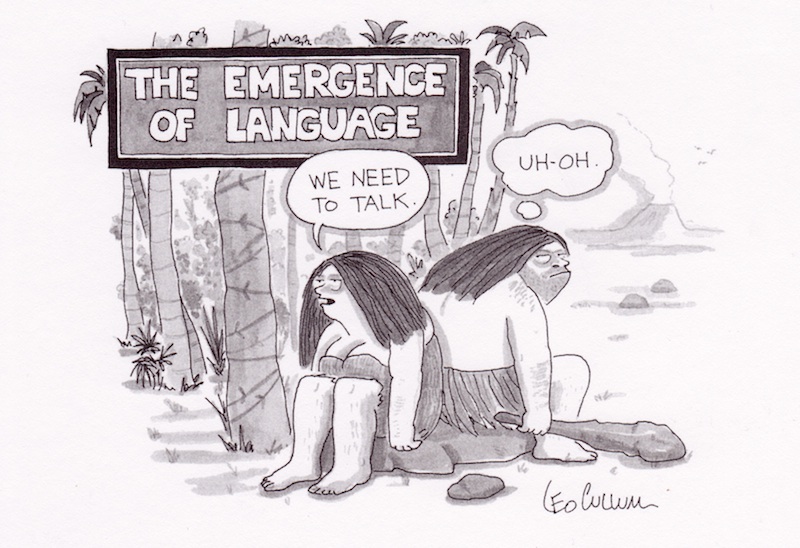
A little while back, we looked at language and the sexes through the eyes of a cartoonist, Don Piraro on “We need to text”. Back in the New Yorker of 12/25/95, Leo Cullum took on “We need to talk” in a different context:

“We need to talk” in this context can have two different imports: as a (socially fraught) statement of necessity implicating a request for couples-talk, or as a statement of necessity for the two of them to begin the evolution of language. The difference between the two can be traced back to the interpretation of the intransitive verb talk, as (respectively) an intransitive verb understood reciprocally (‘We need to talk to/with one another’) and as a plain intransitive; it’s the difference between “Kim and Sandy didn’t talk until they’d known each other for six months” and “As a baby, Kim didn’t talk for six years”.

Honk if you need an expletive

July 1, 2010

Running past me in an episode from the third season of Eureka (a show I’m absurdly fond of): the lead character, the town of Eureka’s Sheriff Jack Carter (played by Colin Ferguson), gasping in wonderment at the size of something or other: “that’s a honking big” whatever.

Meanwhile, out in space, Stargate SG-1‘s lead character, Col. Jack O’Neill (played by Richard Dean Anderson), is given to marvelling at “big honkin’ ” stuff, like a space gun.

This is honkin(g) the evaluative modifier, functioning either as a degree adverbial (an intensifier, specifically) or, apparently, as an adjective, and so covering some of the territory of the evaluative modifier fuckin(g), but without the taboo-word problem.

But there’s more. The verb-particle combination honk off also fills in for the taboo piss off, and the verb honk fills in for the (possibly) rude non-sexual suck, as in “Man, the way they treated you really honks big time.”

At the moment, that seems to be as far as it goes, but maybe we should look forward to things like “Kim took a huge honk right there on the living room floor — totally gross!” or “Kim doesn’t give/care a honk what other people think”.

(more…)

Der Werwolf

July 1, 2010

Having mentioned Christian Morgenstern‘s werewolf poem in a comment on a recent posting, I thought I’d pass it on to readers, with a few comments. First, the German text, from Alexander Gross’s website. The poem takes off from the fact that the first element of Werwolf ‘werewolf’ is (accidentally) homophonous with the interrogative pronoun wer, which is declinable, with distinct forms for each of the four grammatical cases in German — a feature that is sometimes thought to make the poem “untranslatable”. But just as many people have taken up the challenge of translating Lewis Carroll into other languages, so Morgenstern has drawn translators; three approaches will follow.

Der Werwolf

Ein Werwolf eines Nachts entwich
von Weib und Kind und sich begab
an eines Dorfschullehrers Grab
und bat ihn: »Bitte, beuge mich!«

Der Dorfschulmeister stieg hinauf
auf seines Blechschilds Messingknauf
und sprach zum Wolf, der seine Pfoten
geduldig kreuzte vor dem Toten:

»Der Werwolf«, sprach der gute Mann,
»des Weswolfs, Genitiv sodann,
dem Wemwolf, Dativ, wie mans nennt,
den Wenwolf, — damit hats ein End.«

Dem Werwolf schmeichelten die Fälle,
er rollte seine Augenbälle.
»Indessen«, bat er, »füge doch
zur Einzahl auch die Mehrzahl noch!«

Der Dorfschulmeister aber mußte
gestehn, dass er von ihr nichts wußte.
Zwar Wölfe gäbs in grosser Schar,
doch »Wer« gäbs nur im Singular.

Der Wolf erhob sich tränenblind–
er hatte ja doch Weib und Kind!
Doch da er kein Gelehrter eben,
so schied er dankend und ergeben.

…..

Gross’s English translation:

The Werewolf

A Werewolf, troubled by his name,
Left wife and brood one night and came
To a hidden graveyard to enlist
The aid of a long-dead philologist.

“Oh sage, wake up, please don’t berate me,”
He howled sadly, “Just conjugate me.”
The seer arose a bit unsteady
Yawned twice, wheezed once, and then was ready.

“Well, ‘Werewolf’ is your plural past,
While ‘Waswolf’ is singularly cast:
There’s ‘Amwolf’ too, the present tense,
And ‘Iswolf,’ ‘Arewolf’ in this same sense.”

“I know that–I’m no mental cripple–
The future form and participle
Are what I crave,” the beast replied.
The scholar paused–again he tried:

“A ‘Will-be-wolf?’ It’s just too long:
‘Shall-be-wolf?’ ‘Has-been-wolf?’ Utterly wrong!
Such words are wounds beyond all suture–
I’m sorry, but you have no future.”

The Werewolf knew better–his sons still slept
At home, and homewards now he crept,
Happy, humble, without apology
For such folly of philology.

…..

A translation by Jerome Lettvin (from the literary review the fat abbot, number 4, Fall-Winter 1962 — I actually have an original of this one):

Ontology Recapitulates Philology

One night, a werewolf, having dined,
Left his wife to clean the cave
And visited a scholar’s grave —
Asking “How am I declined?”

Whatever way the case was pressed
The ghost could not decline his guest,
But told the wolf (who’d been well-bred
And crossed his paws before the dead).

“The Iswolf, so we may commence,
the Waswolf, simple past in tense,
the Beenwolf, perfect, so construed,
the Werewolf is subjunctive mood.”

The werewolf’s teeth with thanks were bright,
But, mitigating his delight,
There rose the thought, how could one be
Hypostasized contingency?

The ghost observed that few could live,
If werewolves were indicative;
Whereat his guest perceived the role

Of Individual in the Whole.

Condition contrary to fact,
A single werewolf Being lacked —
But in his conjugation showed
The full existence, a la mode.

…..

A rhymed paraphrase by Gary Bachlund, who set the piece to music (here):

The Werewolf

One night a Were-wolf slipped away
From his Were-wife and his Were-wolf child,
To the grave of a rotten schoolmaster
To decline himself as noun-beguiled.

Ghost-like gray the schoolmaster rose
From out of the gravestone’s head,
And spoke to the Wolf, crossed paws suppose
To beseech a philologist long dead:

“The Were-wolf,” spoke the spirited man,
“Of the Were-wolf, in the genitive penned,
To the Were-wolf, is the dative scan,
And objective, a Were-wolf; that’s the end.”

Such cases flattered the wolf called Were,
Its Were-wolf eyeballs rolling widely wide.
“However tense, all remains a blur;
What’s singular? What’s plural?” he cried.

Alas the corrupted schoolmaster confessed
“Incorruptible are most grammatical rules.
While wolves is plural, as you’ve guessed,
Wolf is singular, in most of our grammar schools.”

With this, the Were-wolf howled and cried,
“I am not singular! I’ve a wife and child!”
And so the Were-wolf rushed home to bride
And Were-wolf child, tensely reconciled.

Mini-poem

July 1, 2010

[while I’m posting poetry: from 3/10/09 at the Gordon Biersch in Palo Alto]

From the seasonal menu

misoyaki
    mahi mahi:
tetra
    metrical
trocha
    icity

Golden State Rufskin tit

July 1, 2010

In preparation for another posting, to come, on (men’s) underwear terminology (see, most recently, here and here), I now offer you a draft poem inspired by one of the images I started with. The image will come later in this posting, in case you don’t want to be surprised by homoerotic apparel ads popping up on your computer. The poem is explictly sexy, in case that bothers you. And all of this has only negligible connections to linguistics, in case you want to avoid other stuff (though we could talk about gay men’s appropriation of tit ‘nipple’).

(more…)