UNVOICING

February 26, 2024

From Chris Waigl on Facebook yesterday, coping with the day’s Spelling Bee game on the web, in which she was told that her candidate UNVOICING was not a word — well, not a word acceptable in the game. Her hedged response:

UNVOICING is a word. (Well, maybe.)

(CW is, among other things, a linguist, and linguists often have complaints about what Spelling Bee is willing to accept as a word of English.)

I’ll expand on CW’s comment, and that will take us to a surprising place (AI chatbots and their discontents). But first, some background on the NYT Spelling Bee.

Read the rest of this entry »

Today’s Gaze Downward

February 25, 2024

(Underwear models in, well, nothing but underwear, with plain talk about their bodies, so not to everyone’s taste.)

From the folks at Daily Jocks in yesterday’s e-mail, this ad for the company’s racy DJX underwear:

Read the rest of this entry »

Jack Spicer’s California summers

February 24, 2024

Yesterday, in my posting “Poet to poet”, I gave you extracts from a Billy Collins poem on the poet Jack Spicer and promised a posting on the poets Spicer and Frank O’Hara. I’ve posted a good bit of O’Hara on this blog over the years, but Spicer has gone unsampled. Looking ahead to the next posting, Spicer and O’Hara share four notable things, beyond their being extraordinary poets: they were almost exact contemporaries (and at one point in their lives went out drinking and dancing together); both their lives were cut off early (at the age of 40; Spicer drank himself to death, O’Hara was killed in a freak accident); they were both openly, defiantly gay (in the 1940s to 1960s, yet); and they both pursued their craft doggedly, compulsively, as if it was something they couldn’t not do.

Their poetry came to me together through the same route, my first male lover, and it was a great gift, but the two men could hardly have been less similar. O’Hara was ebullient, gregarious, self-assured; Spicer was unsure of himself, inclined to depression, a natural loner (who also, however, craved social connections of many kinds). O’Hara’s poetry is famously spontaneous, improvised in the moment, while many of Spicer’s poems were reworked and elaborated over time, though he also longed for poetry that would just come to him through the air, like radio waves. Yes, a bundle of contradictions.

Spicer’s life history is so restless, complex, and fascinating that I’m posting most of the Wikipedia article on him, below. After that I offer you just one, fairly long, poem, “Psychoanalysis: An Elegy” (from the late 1940s), framed as a session between a (maximally laconic) therapist and a patient who’s spinning out a shimmering sensuous vision of California summers that just might never end.

Read the rest of this entry »
A proto-Magritte

February 24, 2024

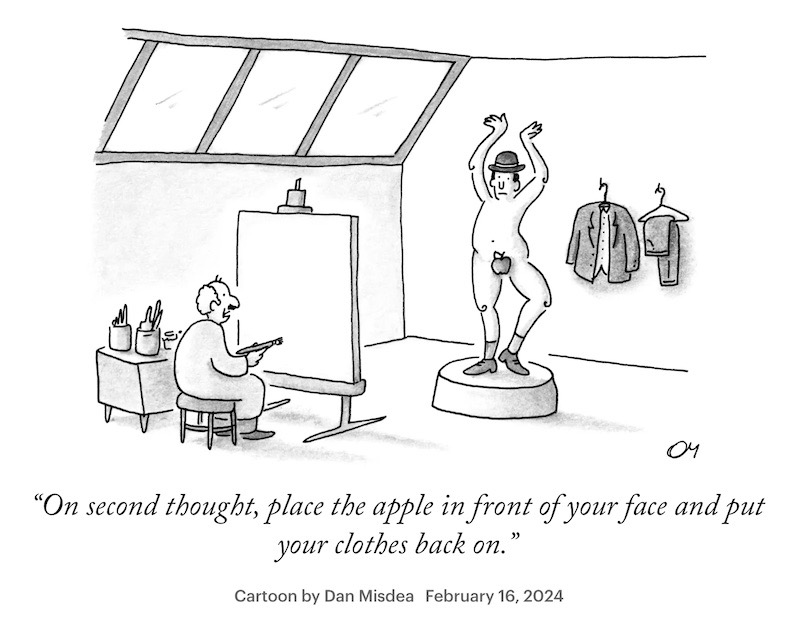
Artists — cartoonists included — rarely preserve and exhibit the drafts of their work, their proto-art. So we should be grateful to cartoonist Dan Misdea (in the latest, 2/26/24, New Yorker) for showing us René Magritte’s first approach to what became his surrealist painting The Son of Man:


(#1) And so the world lost the opportunity for a surrealist soft-porn masterpiece Adam in a Bowler

No doubt the model’s plaintive whining about having an apple glued to his dick encouraged Magritte to reconceptualize the work.

Read the rest of this entry »

Poet to poet

February 23, 2024

Extracted from the New Yorker site:

“Thought a Rarity on Paper”
by Billy Collins
February 19, 2024

Read the rest of this entry »

The TripTik moment

February 22, 2024

This is massively a MQoS Not Dead Yet posting, noting that I am currently in a state of body and mind unlike anything I’ve previously reported on, and opening up a lot of questions about the many experiential states that are depressive in one sense or another. I’ve been sleeping a lot (10+ hours at night the last two nights, plus a couple of hours napping during the day), but it’s been absolutely delicious sleep — in 2-hour chunks between my nighttime whizzes (instead of my long-standard 1-hour schedule), with astoundingly pleasant dreams (one so seductive that I went back into it while I was standing by my bed happily whizzing into a urinal).

Read the rest of this entry »

The discouragements of old age

February 21, 2024

As regular readers will have noticed, things have not been good for me in recent days — physically just hanging on, barely getting through the days; spirits so low I’m almost frozen in discouragement. Many things have no doubt contributed to the fix I’m in, but one part of the story has to do with the late-career recognitions that sum up the accomplishments of the most significant academics: publication of their collected works; a Festschrift from colleagues and students celebrating the influence of their works; honorary degrees; and prizes or awards. I travel in circles where such recognitions are common, but never expected to get them myself: I have genuine talents, with teaching and research ranging over a huge array of topics, and I can pull off an engaging style of presentation, but my achievements are modest.

I’ve had plenty of career recognitions  — a University Professorship at Ohio State; election to the American Academy of Arts and Sciences; the presidency of my learned society, the Linguistic Society of America (LSA); the Sapir Professorship at an LSA Linguistic Institute; an assortment of  grants and fellowships — but these are, as a Stanford dean once explained to me, more than a little haughtily, in what I think of as Harvard Talk — merely what Stanford expects of its faculty members, nothing at all special.

Read the rest of this entry »

The overture to Mozart’s Marriage of Figaro

February 19, 2024

First came the moral monster Don Giovanni being dragged down to hell for murder and a career of sexual imposition, with a restorative operatic appendix in which the people of Seville sing to his downfall. Then a delightful Mozartean orchestral interlude, apparently the brisk scherzo movement of a symphony (dominated by woodwinds and brass). And then we’re back in Seville, where Figaro is measuring the space for the bridal bed he and Susanna will soon share, while she’s trying on her wedding headpiece; hovering over the couple is the specter of Figaro’s literally rapacious employer Count Almaviva. Yes, it’s a comic opera about sex and power, and it’s a masterpiece.

That’s what brought me to consciousness and a new day at 2:15 am — my life has been deranged in so many ways that I no longer know how to report on it, except for the MQoS announcement that I’m not dead yet — and, yes, I did recognize that the orchestral interlude was in fact the overture to Mozart’s Le Nozze di Figaro [‘The Marriage of Figaro‘], capturing the spirit of the work without using any of its music, getting us into the proper mood for the opera without disclosing any of its thematic material. Not even a whiff of Figaro’s aria “Se vuol ballare (signor contino)”, which is the essence of the opera plot distilled into a dance tune. (If this were a Broadway musical, “Se vuol ballare” would be the main theme of the overture. With Figaro’s aria to that amorous butterfly Cherubino, “Non più andrai (farfallone amoroso)”, as a contrasting second theme.)

Expanding now on three things: the overture as a free-standing orchestral composition; “Se vuol ballare” as Figaro‘s theme song; and a note on Figaro as an ensemble opera. Plus an appendix flagging an intricate topic in g&s (gender & sexuality) studies that’s central in the plots of both Don Giovanni and Figaro.

Read the rest of this entry »

Sneezeweed’s the name, not elecampane

February 17, 2024

Or, for that matter, the eccentrically spelled elecamphane. This in reaction to  a third plate from the 19th-century American Flora compendium that I’ve been posting about recently (“My wild valentine” posting here; “Daffodil poem” posting here). Which calls the plant elecamphane, but the name is elecampane, and everyone knows this plant as sneezeweed. The plate:


(#1) The usual spelling is elecampane; a net search turns up the ph spelling only on this American Flora plate — but in any case the flower is pretty clearly not elecampane (Inula helenium), but is instead a garden variety of the closely related common sneezeweed (Helenium autumnale), which is (to my eye anyway) considerably prettier than elecampane

Read the rest of this entry »

Daffodil poem

February 16, 2024

I slept from 7:30 to 4:15 last night, with some of the most distressing grotesque dreams I’ve ever had in my life, awakening frequently with terrible muscle cramps. Eventually I turned the dream around to something life-affirming and pleasant, but I awoke dead-exhausted from the night, confused and bewildered, and with screamingly sore muscles all over my body (for the record: I have had no fever or other clinical signs of infection, and I test negative for COVID).

Not really able to face the day, I retreated to botanical art from the 19th century, as presented to me recently by the Sierra Club, in a set of five greeting cards with flower illustrations from The American Flora of 1840-1855; see yesterday’s posting “My wild valentine”, about the plate of the wildflower Potentilla atrosanguinea. Another plate from the Sierra Club set — this time for a garden flower, a daffodil — caught my eye and moved me to toss off a little poem leading up to the label on the American Flora plate:


(#1) A poem to the intriguingly named three-anthered rush daffodil

Read the rest of this entry »