I slept from 7:30 to 4:15 last night, with some of the most distressing grotesque dreams I’ve ever had in my life, awakening frequently with terrible muscle cramps. Eventually I turned the dream around to something life-affirming and pleasant, but I awoke dead-exhausted from the night, confused and bewildered, and with screamingly sore muscles all over my body (for the record: I have had no fever or other clinical signs of infection, and I test negative for COVID).
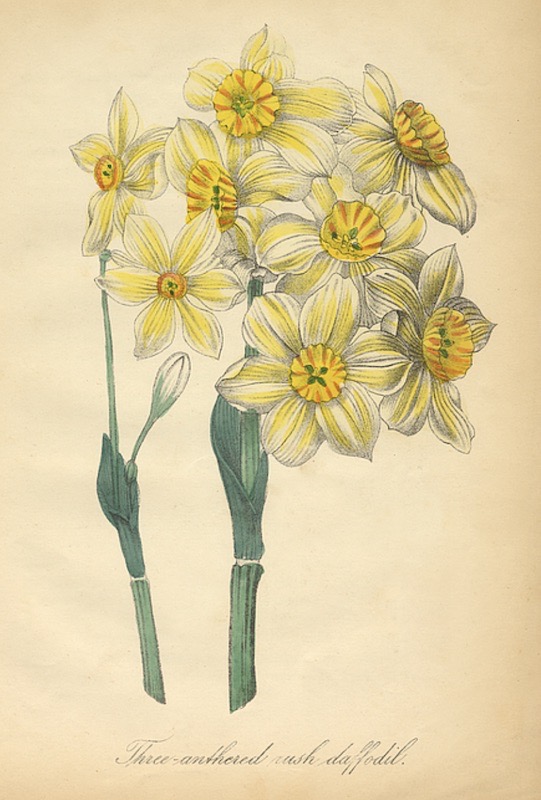
Not really able to face the day, I retreated to botanical art from the 19th century, as presented to me recently by the Sierra Club, in a set of five greeting cards with flower illustrations from The American Flora of 1840-1855; see yesterday’s posting “My wild valentine”, about the plate of the wildflower Potentilla atrosanguinea. Another plate from the Sierra Club set — this time for a garden flower, a daffodil — caught my eye and moved me to toss off a little poem leading up to the label on the American Flora plate:
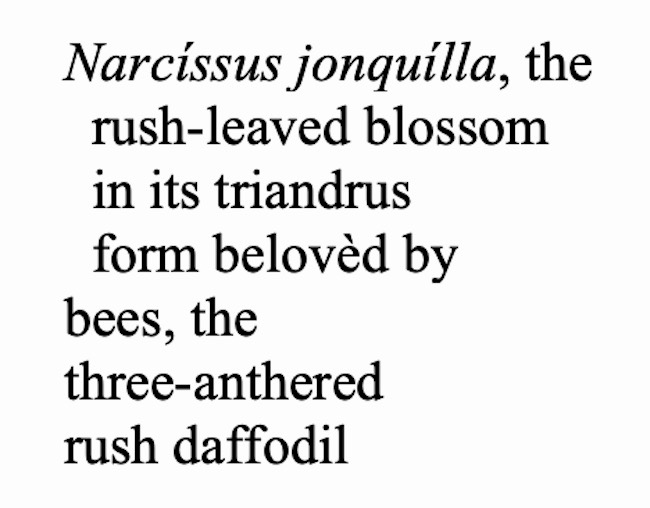
(#1) A poem to the intriguingly named three-anthered rush daffodil
(#2) The American Flora plate
Now, about names and things.
First up: rush (as both C(ount) noun and M(ass) noun). From NOAD:
noun rush-2: 1 [a] an erect, tufted marsh or waterside plant resembling a sedge or grass… Widely distributed in temperate areas, [the dried stems of] some kinds are used for matting, chair seats, and baskets… [c] a stem of a rush plant. [d] rushes used as a material: he worked on the leaks in the hull, using bundles of rush [note: a M noun].
What to do with rushes: basket time:
(#) Handwoven rush basket, designed by Orlando Vasquez for the Novica company

(And of course what the rushes whisper is that Midas has asses’ ears.)
Then: the rush daffodil. From Wikipedia:
Narcissus jonquilla, commonly known as jonquil or rush daffodil, is a bulbous flowering plant, a species of the genus Narcissus (daffodil) that is native to Spain and Portugal but has now become naturalised in many other regions
… Narcissus jonquilla bears long, narrow, rush-like leaves (hence the name jonquil, Spanish junquillo, from the Latin juncus ‘rush [plant]’). In late spring it bears heads of up to five scented yellow or white flowers
Finally: the triandrus ‘three-anthered’ form. From the In Defense of Plants blog, the posting “Daffodil insights” from 4/18/18 (with possibly more about daffodils than you were prepared for):
as of 2008, more than 28,000 daffodil varieties have been named and that number continues to grow each and every year. Even outside of the garden, there is some serious debate over the number of daffodil species, much of this having to do with what constitutes a species in this group.
As I write this, all daffodils fall under the genus Narcissus. Estimates as to the number of species within Narcissus range from as few as 50 to as many as 80.
… Variation in corona shape and size has led to the evolution of three major pollination strategies within this genus. The first form is the daffodil form, whose stigma is situated at the mouth of the corolla, well beyond the 6 anthers. This form is largely pollinated by larger bees. The second form is the paperwhite form, whose stigma is situated more closely to or completely below the anthers at the mouth of the corona. This form is largely pollinated by various Lepidoptera as well as long tongued bees and flies. The third form is the triandrus form, which exhibits three distinct variations on stigma and anther length, all of which are situated deep within the long, narrow corona. The pendant presentation of the flowers in this group is thought to restrict various butterflies and moths from entering the flower in favor of bees.
Little bees. It’s all for those little bees. Like the poem says, those blossoms are belovèd by bees.
February 16, 2024 at 4:15 pm |
Thanks! I expected to be subjected to Wordsworth.
February 16, 2024 at 4:19 pm |
I steeled myself to avoid the obvious Wordsworth.
February 18, 2024 at 6:45 pm |
My two associations with rushes (the plants) are: (1) Alice’s desire to gather scented rushes while out in the boat with the Sheep (the transformed White Queen), and (2) the cumulative song “Green Grow the Rushes, ho!” (whence, supposedly, the term “gringo”),
February 18, 2024 at 7:07 pm |
In addition to the associations in my posting (rush baskets, Midas), there are all those Biblical bulrushes, notably the ark of bulrushes with the infant Moses in it.