(Yes, a day late, but I’m barely functioning, so this is the best I can do.)
A fortuitous find. In my USPS mail, from the Sierra Club, a set of five 19th-century wildflower drawings on greeting cards: a free gift serving as leverage to get me to support their organization. Among the drawings, this intensely red Potentilla atrsosanguinea, with its very rose-like 5-petaled blossoms: a wild Valentine’s flower.
(#1) Blood-colored cinquefoil, Potentilla atrosanguinea, from The American Flora vol. III (1855)
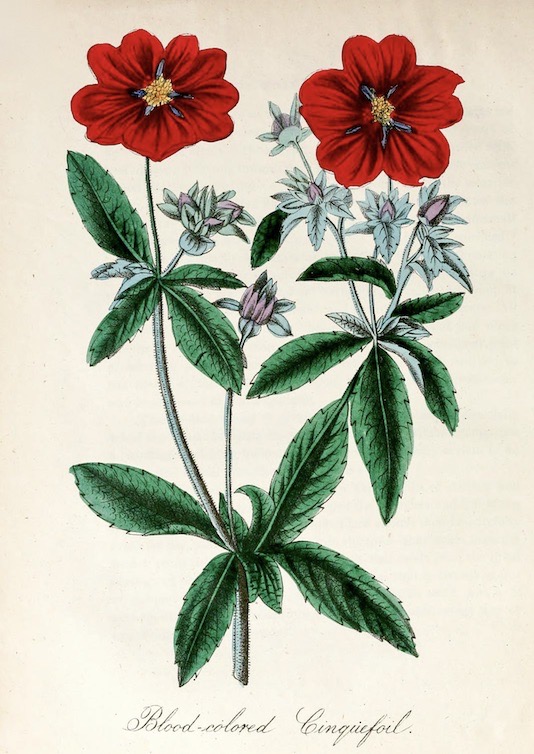
Now: about the plant, and then about The American Flora.
A dark crimson beauty among the cinquefoils. First, the genus, from Wikipedia:
Potentilla is a genus containing over 300 species of annual, biennial and perennial herbaceous flowering plants in the rose family, Rosaceae. Potentillas may also be called cinquefoils [for the 5-petaled flowers] in English
Closely related to roses, even more closely related to strawberries. I grew several species (all with yellow flowers) in my long-ago Columbus OH garden.
Then Wikipedia‘s thumbnail note on the species:
Potentilla atrosanguinea, the dark crimson cinquefoil, Himalayan cinquefoil, or ruby cinquefoil, is a species of Potentilla found in Bhutan and India.
It’s a gorgeous plant in the wild, so eventually plant breeders created well-behaved, and also gorgeous, cultivars. For instance, from the Parrans Greenhouse site:
(#2) Potentilla atrosanquinea Himalayan Cinquefoil ‘Scarlet Starlit’

According to Parrans:
Bright flowers complement silvery green foliage. Blooms from June to August.
A monumental compendium of wildflower lore. With lovely drawings. And an immensely informative subtitle:
Asa B. Strong, The American Flora, or history of plants and wild flowers containing a systematic and general description, natural history, chemical and medical properties of over six thousand plants. Vols. I and II, 1848-1850. Vol. III 1855.
Strong must have had a substantial staff on this project, but I haven’t been able to find any information on how the work was assembled.
Appendix. The legends on the other four Sierra Club reproductions:
1, Passion Flower [and] 2, Spear-mint
Elecamphane
1, Blue Lobelia [and] 2, Pipsessewa
Three-anthered rush daffodil
February 16, 2024 at 8:39 am |
Very pretty, the leaves as well.