May 19, 2014
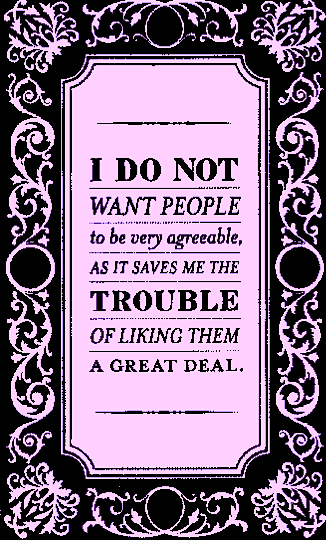
Another quotation from Jane Austen (again, thanks to Chris Ambidge) — this time from a letter written on Xmas Eve 1798:

Chris reminds me that Jane Austen was the daughter of a parish priest, which (I suppose) would put her in a postion to long for release from being agreeable, especially in seasons of celebration..
Posted in Quotations | Leave a Comment »
May 19, 2014
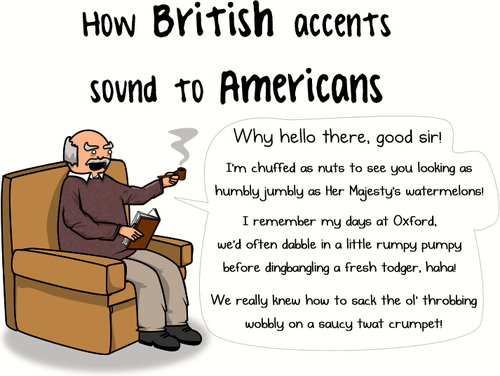
From several sources on Facebook (but ultimately from the Oatmeal webcomic), this item:

This is accent taking in all aspects of a variety of a language, not just the phonological aspects. In this case, phonology is barely involved (though you can imagine some of it, using stereotypes of upper-class British pronunciation)): it’s all about lexical choices, register/style, and conversational topic (leaning heavily towards the sexual) — obscure, perhaps archaic, and pompously rakish.
(This is another case in which I don’t really know whether the item is to be classified as a cartoon, or what.)
Posted in Social life, Style and register, Variation | 1 Comment »
May 19, 2014
From Ryan Tamares recently, a piece of a Subway Flatizza box. The box woudn’t scan for me, but what it says is Flatizza™: “Cheesy & delicious meets crispy & square” (easily readable as tetrameter, with front-accented feet). Square flatbread with pizza toppings: cheese, pepperoni, spicy Italian, veggie.
Flatizza is of course a portmanteau of flatbread (contributing flat-) and pizza (contributing -izza), without overlap between the two parts.
Read the rest of this entry »
Posted in Language and food, Language in advertising, Poetic form | 3 Comments »
May 18, 2014
Cartoon traffic since the five items I talked about in this posting: a Bizarro on passwords, then and now; a Benjamin Schwartz New Yorker cartoon on Canadian eh; a One Big Happy on God talk; and a Zippy on Dagwood (Bumstead).
Read the rest of this entry »
Posted in Conversation, Language and religion, Language technology, Linguistics in the comics, Style and register | 3 Comments »
May 18, 2014
Five items, several of which lead to more complex topics: a Harry Bliss cartoon that I caught, reprinted, in the Funny Times for May; a Zippy on art forgery; a One Big Happy with a kid eggcorn; a Zits with alliteration and rhyme (and the sexual marketplace); and a Rhymes With Orange on consonants and vowels.
Read the rest of this entry »
Posted in Alliteration, Ambiguity, Art/lit/music/film, Idioms, Language play, Linguistics in the comics, Phonology, Pop culture, Rhyme, Social life, Spelling | 3 Comments »
May 14, 2014
On May 2nd on the Everyday Feminism site, “Why Grammar Snobbery Has No Place in the Movement” by Melissa A. Fabello, presenting the customary linguists’ arguments that non-standard, regional, informal, etc. variants are not failed attempts to produce the formal written standard variety, but are instead features of alternative linguistic systems, each appropriate to certain social contexts — and moving on from that linguistic point to the wider sociopolitical point that these features should not be used as weapons against those who customarily employ the features; they are not failed citizens because they deviate from the use of formal standard written features in all contexts.
Fabello goes on to quote a moving poem by Aysha Syed on the matter.
Read the rest of this entry »
Posted in Poetry, Usage attitudes, Variation | Leave a Comment »
May 14, 2014
Four recent cartoons, on varied subjects: two One Big Happy strips; a Bizarro with a portmanteau; and an ecard-like strip.
Read the rest of this entry »
Posted in Linguistics in the comics, Portmanteaus, Pragmatics, Words and things | Leave a Comment »
May 13, 2014
In a bizarre response to the winning of the Eurovision Song Contest by a bearded drag queen, Conchita Wurst singing “Rise Like a Phoenix” (reported in almost every media outlet), some Russian men have taken to shaving off their beards (if they had them). The position seems to be that Wurst’s beard so poisons beards as a symbol of masculinity that real men have no way to protest except by going beardless. (The idea here seems to some degree to be similar to the position that same-sex marriage diminishes and debases opposite-sex marriage — except that in the Wurst case, the threat comes from a single case: just one, though admittedly very visible, bearded man in a dress.)
The result is paradoxical.
Read the rest of this entry »
Posted in Gender and sexuality, Language and politics, Language and sexuality, Language and the body, Metaphor, Music, Names, Pop culture, Signs and symbols | 1 Comment »
May 13, 2014
In the SundayReview section of the NYT on the 11th (in print), an interview by Kate Murphy with my friend and colleague Dan Jurafsky. The lead-in:
Daniel Jurafsky is a professor of linguistics and computer science at Stanford. He teaches a popular freshman seminar course called “The Language of Food,” which is also the title of his forthcoming book.
These Sunday interviews are all a single column (on p. 2), with some fixed topics and some designed for the interviewee’s experiences, opinions, and enthusiasms.
Read the rest of this entry »
Posted in Language and food, Language in the media, Linguists | Leave a Comment »
May 12, 2014
Elizabeth Daingerfield Zwicky offers this passage from the Ask a Manager blog of the 12th:
Managers and the possessive tense
I have a new manager who has placed his desk in the middle of the room, and conducts all of his conference calls in a rather loud fashion. In doing so, he constantly refers to the employees (myself and my peers) as “his” — e.g. “my team,” “my testers,” “my people.”
Am I wrong to feel a bit demeaned that my new manager is placing himself as a king among the common employee? His self-placement of prominence above those that he rules is causing quite a bit of resentment amongst “we the people.”
Elizabeth reports that this is otherwise an excellent blog (offering good advice on managing), but possessive tense is nonsensical as a technical term of grammar.
Read the rest of this entry »
Posted in Grammatical categories, Ordinary vs. technical lg, Singular & plural, Tense-aspect-mood | Leave a Comment »