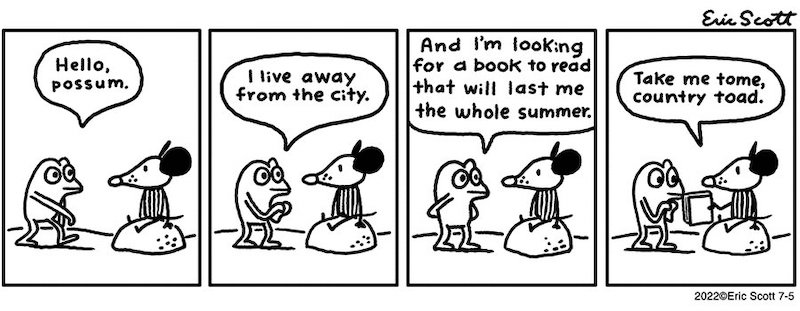
From Verdant on Twitter this morning, a link to this carefully set-up elaborate pun from cartoonist Eric Scott (in a strip published today):
(#1) The set-up introduces the crucial words, but indirectly:
From Verdant on Twitter this morning, a link to this carefully set-up elaborate pun from cartoonist Eric Scott (in a strip published today):
(#1) The set-up introduces the crucial words, but indirectly:
(The customary warning: male sexual parts, man-on-man sex, and street language about all of it, so not for kids or the sexually modest.)
Zach Astor, a porn name that caught my eye this morning (while I was engaged with various recent CockyBoys porn offerings, for reasons both personal and professional) — because it’s ZA, while I’m AZ. The reverse of me. (Alas, the bearer of the name isn’t from South Africa, and I’m not from either Azerbaijan or Arizona, but then nobody’s perfect.)
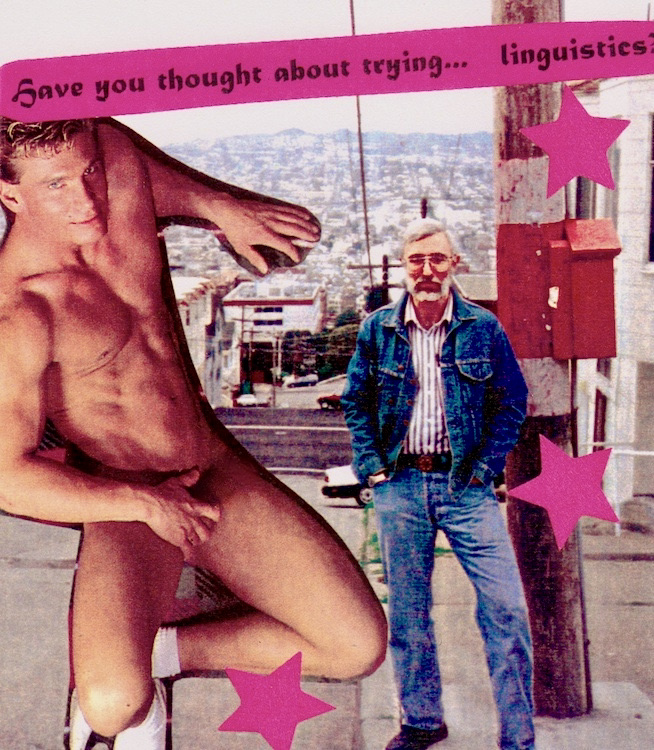
It turns out that ZA is (of course, being a gay porn actor) young, young enough to be my grandson, or maybe even my great-grandson; with curly hair that is sometimes mostly blond, sometimes brown with blond highlights (vs. my very fine very straight brunet-gone-gray); with a slim build (vs. my fat one); with a smooth body (vs. my hairy one); with a really big dick (a thick 8ʺ — vs. my svelte 5ʺ); and he’s a devoted top (while I’m an enthusiastic bottom). Well, we’re both gay men, both born in Pennsylvania (ZA in Philadelphia, AZ in Allentown), and both circumcised — but that’s not a lot of common ground. I should ask him if he’s thought about trying … linguistics:
(#1) Not, as you will soon see, ZA, but a different porn actor, the one I put in this collage (set on Potrero Hill in SF) long ago
(Men’s sexual bodies and man-on-man sex discussed in street language, so not appropriate for kids or the sexually modest)
Gay Pornlandia celebrates the American commercial holiday Fathers / Father’s / Fathers’ Day with annual sales on wares explicitly featuring Boys and their Daddies, or gay male roles and relationships in that sociosexual neighborhood (running the scale from temperamentally contrasted boyfriends to subs / slaves / boys vs. doms / masters / sirs in BDSM practices).
From my 6/21/15 posting “My hard-on belongs to daddy, for Fathers Day (which always comes in the middle of Gay Pride Month), on daddy – boy films (taking off from the 2011 Catalina flick Daddy It Hurts!):
(#1) Spencer Reed as a muscle-hunk daddy — and calliphallic top — and Cole Harvey as a twinkish boy — and callipygian bottom (naughty bits cropped for WordPress modesty)
In this world boy and daddy name “types”, personas, or social roles — and also relationships; these can be more or less conventionalized or ritualized and so framed as identities (in which case the talk will be about a Boy and his Daddy)
(Men’s bodies, man-on-man sex, raunchy talk — not for kids or the sexually modest.)
To celebrate high summer, my male-calendar pages for the month of July, both featuring smiles: a smile of callipygian appreciation in a Tom of Finland drawing; a subtle half-smile on the face of Cocky Boy Levi Karter — which led quickly to a photo of a sexual encounter between Mr. July Karter and Mr. June Blake Mitchell that exemplifies a common trope of gay male porn (which cries out for a name), combining a facial component — two faces pleasurably engaged with one another (in what I’ll call facial coupling) — and a groin-buttocks component — a back-on-front sit-fuck (what I’ll call a lap fuck). And led from that to the complex career of Levi Karter, with reflections on personas.
(Warning: lots of off-color word play about male masturbation)
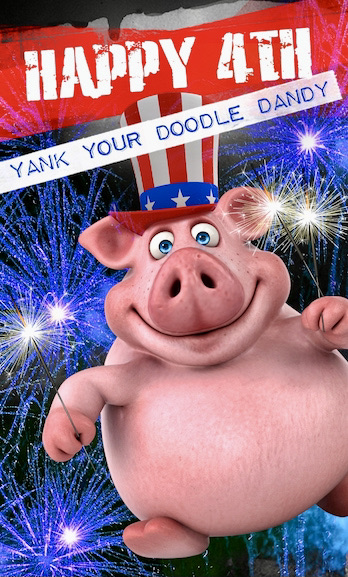
To celebrate American independence (year 246), the Fort Troff company (“Ruff Stuff for Pig Sluts”), purveyor of sex accessories, primarily to guys like me), offers this (parodic) slogan:
Yankee Doodle keep it up / Yank your doodle dandy
The verb yank ‘masturbate’ is only accidentally homophonous with the yank– of Yankee, but according to GDoS, the noun doodle ‘penis, esp. a child’s penis’ is attested from the 18th century on.
🐇 🐇 🐇 It’s Canada Day, 7/1, and this year’s appointments to the Order of Canada, announced yesterday, include philosopher, poet, musician, and political essayist Jan Zwicky.
The densest truths are home.
Liszt, Paganini, all the brilliant unreal
postures of intensity—nothing like
the dishes in the rack, heads raised
for the clear hot rinse, children
having their hair washed in the bath.
— from “Practising Bach” in Zwicky’s Forge, 2011
🐆 🐆 🐆. (That’s a ritual tiger-tiger-tiger for the last day of the month; details below.) Today is Ultimate June, the final day of a month packed with occasions of considerable emotional content, also (etymologically) a month dedicated to the Roman goddess Juno: queen of the gods (in fact, also called in Latin Regina ‘queen’), counterpart to Greek Hera; protector of women and motherhood; also embracing warlike features of Greek Athena, the goddess of wisdom and war (the deities of classic times were marvels of intersectionality, as we would now put it), and oh yes, wife of Jupiter, the counterpart to Greek Zeus.
So I am suggesting that 6/30 be recognized as Ultimate Queen Day, especially celebrating men who are flamboyant (in any way) and those who are effeminate (in their presentation of themselves). Stereotypically, these two bundles of characteristics are manifested together, in the cultural type the queen (not to be confused with royalty, with the drag queen, with X queen used to label tastes or preferences of many kinds — imagine a white-cross queen, a man who prefers Swiss men as sexual partners, or a fan of Swiss things — or with various other uses of /kwin/).
To come: on the content of the month of June; a bit more of etymology; on flamboyance; on some queens; and, yes, on 🐆 🐆 🐆.
The month of June. Relevant for everyone: June has the Summer Solstice in it, and Midsummer Day quite close to that. The Summer Solstice Day is often labeled “the first day of summer” (in the Northern Hemisphere), but no ordinary person talks that way; folk (and commercial) usage treats the season of summer as embracing June, July, and August, with exact starting and ending dates a matter of local custom. There are ways of thinking about summer, but June is, first of all, a summer month — time for exposing the body, in minimal (or no) clothing; playing in the water (in swimming pools or, especially, at the beach ); randy sex (all over the place, by day or by night); and, in the US, baseball.
I must confess that I have a 🐇 🐇 🐇 posting for 6/1 that looks at this summer-month stuff, still not finished and polished after about 30 hours of work; I am overwhelmed by life. As a place holder, vividly illustrating June As Summer, the image (Hot Water) on the June page in the Tom of Finland 2022 calendar:
(#1)
Then, relevant to various parts of my life:
— June is Gay Pride Month
— and has Juneteenth in it, a US holiday celebrating the end of slavery in my country
— and has Flag Day in it, a US patriotic occasion, memorializing the adoption of the US flag in 1777
— and has the commercial holiday Father’s Day in it, which functions as a gender event, celebrating conventional masculinity in all its forms — in particular, it’s a Masculine Meat Holiday (see my 6/17/22 posting “Be the Master of the Meat!”) — and also as a sexuality event, through being hi-jacked by gay porn studios as a vehicle for Daddy – Boy sex films.
A little more etymology. If I read the OED right, the month of June (in English) gets its name from the month name in Classical Latin, the masculine noun Jūnius, which is the masculine version of the feminine name Jūnō — the goddess Juno.
Flamboyance. Queens are flamboyant, etymologically ‘flaming’. Then from NOAD:
adj. flamboyant: 1 [a] (of a person or their behavior) tending to attract attention because of their exuberance, confidence, and stylishness: a flamboyant display of aerobatics | she is outgoing and flamboyant, continuously talking and joking. [b] (especially of clothing) noticeable because brightly colored, highly patterned, or unusual in style. …
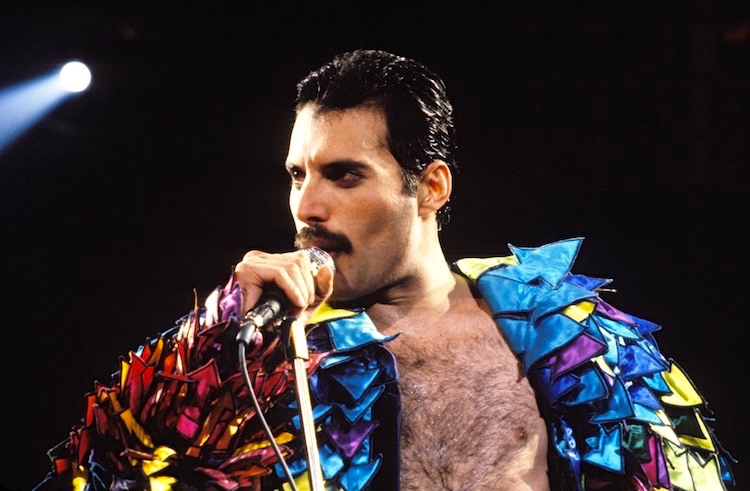
On flamboyance in action, consider, among others: flamboyant entrepreneurs (Malcolm Forbes, Richard Branson, Jack Ma) and flamboyant musicians (Jimi Hendrix, Mick Jagger, Steven Tyler). Here’s Freddie Mercury (of Queen), queening flamboyantly in performance:
(#2) Note armband on the right arm, indicating a sexual receptive or subordinate
On flamboyance in dress, consider, among others: historical dandies, peacocking by men, extravagant fashion models, and the costumes of some flamboyant musicians. Here’s Freddie Mercury again:
(#3)
Meanwhile, I’ve posted often about flamboyant items of apparel: underwear and gymwear in fabulous colors and patterns, loungewear, and shirts of all kinds. I bought my first gorgeously patterned shirts at the B. Altman flagship store on 5th Avenue in NYC in 1958; I was 17, and you can see, from the fact that I remember so many details, that it was a moving experience. Many others followed.
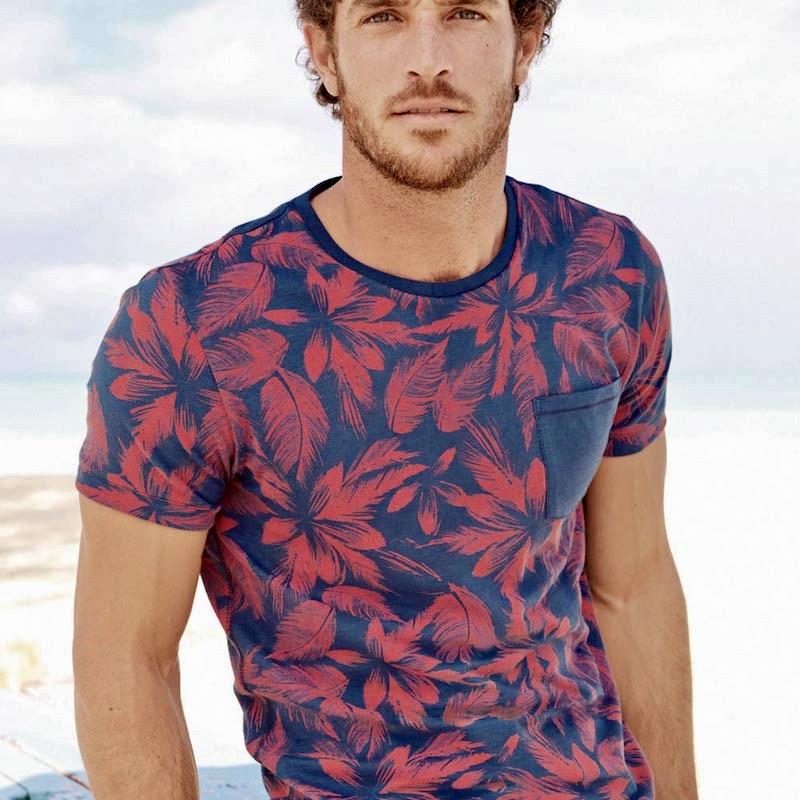
Now I collect images of such things, rather than the things themselves, and I tend to specialize in floral patterns (well, I’m a plant person as well as a queer person). From the GentleManual site, “Floral Style: A Masculine Guide to Fresh Floral Prints” from 8/1/19, this attractively flamboyant floral t-shirt, worn by a model who’s also to my taste (though not flamboyantly posed):
(#4)
Finally, flamboyance in personality. First, a little study in Going Too Far. From the MentalHelp site on “DSM-5: The Ten Personality Disorders: Cluster B”:
the dramatic, emotional, and erratic cluster. It includes: Borderline Personality Disorder; Narcissistic Personality Disorder; Histrionic Personality Disorder; and Antisocial Personality Disorder. Disorders in this cluster share problems with impulse control and emotional regulation.
… Persons with Histrionic Personality Disorder are characterized by a pattern of excessive emotionality and attention seeking. Their lives are full of drama (so-called “drama queens”). They are uncomfortable in situations where they are not the center of attention.
People with this disorder are often quite flirtatious or seductive, and like to dress in a manner that draws attention to them. They can be flamboyant and theatrical, exhibiting an exaggerated degree of emotional expression. Yet simultaneously, their emotional expression is vague, shallow, and lacking in detail. This gives them the appearance of being disingenuous and insincere. Moreover, the drama and exaggerated emotional expression often embarrasses friends and acquaintances as they may embrace even casual acquaintances with excessive ardor, or may sob uncontrollably over some minor sentimentality.
People with Histrionic Personality Disorder can appear flighty and fickle. Their behavioral style often gets in the way of truly intimate relationships, but it is also the case that they are uncomfortable being alone.
They tend to feel depressed when they are not the center of attention. When they are in relationships, they often imagine relationships to be more intimate in nature than they actually are.
People with Histrionic Personality Disorder tend to be suggestible; that is, they are easily influenced by other people’s suggestions and opinions. A literary character that exemplifies the Histrionic Personality Disorder is the character of Blanche DuBois in Tennessee William’s classic play, “Streetcar Named Desire.”
That’s the bad news. The world is, however, well supplied with delightful flamboyant queens, extravagant but empathetic, fully in control of their emotions while presenting an exaggerated version of themselves. There are, in fact, several subtypes. From my 5/29/22 posting “The pansies and the birds will speak for us”, with Paul Harfleet, author of Pansy Boy, displaying his Tough Queen face:
(#5) This along with illustrations of a tough queen — Emory in the 1970 movie of The Boys in the Band — and a ditzy queen — Randy Rainbow giving his musical commentaries on the newsBoth characters [Emory and Randy] are dead serious, with moral agendas behind the apparent superficiality of the personas they project (of eye-rolling, disdainful self-involvement for Emory; of wide-eyed, scatter-brained silliness for Randy). This they share with Harfleet, whose ornamental, often sexualized presentations of himself can’t conceal the almost painful urgency of his aim to rescue the children, honor the despised, and celebrate nature’s gifts of flowers and birds.
There’s more. For several years, my department chair at Ohio State was a good friend who presented himself as what I now think of as an ornamental queen: full of amiable laughter, warm companionship, and energy, with the gay gestures, the gay voice, all the gay eye stuff (side-eyes, wide eyes, eye rolls), all of that dialed up to about 150% of normal. He had a fine conventional three-piece suit that he wore when one of his students defended their PhD dissertation (the suit was a mark of respect for them), but mostly dressed flamboyantly. He went to Humanities College Executive Committee meetings (with the deans and the other department chairs) in very worn denim short shorts that showed off his gym-developed lower body, plus an equally worn Mickey Mouse t-shirt that showed off his upper body. Vibrating energy and enthusiasm.
And it all worked. Well, he was an able administrator, a solid scholar (in Indo-European historical linguistics!), a wonderful teacher, and a tireless, thoughtful adviser. And yes, a treat to look at and a hell of a lot of fun to be around.
The jaguar-jaguar-jaguar goodbye. The counterpart to the rabbit-rabbit-rabbit hello. For which, see these two postings:
— from 5/1/17 in “Rabbit, rabbit, rabbit: three cartoons for the 1st”, on the ritual
that calls for everyone to greet the new month, upon awakening, by saying “rabbit, rabbit, rabbit”
— from 5/1/20 in “Trois lapins pour le premier mai”
So the question became: what’s the opposite of a rabbit? The closest animal opposition to rabbit is hare, but that’s way too narrow. What we want is something opposed to rabbits in a number of relevant features.
Rabbits are small, furry, large-eared mammals; they are gregarious, gentle, fast-moving, shyly reclusive, prolifically breeding, herbivorous prey animals. They are folklorically cunning (in trickster figures) and hypersexual (so serving as symbols of fertility and rebirth, and then of spring and Easter).
So, sticking to the world of mammals, we’re looking for a large fierce carnivorous predator (forget about the fur, which most mammals have, and the ears, since most mammals have smaller ones; and the big broods, since large predators in general have small broods). Jaguars were my first choice, because they’re viciously fierce and much fleeter of foot than even the fastest rabbit (even the Energizer Bunny), and because I just love the name jaguar. Alas, Apple has no jaguar emoji, or even a panther; so I settled for the tiger emoji. Tiger tiger tiger, goodbye, month.
On Twitter yesterday, given a little push by my posting “Did that actually just happen?”, Merrill Markoe tweeted:
The Jan 6 hearings were once again amazing, stunning and magnificent. In a related story, because it is my responsibility and my job, I have recorded the valiant attempts made by the closed-captioning software to spell Pat Cipollone [AZ: the attorney who served as White House Counsel for [Helmet Grabpussy]]
MM supplied a series of screen captures with attempts at an orthographic rendering of
/ ˈpætˌsɪpǝˈloni /
of which her favorite (and mine) was Patsy Baloney:
(#1) Left, for the committee: US Representative Liz Cheney of Wyoming; right: the witness Cassidy Hutchinson
Or words to that effect, from Rachel Maddow, describing her stunned reaction to watching pieces of Cassidy Hutchinson’s testimony on 6/28 before the Jan 6 committee (the US House select committee investigating the 1/6/21 insurrection at the US Capitol). And yes, it did actually just happen. And I was stunned too; I watched the whole thing, amazed and appalled. (Also moved to recall my rapt attention through the Army-McCarthy hearings when I was 13 and the Watergate hearings and House impeachment hearings when I was 33).
6/28 is also Stonewall Day (remembering 1969), this year an occasion for a mixture of extreme emotions, among them distressed disbelief that we lgbt-folk are threatened with a return to the mindset — and the laws — of the Pinko Communist Scare fostered by Joe McCarthy about 70 years ago.
6/28 is also Sarajevo Day (remembering 1914), the anniversary of the assassination of Archduke Franz Ferdinand and Archduchess Sophie, which somehow tipped the world into the nightmare of the Great War. Followed by the Russian Revolution of 1917 and the great influenza pandemic of 1918 — the wars echoed now in the monstrous evil of the Russian invasion of Ukraine, the Great Flu mirrored in the Covid pandemic we’re living through now.
Meanwhile, here in 2022 everything is happening at once, and a lot of it is unbelievably awful. (Did that actually just happen?) See the above, and add last week’s US Supreme Court decisions on concealed carry of weapons in public and on abortion. The last of which moved Ann Burlingham to whip off a postcard of rage and protest to me (written and mailed in Pittsburgh on the 6/25, arrived in Palo Alto on 6/28, whoopee!):
On 6/26, this query from genealogist Randi Zwickel-Patrick (hereafter, RZ), offered as a comment on one of my very many postings on people named Zwicky (there’s a Page on this blog chronicling these postings):
Was the Zwicky family’s name originally Zwickel or another variation?
The query has no particular relevance to my posting “A Swiss thread in Paris”, from 6/24/18; that posting just happens to be about some Zwickys (and their thread company). So I’ve detached the query from that posting, to give something of an answer here.
But the briefest response is to say that a family name often has a number of histories (names are changed, inadvertently or intentionally, in ways small and large; names get mixed up with one another), but in any case almost never has something identifiable as the original name, and even for one version or variant of the name, we almost never have access to the first use of a name, to the circumstances surrounding that version’s choosing, an event or events that happened very long ago, far away, involving people who not only didn’t keep records of these things but were, most of them, illiterate.
So I can’t answer RZ’s query as it stands, and I don’t think anyone could. Even a much less ambitious query — what’s the history of the Zwicky name in the male line going back just from me? (forget about all those other people with the surname Zwicky) — runs aground 5 to 7 centuries ago, still in the same part of what is now Switzerland (a village in the canton of Glarus) that serves as Zwicky Central. (Brazil, where the nuts come from; Mollis, where the Zwickys come from.)
I have, however, looked at Zwicknames — not just Zwicky, but also Zwickey, Zwicki, Zwicke, Zwickie, Zwick, Zwicker, Zwickel, Zwickl — and also at Zwicky-adjacent names, like Zawicky, Swicky, Sowicky, and, oh my, Tsviki. This is all about names, not actual (genetic) ancestry, and given the naming conventions in Anglophone countries, it’s also all about descent in the male line, disregarding entirely all the female ancestors.
And going back 500-700 years ago is going back about 20-28 generations ago (with each generation about 25 years), so there are 20-28 ancestors in the male line, but (in principle) 2^20 to 2^28 ancestors total (1,048,576, or about a million, to 268,435,456, or about 300 million).
In either case, I can’t imagine much in this that could be actually relevant to Arnold Arnoldson. Swiss people can generally peg me as of Swiss ancestry from my facial features, but they also peg me (like my father but unlike my grandfather) as American, from my gestures, facial expressions, postures and gaits, speech, grooming, ornament, and dress. As for character traits, I (b. 1940) do have Swiss stubbornness, but I got that from the models of Arnold Melchiorson (b. 1914) and Melchior Johannson (b. 1879).
So this genealogical stuff, though entertaining, offers nothing revelatory. On to some of my postings on the subject.