Archive for the ‘Variation’ Category

Santa sport

February 6, 2024

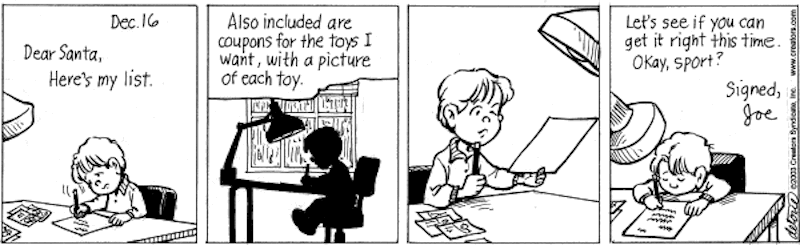
An old One Big Happy strip that recently came up in my comics feed:


Joe writes to Santa with a very specific gift list, with an accusatory flourish at the end (presupposing that in earlier years Santa had failed to honor Joe’s requests and telling Santa that now it’s time for the old guy to get it right) in which he addresses Santa as sport

This is one of those occasions where I pose questions that I’m in no position to answer, because I don’t have the resources to pursue them. I am an address terms guy — see the Page on this blog with links to my postings on the topic —  but sport isn’t a term I use myself, so I have no self-report data on it; and though dictionaries have some useful information on sport, they aren’t able to describe the complexities of usage of address terms like it; and, finally, sport is not one of the high-frequency address terms (like guy) that have gotten the attention of variationist sociolinguists, so we have no systematic data on the way it’s used.

Even so, my first response to Joe’s use was that it was odd. Somewhat antique, but more significantly, impertinent — treating Santa as if he were an equal, or in fact a subordinate. My impression is that Santa, in a somewhat old-fashioned way, might amiably address a little boy as sport, but little kids don’t talk to adults (especially powerful adults) that way. Such an impertinence would, however, fit right in with Joe’s challenge to Santa to get with the program of supplying Joe with the toys he’s asking for (well, demanding). Cheeky monkey.

(more…)

The vomiting and nauseated emojis

December 6, 2023

A posting in which I realize, once again, that an emoji (say, the vomiting (face) emoji) can look different on different platforms (in this case, Facebook vs. Microsoft Word), even though you use the same code to call it up — an effect that’s analogous to a letter of the alphabet (say, the lower-case letter whose English name is /ti/) looking different in different fonts (notably, being serifed in some, sans serif in others). And even more distantly analogous to a phoneme of a language, in a specifc position (say, /t/ after an accented vowel and before an unaccented syllable, as in battle and blotto), being pronounced differently in different social varieties of the language (as an voiceless stop in BrE but a voiced tap in AmE). Autres lieux, autres moeurs.

The emoji action went down this morning on Facebook, prompted by Gadi Niram getting set off by US Senator Tommy Tuberville’s having ceased his months-long blocking of a big pile of military promotions  (for a reason that has nothing to do with the merits of the promotions). The FB exchange:

(more…)

Slutty T-Rex

November 30, 2023

🐅 🐅 tiger tiger for ultimate November, also St. Andrew’s Day (Scotland’s national day); meanwhile, I bring you two dinosaurs trading ideas about popularity and sluttiness

A pair of Ryan North’s Dinosaur Comics strips, coming in succession on 11/10 and 11/13, in which T-Rex rambles on to his buddy Utahraptor about a fairly well-known paradoxical-sounding phenomenon in social networks, the friendship paradox. Actually, it applies more generally, and I’ll talk you through the (apparent) paradox in the general case. Yes, I’ll get to the comics, and to the way T-Rex uses the adjective slutty, but first let’s talk about your lunch partners.

The symmetric-relation paradox. Brace yourself for some mathematician-talk, but don’t despair: I’ll work up a concrete example (about you and your lunch partners) along the way.

Consider a a set N (for example, the set of people in a social network) and a symmetric relation R between members of N; R might be being friends with, say, or having gone to grade school with or — my concrete example — having had lunch with. Then for any member m of N (like you, for definiteness), define m’s R:N-cohort to be the set of members of N that m bears R to (like, the set of all your lunch partners), and m’s R:N-index to be the size of m’s R:N-cohort (like, how many lunch partners you’d had). Then it can be shown that, on average, the R:N-indices of members of m’s R:N-cohort are greater than m’s R:N-index — like, on average, the number of lunch partners your lunch partners have had is greater than the number of lunch partners you have had. Yes, it sounds paradoxical. But it’s provably so.

Now, listen up: what the symmetric-relation paradox does not say is that (all) your lunch partners have more lunch partners than you do. That would be genuinely paradoxical. All it says is that the (arithmetic) mean of their lunch-partner figures is higher than yours, which is a great deal less thrilling (though it still has a whiff of the perverse about it). So let’s look at the special case, the friendship paradox, where N is a social network and R is the being friends with relation (which is where T-Rex starts in his Dinosaur Comics ramble, before he goes on to the having had sex with relation (parallel to the having had lunch with relation) and to sluttiness, having had many sexual (rather than lunch) partners.

(more…)

James and the knock-knock joke

November 27, 2023

One Big Happy strip, recently in my comics feed:


(#1) James (mis-)takes Ruthie’s meta-commentary — her talk about what’s going on in her interaction with James — to be part of that interaction, to be her next move in the routine of the knock-knock joke, and shows that he understands that routine, by producing the appropriate next move in the routine

James might be a dirty-faced urchin, but he knows his joke routines. And, in the last panel, is probably wondering how on earth Ruthie’s going to make a pun out of jeezy-peezy-I-forgot-the-joke.

So: mastering the routine of the knock-knock-joke is one thing, but then the routine incorporates another type of joke, the pun joke, which has its own requirements. In addition, the knock-knock joke requires not just any pun, but a (phonologically) imperfect pun, the more distant the better, so that its punch line will have genuine surprise value.

(more…)

jack or jerk?

August 22, 2023

(It’s about vernacular masturbatory verbs, so it’s deemed not suitable for kids, and of course it’s not to the taste of the sexually modest.)

Why would anyone care whether a guy favors jack off or jerk off — or something else, like jag off or toss off or wank — as his masturbatory verb?

Street talk about sexual practices and unsavory bodily substances varies over time and place and context, differs from one speech community to another, just like all kinds of talk: wank and toss off are distinctly BrE, jag off distinctly AmE, and jack off and jerk off both seem to be originally AmE, though they’ve spread more widely; guys will have different preferences for vocabulary in this domain, mostly according to their personal experience with the verbs, and they’ll know that some guys use different verbs. Why doesn’t it stop at that?

Well, this is linguistic variation, and it pretty much never stops at that. There’s a general human inclination to believe that your own practices are the best ones, the right ones; and also a general human inclination to accept the practices of your community, which are likely to be supported by explicit teaching and advice, and even enforced with sanctions, as the best ones, the right ones.

So we find people deploring other people’s linguistic practices, often in extravagant terms (disgusting, ignorant, …), sometimes ascribing dubious or discreditable motives to other people’s choices (hypercorrection and varieties of avoidance are often cited, as are faddism, reflexive following of fashion, and misguided attempts to sound clever). Even for masturbatory verbs, where there’s no explicit teaching and no advice literature.

Now, one such example, in a recent Facebook exchange between Jeff Shaumeyer (a jerk-off user) and me (a jack-off user), which turns out to be surprisingly complex, because it involves a second-order effect, with responses to (first-order) critiques of the usage jerk off, that it’s too crude, too vivid (the imagery is of the jerking motion in masturbation, and in the jerking of the body in orgasm — jerk was used for ‘copulate with’ before it was extended to masturbation, and is still so used by some speakers). This critique has led to the idea that guys who use jack off do so (only) because they’re (fastidiously) avoiding the gutsy, authentically masculine jack off — a gratuitous attribution of motives that I stringently objected to.

(more…)

The grand jury’s cough drop

August 18, 2023

The political / medicinal pun RICO Law / Ricola: on Facebook on 8/15, Kyle Wohlmut passed along  — “meanwhile in Switzerland” — the 8/14 Mike Scollins titling RICO LAW of an image from the classic Ricola (Swiss cough drop) commercial:


Posted within minutes of the Georgia RICO indictments (see below)

Now to the commercially medicinal and the political-conspiratorial.

(more…)

Crotch pong

August 9, 2023

(Intimate talk about male bodies, mostly mine, in plain terms, though not so racy as to ban kids — but I will freely use the vernacular noun and verb piss, nouns dick and balls. In any case, some people will find the topic of crotch odor unsavory.)

I’d hoped to be able to post about meat dreams and crotch pong on the same day — just for the sound of the two off-color compounds together, but meat dreams took a lot longer than I’d expected (I somehow ended up in the 16th century), so crotch pong had to wait a day. So it goes.

(more…)

The ultimate party jockstrap

July 19, 2023

(The title should warn you about what’s coming. There will be talk — in generally decorous language, but still — about men’s bodies as objects of sexual desire and about man-on-man sex, so not recommended for kids or the sexually modest.)

Yesterday’s Daily Jocks e-mail sale ad:

ad copy:

The ultimate party jockstrap from Vaux! Crafted exclusively from breathable, lightweight athletic nylon/spandex material, Vaux Playa Jockstrap is guaranteed to keep you cool and looking sexy af 😈.

Now, these images are designed to focus the viewer’s gaze on the visual center of the image, the model’s amply filled jockstrap (embracing the object of the intended viewer’s sexual desire but also what’s on sale here) and then, inevitably, the model’s handsome face, because people are strongly face-oriented. Then you appreciate the model’s beautifully developed body and notice the angling of his body in what is in fact a conventional beefcake pose. Buy my clothes and you can become me, or at least fantasize about doing me.

I’ll go on to analyze how the ad drips with gay sex, but after I appreciated the promise of the model’s dick and balls in that jockstrap and the warmth of his gaze — I am, after all, a big ol’ fag, a gay man with a high sex drive and an inventive and diverse fantasy sex life — I just delighted in the beauty of the clothes, which made me smile with pleasure. Every man should wear such beautiful things. Not necessarily in a jockstrap, or of course in what looks like a shredded crop top (though those would be admirably functional as gay partywear — more on this below), but in briefs, swimsuits, shirts of all kinds, and shorts.

Now on to the sociocultural analysis …

(more…)

Comes in /perz/

July 5, 2023

A very much not-dead-yet posting to hold this space while I cope with an avalanche of posting material, plus my suddenly much improved medical condition (which is totally exhilarating). In any case, an old One Big Happy cartoon (originally from 9/4/14) in which Ruthie asks her defiantly working-class neighbor James to name something that comes in pairs, but James hears the homophone pears (both nouns pronounced /perz/ in my variety of English) and just can’t get shift his perspective:


Note James’s multiply non-standard negative existential construction in his ain’t no shoes

(more…)

Iddle-Do and Not Zarella

May 5, 2023

As a temporary diversion from some truly awful times in my life (which I will eventually post about), two reprised One Big Happy strips recently in my comics feed, in which Ruthie struggles to interpret language unfamiliar to her.

The strips.


(#1) The Iddle-Do Rule; which should lead us to reflect some on the distinction between circumstances in which “good enough for some purpose” — it’ll do — is the appropriate goal (the general case for most aspects of everyday social life) and the special cases in which a perfect performance is called for


(#2) Not Zarella cheese (with Not Zoball soup as a bonus); I note that Zarella is a fairly common Italian surname, which Ruthie (who is of Italian descent) might well be familiar with, so that  a cheese named after a Zarella wouldn’t be at all surprising

(more…)